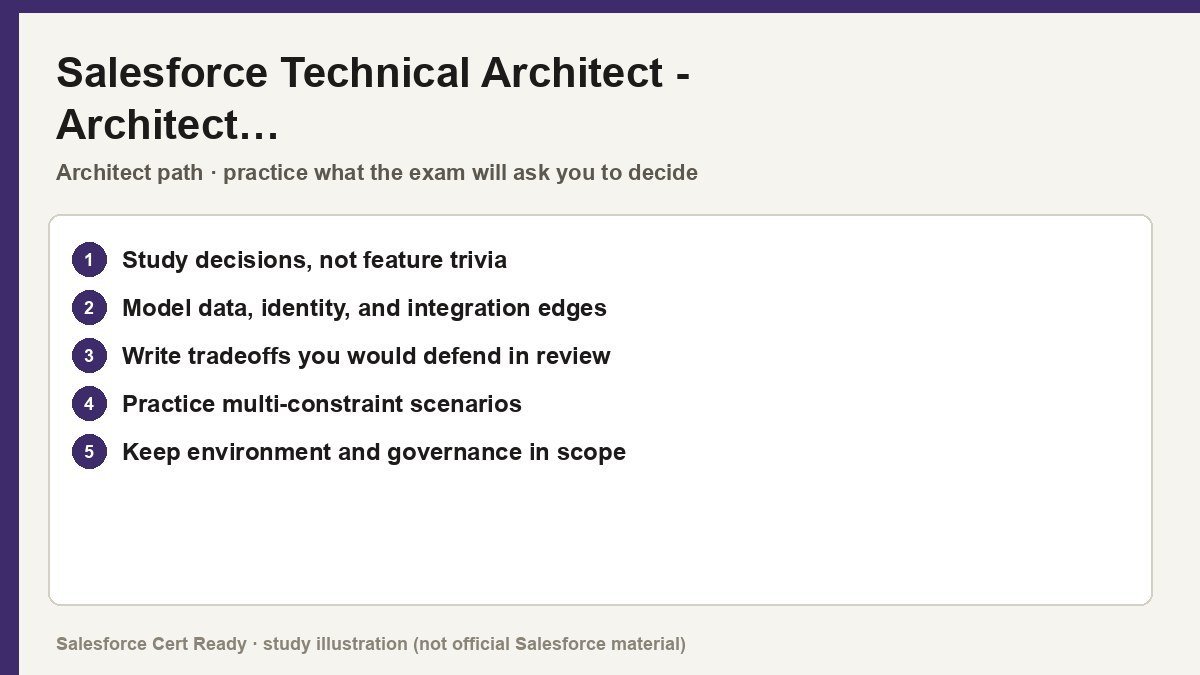
Study map for Salesforce Technical Architect – Architect…. Confirm objectives on current Salesforce sources.
Salesforce Technical Architect – Architect Review Board Exam
Catalog status checked July 19, 2026: Available.
Current credential snapshot
| Item | Current listing |
|---|---|
| Credential | Salesforce Technical Architect – Architect Review Board Exam |
| Track | Architect |
| Level in source inventory | Senior |
| Exam code in source inventory | CTA-Board |
| Price in source inventory | $6000 USD |
| Availability | Available |
Exam format, objectives, pricing, and prerequisites can change. Confirm those details in Salesforce’s current exam guide before purchasing or scheduling an exam.
Study overview
🏔️ This is the “mental Ironman” of the Salesforce ecosystem.Certified Technical Architect (CTA) – Review Board
The pinnacle of the Salesforce Architect journey, validating the ability to design and defend enterprise-grade solutions.
At a Glance
| Feature | Details |
|---|---|
| Exam Code | CTA-Board |
| Duration | ~4 hours (180m Prep, 45m Presentation, 40m Q&A) |
| Questions | 1 hypothetical business scenario |
| Passing Score | Qualitative evaluation by a panel of judges |
| Cost | $6,000 USD (Retakes: $2,250 – $3,000 USD) |
| Delivery | Online (Virtual Review Board) |
| Prerequisites | Application Architect, System Architect, and CTA Evaluation (Step 1) |
| Recommended Experience | 5+ years of implementation; 3+ years in an Architect role |
🎯 Who Should Take This – The Strategic Leader: You have moved beyond simple configuration and spend your days translating complex business chaos into scalable technical blueprints.
- The Enterprise Architect: You have led multiple complex deployments and are comfortable navigating the trade-offs between
LDVstrategies, integration patterns, and security models. - The Technical Defender: You can sit in a room with C-suite stakeholders and defend your architectural choices against skeptical questioning without breaking a sweat.
What You’ll Prove
This is not a multiple-choice test. It is a performance-based assessment that forces you to architect a complete enterprise ecosystem under intense time pressure and then justify every single click, code, and connector you’ve proposed. – You can architect end-to-end solutions that span multiple Salesforce clouds and external systems while respecting platform limits.
- You can communicate highly technical design trade-offs to non-technical business stakeholders effectively.
- You can mitigate technical risks by selecting the correct integration patterns and security mechanisms for global deployments.
- You can design a robust governance and delivery framework that ensures project success across the full software development lifecycle.
Exam Outline
| Domain | Weight | What’s Covered |
|---|---|---|
| Presentation | 35% | Clarity of solution, coverage of requirements, and logical flow of the architectural deck. |
| Design Defense | 35% | Justification of technical choices and the ability to handle objections from the board. |
| Board Q&A | 30% | Direct responses to deep-dive technical questions on security, data, and integration. |
💡 In Notion, convert each domain row into a toggle to nest your study notes underneath.
Suggested Study Path
- Master the Prerequisites. Complete the
Application ArchitectandSystem Architectpyramids first. These provide the fundamental domain knowledge required for the board. - Pass the Architect Evaluation. Treat Step 1 as a formal dry run. It is a 60-minute preparation and presentation session that validates you are ready for the full 6-hour marathon.
- Form a Study Group. Find 2-3 other candidates. You need peers to grade your diagrams and challenge your logic. Join community groups like “Ladies Be Architects” or the “Architect Ohana” Slack.
- Practice Mock Scenarios. Run at least 10–20 full-length mock scenarios. Focus on reading and solutioning within the 180-minute window. Speed in
Lucidchartis a non-negotiable skill. - Sharpen the Q&A. Record yourself explaining why you chose a specific integration pattern (e.g.,
Request and Replyvs.Fire and Forget). If you can’t explain the “why” in 30 seconds, you aren’t ready.
⚠️ Watch Out For – The “Skinny Table” Trap: Never suggest a technical solution—like Skinny Tables or Custom Indexes—unless you can explain exactly how they work and when they are triggered. Don’t open doors you can’t walk through.
- Diagramming Lag: Since the move to an all-online format, you must be proficient with digital tools. Hand-drawn artifacts are no longer accepted; your
Lucidchartspeed can make or break your prep time. - Ignoring the Persona: The board often acts as a C-level audience. If you get too bogged down in code-level details without addressing business value or ROI, you will lose the room.
- Time Mismanagement: Many great architects fail because they are slow readers. If you haven’t finished your
Data ModelandSystem Landscapewith 60 minutes left in prep, you’re in trouble.
🔗 Resources – Official Salesforce CTA Exam Guide
If you’re going to fail, fail because the scenario was impossible, not because you couldn’t draw a box fast enough. Now go find a study partner and start solutioning.
Official status sources
Catalog status last verified: 2026-07-19.