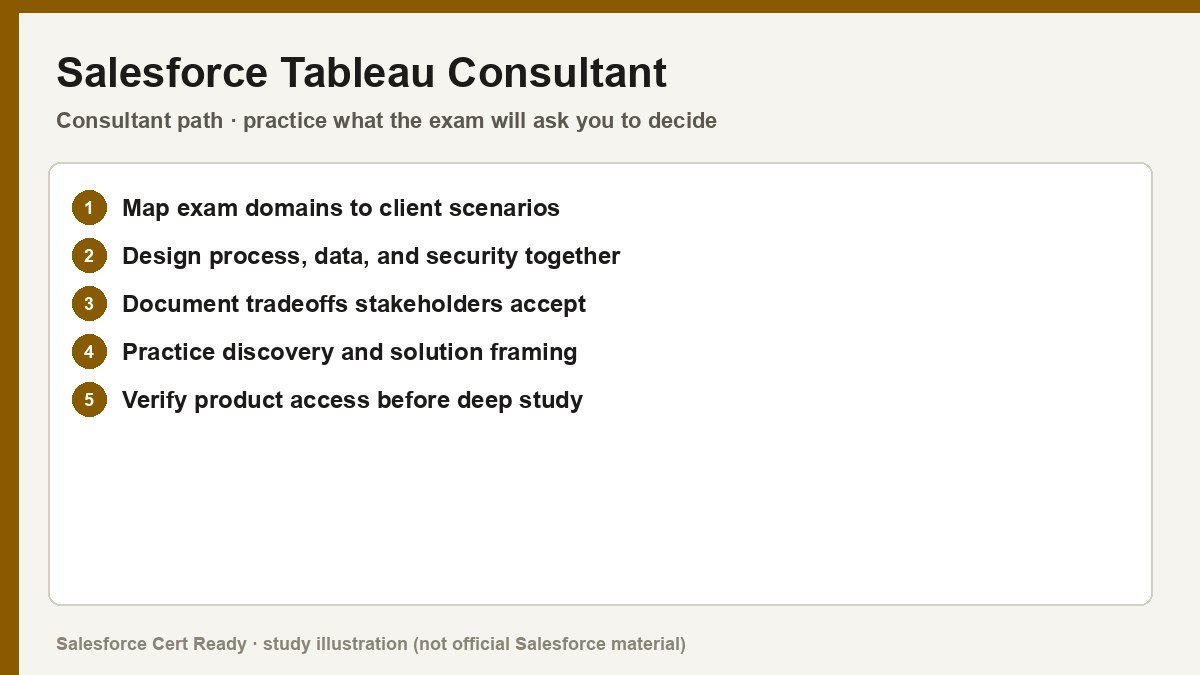
Study map for Salesforce Tableau Consultant. Confirm objectives on current Salesforce sources.
Salesforce Tableau Consultant
Catalog status checked July 19, 2026: Available.
Current credential snapshot
| Item | Current listing |
|---|---|
| Credential | Salesforce Tableau Consultant |
| Track | Consultant |
| Level in source inventory | Senior |
| Exam code in source inventory | Analytics-Con-301 |
| Price in source inventory | $200 USD |
| Availability | Available |
Exam format, objectives, pricing, and prerequisites can change. Confirm those details in Salesforce’s current exam guide before purchasing or scheduling an exam.
Study overview
📊 Strategy, technical depth, and the ability to solve client puzzles at scale.Salesforce Certified Tableau Consultant
The benchmark for professionals who architect end-to-end analytics solutions.
At a Glance
| Feature | Details |
|---|---|
| Exam Code | Analytics-Con-301 |
| Duration | 105 Minutes |
| Questions | 60 scored, up to 5 non-scored (Multiple-choice/Multiple-select) |
| Passing Score | 63% |
| Cost | $200 USD (Retake: $100) |
| Delivery | Online proctored or onsite testing center |
| Prerequisites | None |
| Recommended Experience | 1+ years as a Tableau Consultant or similar advisory role |
Who Should Take This
- The External Consultant: Professionals working for Salesforce Partners who need to translate messy business requirements into structured technical roadmaps.
- The Internal Architect: Lead analysts responsible for maintaining
Tableau ServerorTableau Cloudgovernance and performance across an entire enterprise. - The Data Strategist: Individuals who don’t just build charts but decide how data should be transformed, secured, and distributed to stakeholders.
What You’ll Prove
This certification validates that you aren’t just a “tool user” but a strategic advisor. You demonstrate the technical proficiency to manage the full lifecycle of a Tableau deployment, from initial discovery to final content governance. * You can recommend appropriate analytics delivery methods based on specific client constraints and infrastructure.
- You can architect complex data connections, choosing between
LivevsExtractand implementingTableau Bridgewhere necessary. - You can implement advanced
Row-Level Security (RLS)models and multi-layered calculation logic. - You can optimize workbook performance by identifying resource-intensive queries and resolving order-of-operations issues.
Exam Outline
| Domain | Weight | What’s Covered |
|---|---|---|
| Evaluate Current State | 22% | Business requirements, Tableau Cloud vs Tableau Server, and analytics maturity. |
| Plan and Prepare Data Connections | 22% | Tableau Prep, transformation strategies, RLS, and Virtual Connections. |
| Design and Troubleshoot | 40% | LOD Expressions, Table Calcs, performance recording, and advanced dashboarding. |
| Governance and Support | 16% | Permissions, data source certification, administrative views, and content lifecycle. |
💡 In Notion, convert each domain row into a toggle to nest your study notes underneath.
Suggested Study Path
- Master the Product Matrix: Document the fine differences between
Creator,Explorer, andViewerroles, as well as the feature parity between Cloud and Server. - Deep Dive into Calculations: Review
Tableau's Order of Operationsextensively. You must know exactly when aFixed LODfires versus aTable Calculation. - Practice Performance Tuning: Spend time with the
Performance Recorder. Learn to identify “heavy” dashboards caused by large images, too many filters, or complex string manipulations. - Build Security Scenarios: Set up a dummy environment to practice
Row-Level Securityusing entitlement tables and user functions. - Simulate Consulting Scenarios: This exam is heavily scenario-based. Don’t just memorize definitions; ask “In what situation would I recommend
Custom SQLover aRelationship?”
Watch Out For
- The All-or-Nothing Rule: Many questions are multiple-select (“Choose three”). There is no partial credit; you must identify every correct option to score the point.
- Prep vs. Database: A common pitfall is incorrectly identifying when to move data transformation upstream (to the DB/ETL layer) versus handling it within
Tableau Prep. - Ambiguous Requirements: Expect questions that provide “missing context.” Your job is to select the most “consultant-like” best practice even when the scenario feels incomplete.
Resources
- Official Exam Guide
- Tableau Help Documentation
- Tableau Blueprint for Governance
- Visual Analysis Best Practices Guide
Go pass this thing so you can finally charge the “Consultant” rates you deserve. Just remember: if the dashboard is slow, it’s probably your LOD expressions.
Official status sources
Catalog status last verified: 2026-07-19.