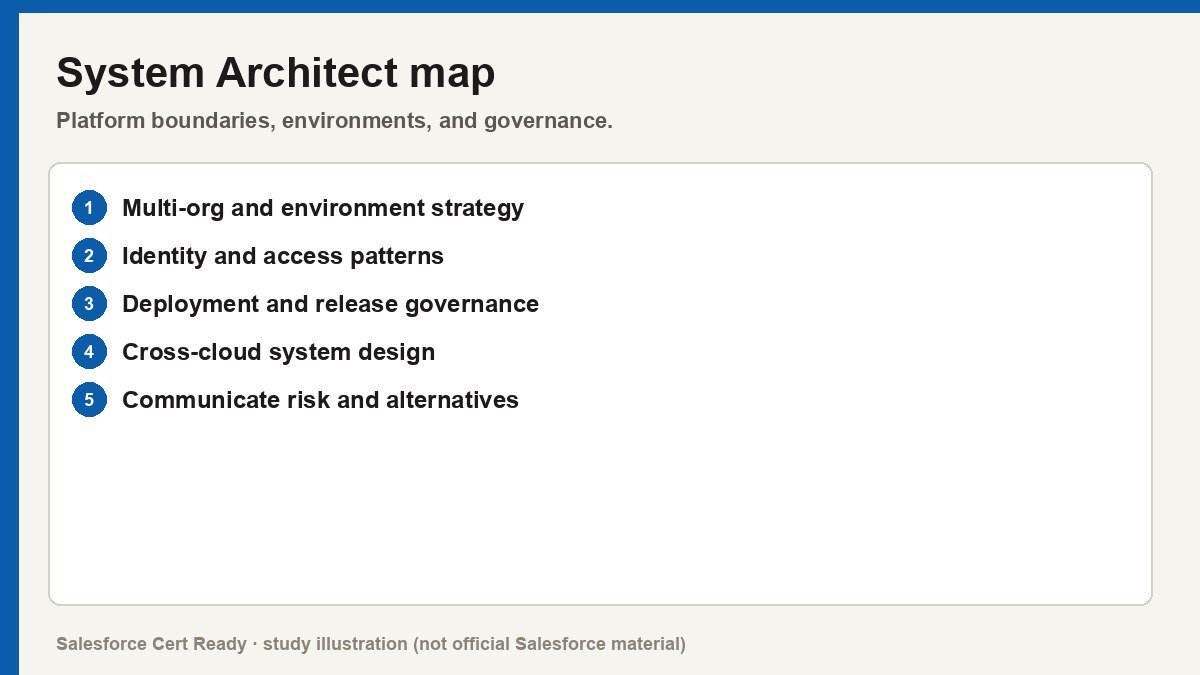
Think in systems: identity, environments, and change control.
Salesforce System Architect
Catalog status checked July 19, 2026: Available.
Current credential snapshot
| Item | Current listing |
|---|---|
| Credential | Salesforce System Architect |
| Track | Architect |
| Level in source inventory | Senior |
| Exam code in source inventory | Sys-Arch |
| Price in source inventory | $0 USD |
| Availability | Available |
Exam format, objectives, pricing, and prerequisites can change. Confirm those details in Salesforce’s current exam guide before purchasing or scheduling an exam.
Study overview
🏗️ Build the bridge between off-platform systems and the Salesforce core with confidence.Salesforce Certified System Architect
The elite credential for masters of integration, identity, and the development lifecycle.
At a Glance
| Feature | Details |
|---|---|
| Exam Code | Sys-Arch |
| Duration | N/A (Automatically granted upon meeting prerequisites) |
| Questions | N/A |
| Passing Score | N/A |
| Cost | $0 (After paying for prerequisite exams) |
| Delivery | Credential issued via Trailhead |
| Prerequisites | Platform Developer I, Integration Architect, Identity and Access Management Architect, Development Lifecycle and Deployment Architect |
| Recommended Experience | 5-8 years on the platform with cross-system design expertise |
Who Should Take This
- Senior Developers looking to transition into architectural roles by proving they understand how code impacts the broader system landscape.
- Technical Leads responsible for managing complex deployments, governance, and environment strategies across multiple teams.
- Integration Specialists who need to validate their expertise in connecting Salesforce to external enterprise systems securely and at scale.
- Aspiring CTAs who are checking off the mandatory domain architect requirements for the Review Board.
What You’ll Prove
This certification validates that you have moved beyond “building in a silo” to managing the entire technical ecosystem. You demonstrate mastery over how data flows in and out of the platform, how users are authenticated safely, and how changes are moved through environments without breaking production. * You can design end-to-end integration patterns that respect platform limits and enterprise security standards.
- You can implement complex identity solutions like
Single Sign-On (SSO)andOAuthflows to ensure seamless user access. - You can govern the release management process, utilizing
Salesforce DX, version control, and automated testing to maintain stability. - You can secure access between systems while maintaining high performance and data integrity.
📚 Exam Outline
Since this is a composite “Domain Architect” credential, your mastery is tested through its four constituent exams.| Domain | Weight | What’s Covered |
| :
- | :
| :
— |
| Integration Architecture | 25% | API selection, integration patterns, error handling, and middleware. |
| Identity & Access Management | 25% | Authentication, authorization, SSO, and external identity providers. |
| Development Lifecycle | 25% | Sandbox strategy, CI/CD, governance, and deployment tools. |
| Platform Development | 25% | Apex, Lightning Web Components, and programmatic business logic. |
💡 In Notion, convert each domain row into a toggle to nest your study notes underneath.
Suggested Study Path
- Clear the PD1 Hurdle. Secure your
Salesforce Certified Platform Developer Ifirst to establish your programmatic foundation. - Master the Lifecycle. Tackle the
Development Lifecycle and Deployment Architectexam next; it’s often cited as the most approachable of the architect-level trio. - Deep Dive into Identity. Study
OAuthflows andSAMLextensively. This is usually the most technical challenge in the path. - Solve for Integration. Close out with
Platform Integration Architect, focusing on when to useRemote Process Invocationvs.Change Data Capture. - Verify the Stack. Once all four prerequisites are reflected in your Trailhead profile, the
System Architectcredential will be issued automatically.
Watch Out For
- The Multi-Select Trap. Unlike entry-level exams, architect-level questions often have 4-5 options with multiple correct answers that require deep nuanced understanding.
- Over-Engineering Integrations. Don’t default to code; the exam expects you to know when a declarative solution or a standard API is the superior architectural choice.
- Identity Terminology Confusion. Mixing up the roles of the
Service Provider(SP) and theIdentity Provider(IdP) is a quick way to fail the Identity exam. - Ignoring Governance. The
Development Lifecycleexam isn’t just about tools; it’s about the “people and process” side of architecture, including Center of Excellence (CoE) structures.
Resources
- Official Salesforce Architect Pyramid Guide
- Trailmix: Architect Journey – Integration Architecture
- Trailmix: Architect Journey – Identity and Access Management
- Architect Journey: Development Lifecycle and Deployment
Stop building features and start designing systems. You’re halfway to the pyramid’s peak, so don’t trip on the identity flows now.
Official status sources
Catalog status last verified: 2026-07-19.