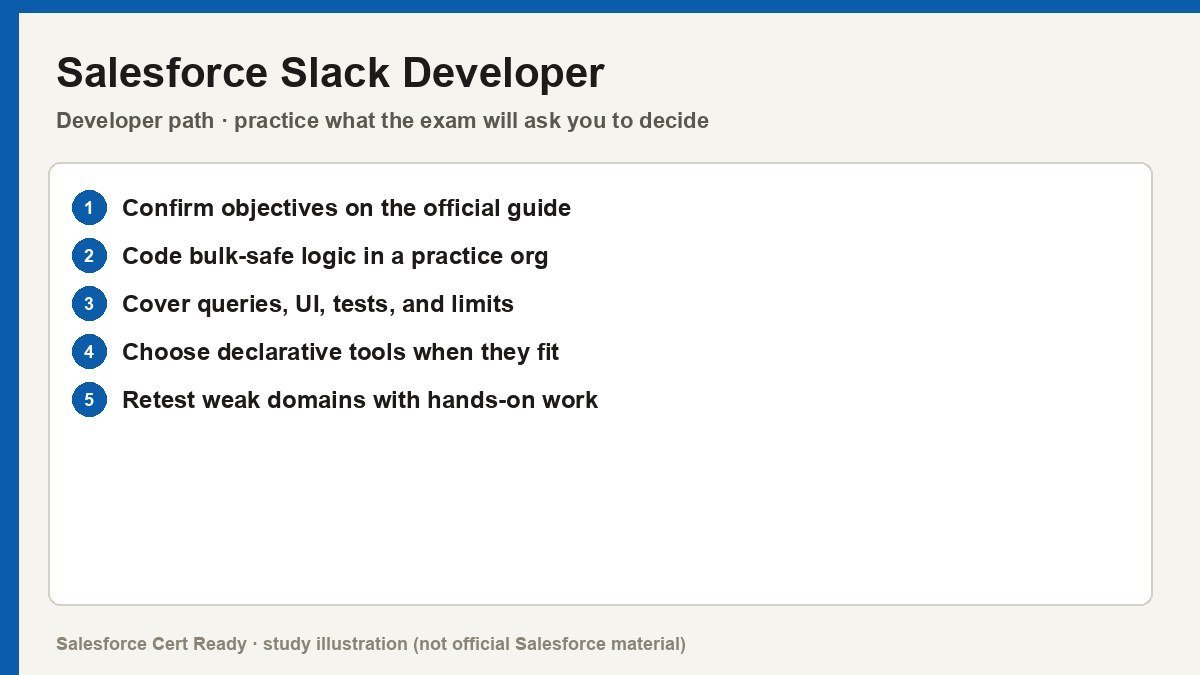
Study map for Salesforce Slack Developer. Confirm objectives on current Salesforce sources.
Salesforce Slack Developer
Catalog status checked July 19, 2026: Available.
Current credential snapshot
| Item | Current listing |
|---|---|
| Credential | Salesforce Slack Developer |
| Track | Developer |
| Level in source inventory | Mid |
| Exam code in source inventory | Slack-Dev-201 |
| Price in source inventory | $200 USD |
| Availability | Available |
Exam format, objectives, pricing, and prerequisites can change. Confirm those details in Salesforce’s current exam guide before purchasing or scheduling an exam.
Study overview
⚡ Build beyond the bot and master the Slack API ecosystem.Salesforce Certified Slack Developer
The definitive credential for engineers architecting custom apps and integrations on the Slack platform.
At a Glance
| Feature | Details |
|---|---|
| Exam Code | Slack-Dev-201 |
| Duration | 90 minutes |
| Questions | 60–65 (multiple-choice or multiple-select) |
| Passing Score | 67% |
| Cost | $200 USD ($100 USD retake) |
| Delivery | Online proctored or onsite testing center |
| Prerequisites | None |
| Recommended Experience | 6–12 months building Slack apps and working with Slack APIs |
Who Should Take This
- Full-Stack Developers looking to specialize in the “operating system of work” by building custom internal tools or public-facing apps.
- Salesforce Developers tasked with bridging the gap between Customer 360 and the Slack interface using Bolt or custom middleware.
- Solution Architects who need to design scalable, secure, and performant integration patterns for Enterprise Grid environments.
- Platform Engineers focused on automating organizational overhead through the SCIM, Audit Logs, and Admin APIs.
What You’ll Prove
This certification validates that you aren’t just sending “Hello World” messages to a webhook. It confirms you can handle complex asynchronous event delivery, manage granular OAuth scopes, and optimize for high-traffic environments. * You can implement the Web API, Events API, and Socket Mode while identifying the correct use case for each delivery method.
- You can design sophisticated user interfaces using
Block Kitacross various surfaces like Modals, App Home, and Messages. - You can manage secure token storage and the
OAuthinstallation flow to ensure enterprise-grade security. - You can optimize app performance by handling rate limits and designing for the specific architecture of
Enterprise Grid. - You can automate workspace administration using the
SCIM APIandAudit Logs APIto maintain compliance and governance.
Exam Outline
| Domain | Weight | What’s Covered |
|---|---|---|
| Apps in the Slack Platform | 7% | Surfaces (Modals, App Home), app collaboration, and automation strategy. |
| Interactive Flow Design | 20% | Block Kit, workflow building, interactive components, and user entry points. |
| Slack APIs: Workflows | 13% | Web API, Events API, Socket Mode vs. HTTP, and handling rate limits. |
| User Experience | 8% | Designing for simplicity and alignment with Slack’s UX principles. |
| Design for Security | 19% | OAuth flow, granular scopes, secure token management, and data protection. |
| Design for Scale | 9% | Enterprise Grid sandboxes, Slack Connect, and multi-workspace architecture. |
| Developer Tools | 5% | Bolt framework, Block Kit Builder, and Slack Developer Tools (SDT). |
| Admin & Management APIs | 12% | SCIM API, Audit Logs API, Discovery API, and Admin automation. |
| Distributing Your App | 7% | Single-workspace vs. distributed apps and App Directory submission. |
💡 In Notion, convert each domain row into a toggle to nest your study notes underneath.
Suggested Study Path
- Review the official Guide and verify the latest weightings and technical requirements for the
Slack-Dev-201exam. - Complete the Developer Trailmix on Trailhead to establish a baseline of the terminology and standard Salesforce-Slack integration patterns.
- Build a Slack app using the
Boltframework (Node.js, Python, or Java) that utilizesSocket ModeandBlock Kitto understand real-time interactions. - Master the Admin APIs by documenting the differences between the
SCIM APIfor identity and theDiscovery APIfor compliance archiving. - Simulate the OAuth flow manually to understand how scopes are requested and how to safely store user vs. bot tokens.
- Take practice exams to get used to the adaptive timing and the specific phrasing of scenario-based development questions.
Watch Out For
- Legacy vs. Current API terminology. The exam will test your ability to differentiate between older Slack methods and modern, granular-scope apps.
- The “Adaptive Ending” feature. Don’t panic if your exam ends at question 45; the system concludes as soon as a pass/fail score is mathematically determined.
- Socket Mode limitations. Know exactly when to use
Socket Mode(behind firewalls/local dev) versus standardHTTPendpoints for production-scale apps. - Rate Limit tiers. Different API methods have different tiers (Tier 1-4); knowing which methods are most restrictive is key for the “Design for Scale” domain.
Resources
- Official Salesforce Slack Developer Exam Guide
- Slack API Documentation
- Trailmix: Prepare for Your Slack Developer Credential
- Block Kit Builder
- Slack Community Forum
Stop building static bots and start building the future of work. If you fail, just remember that even the most complex apps started with a single 429 Too Many Requests error.
Official status sources
Catalog status last verified: 2026-07-19.