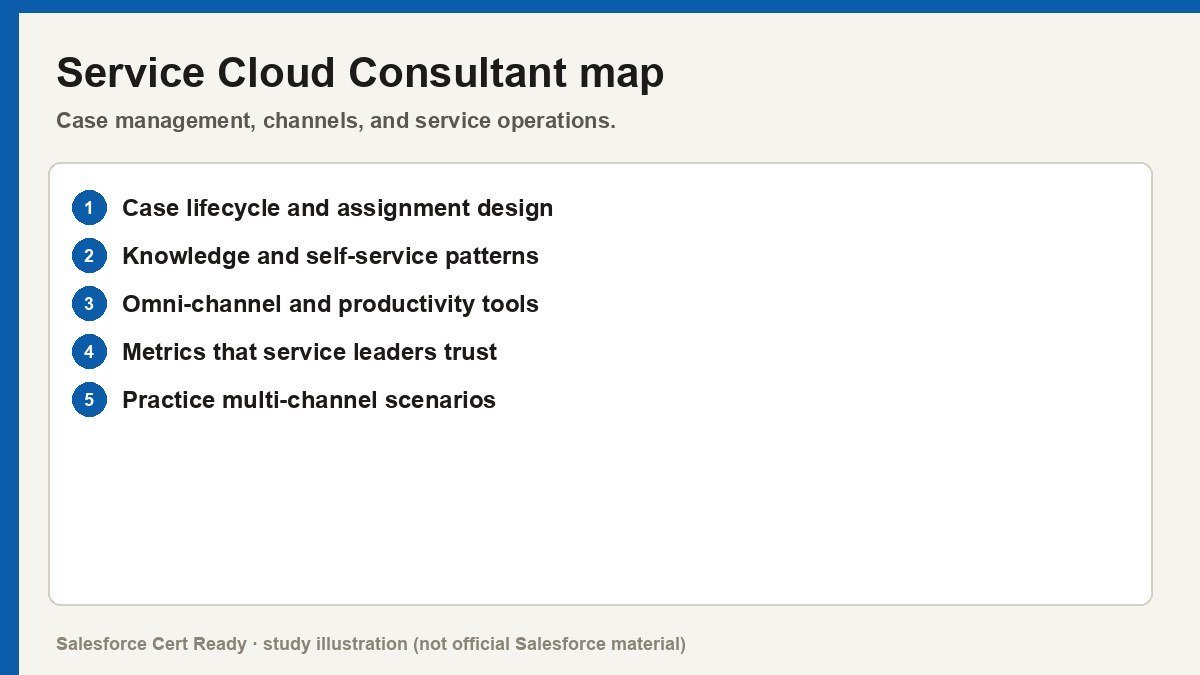
Design service operations you could defend to a client.
Salesforce Service Cloud Consultant
Catalog status checked July 19, 2026: Available.
Current credential snapshot
| Item | Current listing |
|---|---|
| Credential | Salesforce Service Cloud Consultant |
| Track | Consultant |
| Level in source inventory | Mid |
| Exam code in source inventory | Service-Con-201 |
| Price in source inventory | $200 USD |
| Availability | Available |
Exam format, objectives, pricing, and prerequisites can change. Confirm those details in Salesforce’s current exam guide before purchasing or scheduling an exam.
Study overview
🛠️ Stop reacting to tickets and start architecting solutions.Salesforce Certified Service Cloud Consultant
Master the art of the contact center and high-scale customer support.
At a Glance
| Feature | Details |
|---|---|
| Exam Code | Service-Con-201 |
| Duration | 105 Minutes |
| Questions | 60 scored, 5 unscored |
| Passing Score | 67% |
| Cost | USD 200 (Retake: USD 100) |
| Delivery | Proctored (Online or In-center) |
| Prerequisites | Salesforce Certified Administrator |
| Recommended Experience | 12-18 months implementing Service Cloud |
Who Should Take This
- The Experienced Consultant: You have already spent a year or more navigating the complexities of contact centers and implementing
Service Cloudsolutions for diverse clients. - The Senior Admin: You have moved beyond basic user management and are now designing complex case lifecycles,
Omni-Channelrouting, andKnowledgearchitectures. - The Solution Architect: You need to prove you can translate messy business requirements into scalable support models that balance agent productivity with customer satisfaction.
What You’ll Prove
This exam isn’t just about knowing where the buttons are; it’s about making the right architectural trade-offs in a high-pressure support environment. You will demonstrate that you understand the “why” behind the “how.” * You can design end-to-end case management lifecycles that incorporate Entitlements, Milestones, and automated escalation logic.
- You can architect multi-channel intake strategies including
Email-to-Case,Web-to-Case, andDigital Engagementvia chat and social media. - You can implement
Salesforce Knowledgebest practices, from data category design to article versioning and community exposure. - You can configure the
Service Consoleto maximize agent efficiency using tools likeMacros,Quick Text, andHistorycomponents. - You can interpret contact center KPIs and translate them into actionable
ReportsandDashboardsfor stakeholders.
Exam Outline
| Domain | Weight | What’s Covered |
|---|---|---|
| Industry Knowledge | 12% | Contact center KPIs, metrics (SLA, CSAT), and business challenges. |
| Implementation Strategies | 12% | Consulting engagement phases, deployment strategies, and data migration. |
| Service Cloud Solution Design | 15% | Customer vs. Agent experience, security, and scalability trade-offs. |
| Knowledge Management | 12% | Article lifecycle, KCS methodology, and data category configuration. |
| Intake & Interaction Channels | 13% | Omni-Channel, Messaging, Service Cloud Voice, and AI Agents. |
| Case Management | 13% | Entitlements, Milestones, SLAs, and case deflection strategies. |
| Contact Center Analytics | 13% | Stakeholder reporting, dashboard design, and metric interpretation. |
| Integrations | 10% | Core integrations, third-party CTI, and external data sources. |
💡 In Notion, convert each domain row into a toggle to nest your study notes underneath.
Suggested Study Path
- Verify your prerequisites by ensuring your
Salesforce Administratorcredential is active and you have a solid grasp of core platform security. - Conquer the Superbadge by completing the
Service Cloud Specialiston Trailhead; it’s the closest you’ll get to the hands-on complexity found in exam scenarios. - Internalize the Consultant mindset by studying the official Exam Guide and focusing on the “Consulting Engagement” phases (Plan, Analyze, Design, Build, Test, Deploy).
- Deep-dive into Knowledge because the lifecycle—from Draft to Archive—and the specific nuances of
Data Categoriesoften trip up those who only use standard objects. - Master Entitlements and Milestones by building a complex SLA model in a developer org to see exactly how business hours and triggers interact.
- Simulate the environment using high-quality practice exams to get used to the 105-minute clock and the “choose the BEST answer” style of questioning.
Watch Out For
- Email-to-Case vs. On-Demand: Know the exact limits (25MB attachments) and infrastructure requirements for each. They aren’t interchangeable in a scenario.
- The “Best” Answer Trap: Many questions present three technically “correct” ways to do something, but only one is the standard, scalable, “Salesforce-way” for a consultant.
- Knowledge Data Categories: Pay close attention to how categories control visibility versus how
Sharing SettingsorUser Profilepermissions work. - Omni-Channel Routing Models: Understand the difference between
Least ActiveandMost Availableand which one fits a specific business requirement.
Resources
- Official Salesforce Exam Guide
- Prepare for Your Service Cloud Consultant Credential (Trailmix)
- Service Cloud PDF Documentation
- Salesforce Ben Study Tips
Go pass this thing so you can stop explaining why Case Assignment Rules aren’t working. If you can handle a Tier 3 escalation, you can handle 60 multiple-choice questions.
Official status sources
Catalog status last verified: 2026-07-19.