Learn the sales process Salesforce is built to support.
Salesforce Sales Foundations
Catalog status checked July 19, 2026: Available.
Current credential snapshot
| Item | Current listing |
|---|---|
| Credential | Salesforce Sales Foundations |
| Track | Foundations |
| Level in source inventory | Entry |
| Exam code in source inventory | Sales-101 |
| Price in source inventory | $75 USD |
| Availability | Available |
Exam format, objectives, pricing, and prerequisites can change. Confirm those details in Salesforce’s current exam guide before purchasing or scheduling an exam.
Study overview
🤝 Master the customer-centric sales cycle with a foundational credential that moves the needle.Salesforce Certified Sales Foundations
Bridging the gap between general sales excellence and Salesforce-powered execution.
At a Glance
| Feature | Details |
|---|---|
| Exam Code | Sales-101 |
| Duration | 105 minutes |
| Questions | 40 multiple-choice (+5 unscored) |
| Passing Score | 70% |
| Cost | $75 USD |
| Delivery | Onsite or Online Proctored |
| Prerequisites | None |
| Recommended Experience | 0-6 months (Salesforce) or 6 months – 3 years (Sales roles) |
🎯 Who Should Take This – Early-Career Sales Reps looking to validate their understanding of the modern sales lifecycle and how it maps to CRM technology.
- Career Switchers moving into the Salesforce ecosystem who need a credible starting point before tackling more advanced consultant tracks.
- Sales Operations Beginners who require a high-level view of account strategy, pipeline mechanics, and forecasting accuracy.
- Business Students wanting to prove they understand value-based selling and customer-centric discovery methodologies.
What You’ll Prove
This certification validates that you aren’t just pushing products—you’re solving business problems. It tests your ability to navigate the full customer journey while maintaining data integrity within the Salesforce platform. – You can identify and qualify prospects by analyzing their business goals, challenges, and key KPIs.
- You can manage complex deals by aligning with account teams, executive sponsors, and multi-stakeholder maps.
- You can execute value-based discovery to build a business case that focuses on
ROIandTCOreduction. - You can maintain a healthy pipeline by accurately tracking stage velocity and addressing bottlenecks.
- You can forecast revenue outcomes with confidence using historical trends and objective deal data.
Exam Outline
| Domain | Weight | What’s Covered |
|---|---|---|
| Planning | 21% | Territory planning, account engagement strategy, sales quotas, and persona mapping. |
| Customer Engagement | 15% | Thought leadership, building credibility, relationship nurturing, and product adoption. |
| Deal Management | 37% | Full sales lifecycle (qualification to close), value selling, and handling objections. |
| Pipeline Management | 12% | Pipeline generation, health analysis, data integrity, and stage velocity. |
| Forecasting | 6% | Accuracy assessment, risk/opportunity measurement, and key inputs for the forecast. |
| Customer Success | 9% | Order fulfillment, post-sale journey, retention, and measuring realized value. |
💡 In Notion, convert each domain row into a toggle to nest your study notes underneath.
Suggested Study Path
- Review the official guide to understand the specific syllabus and weights. Don’t skip the “Planning” section just because you think you know how to sell; Salesforce’s definitions matter.
- Complete the official Trailmix “Prepare for Your Salesforce Certified Sales Foundations Certification” on Trailhead. It’s about 35 minutes of curated content that covers the high-level theory.
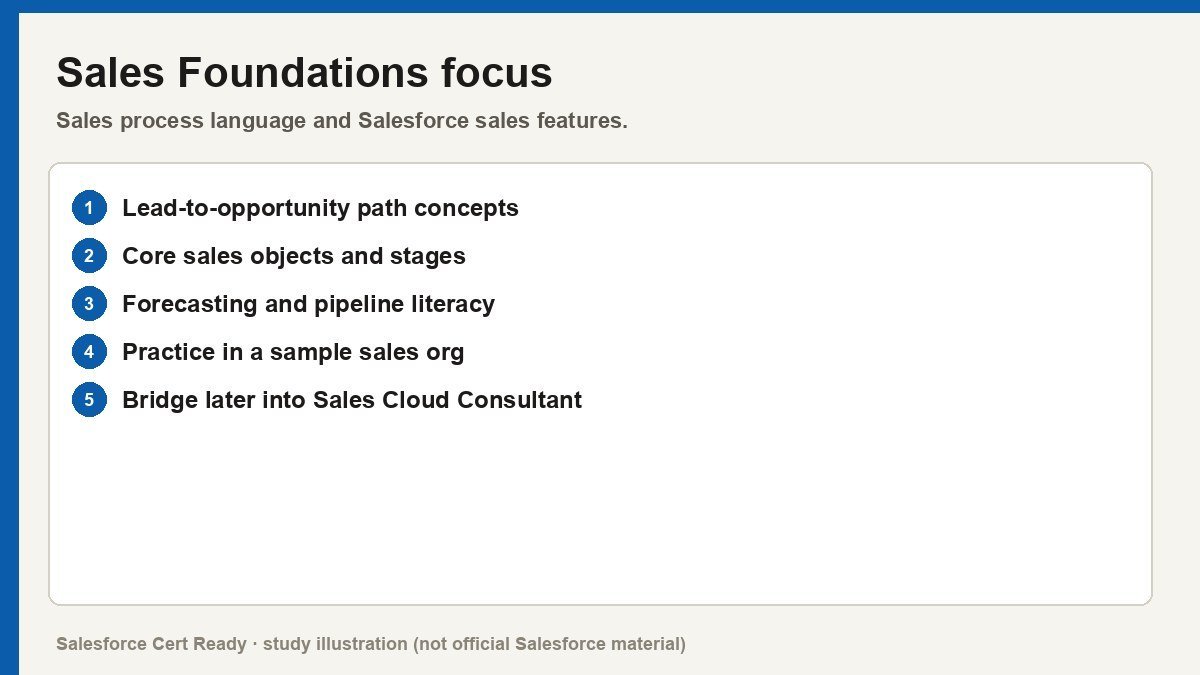
- Internalize the sales process from Lead to Opportunity to Closed-Won. You should be able to explain what happens at each stage and what data is required to move a deal forward.
- Focus on Deal Management because it accounts for 37% of your score. Understand the nuances of “Value Selling” versus “Feature Selling.”
- Take timed practice exams to get used to the scenario-based question style. Salesforce loves to ask “What is the best next action?” when a deal stalls or an objection is raised.
- Review Business Reviews and post-sale concepts. Remember that for this cert, the sale doesn’t end at the contract—it ends at customer value realization.
⚠️ Watch Out For – The “Check-In” Trap: In scenario questions, contacting a customer only right before a renewal is always the wrong answer. Salesforce prizes regular business reviews over “panic mode” renewals.
- Generic vs. Persona-based messaging: If a question asks how to engage a CEO vs. a technical lead, the correct answer usually involves tailoring KPIs to their specific role.
- Distractor Features: Some answers will list product features that don’t exist. If you don’t recognize the name of a specific “automated negotiation bot,” it’s likely a distractor.
- Over-selling features: When a customer has an objection, the answer is almost never “show them more features.” It’s usually “ask clarifying questions to find the root cause.”
🔗 Resources – Official Salesforce Exam Guide
- Official Trailmix: Prepare for Sales Foundations
- Trailblazer Community: Certification Resources
- Salesforce 360 Blog: Objection Handling Best Practices
Get the credential, then get back to closing. If you can handle a Discovery call, you can handle 40 multiple-choice questions.
Official status sources
Catalog status last verified: 2026-07-19.