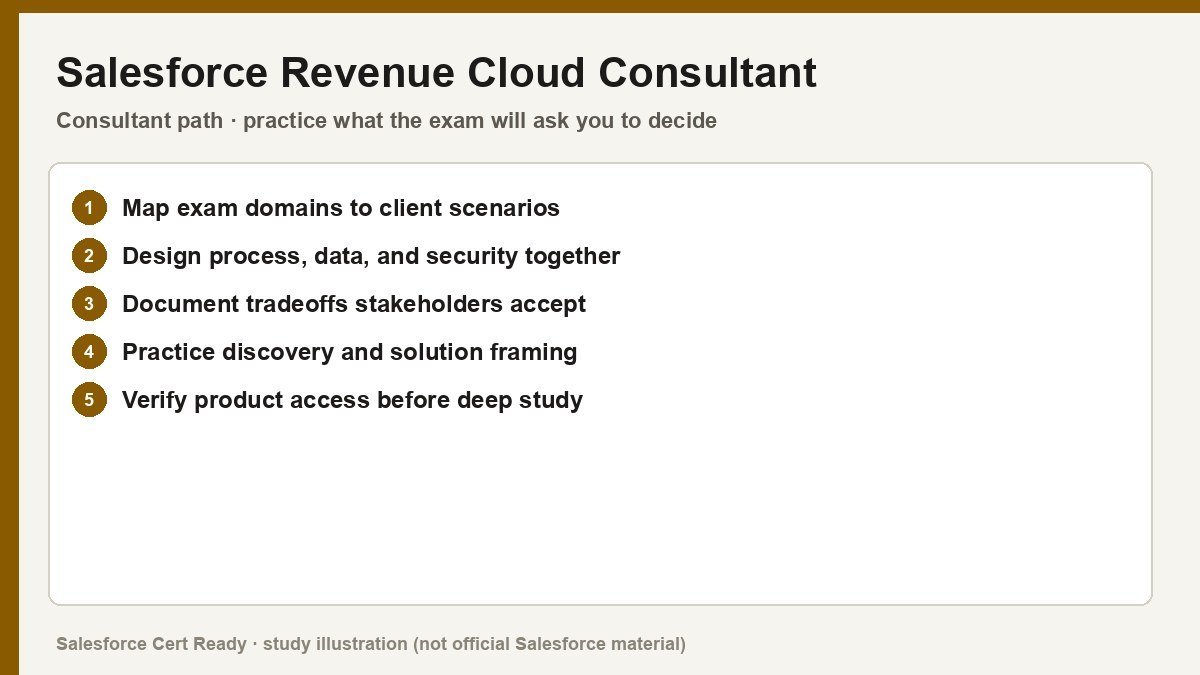
Study map for Salesforce Revenue Cloud Consultant. Confirm objectives on current Salesforce sources.
Salesforce Revenue Cloud Consultant
Catalog status checked July 19, 2026: Available.
Current credential snapshot
| Item | Current listing |
|---|---|
| Credential | Salesforce Revenue Cloud Consultant |
| Track | Consultant |
| Level in source inventory | Mid |
| Exam code in source inventory | Rev-Con-201 |
| Price in source inventory | $200 USD |
| Availability | Available |
Exam format, objectives, pricing, and prerequisites can change. Confirm those details in Salesforce’s current exam guide before purchasing or scheduling an exam.
Study overview
💰 Revenue flows through the entire lifecycle, and now you’re the one who maps it.Salesforce Certified Revenue Cloud Consultant
Mastering the Product-to-Cash journey on the core Salesforce platform.
At a Glance
| Feature | Details |
|---|---|
| Exam Code | Rev-Con-201 |
| Duration | 105 Minutes |
| Questions | 60 Multiple-choice (plus 5 unscored) |
| Passing Score | 63% |
| Cost | $200 USD ($100 retake fee) |
| Delivery | Online proctored or Onsite testing center |
| Prerequisites | None |
| Recommended Experience | 2–3 years of Product-to-Cash domain experience |
Who Should Take This
- Implementation Consultants: Professionals responsible for the hands-on configuration of
CPQ,Billing, andOrder Managementto meet specific business requirements. - Solution Architects: Individuals who design scalable technical architectures that unify sales, partners, finance, and operations on the core platform.
- Revenue Operations Leads: Experts focused on optimizing the end-to-end lifecycle, from initial quoting to final revenue recognition and asset management.
What You’ll Prove
This credential validates your ability to lead discovery sessions and translate complex business needs into a functional Revenue Cloud solution. It proves you understand the intersection of sales automation and financial accuracy. * You can architect scalable solutions using native objects, relationships, and APIs while documenting technical specifications for development teams.
- You can implement the full
Product-to-Cashlifecycle, including complex product bundles, pricing procedures, and automated invoicing. - You can leverage advanced platform features like
OmniStudio,Business Rules Engine (BRE), andContext Serviceto drive guided user experiences. - You can manage the transition from initial implementation through testing, deployment, and long-term adoption using
Agentforce-ready capabilities.
Exam Outline
| Domain | Weight | What’s Covered |
|---|---|---|
| Revenue Cloud Platform Concepts | 18% | Context Service, OmniStudio, BRE, and API descriptions; native reporting and KPI dashboards. |
| Implementation Readiness | 14% | Licenses, permission sets, scope of work, project planning, and stakeholder alignment. |
| Catalog Management | 16% | Product catalog configuration, management, and foundational data models. |
| Configure, Price, Quote | 18% | Product Configurator attributes, pricing procedures, and Agentforce quoting scenarios. |
| Asset Management | 16% | Core asset concepts, lifecycle management, and out-of-the-box functionality. |
| Contracts and Orders | 11% | Salesforce Contracts and Order Management workflows and integration touchpoints. |
| Invoice Management | 7% | Invoicing capabilities, billing logic, and standard objects within the revenue ecosystem. |
💡 In Notion, convert each domain row into a toggle to nest your study notes underneath.
Suggested Study Path
- Master the Core Objects. Focus on the relationship between
Product2,PricebookEntry,Quote,Order, andInvoiceto understand how data flows. - Spin up a Developer Org. Use the dedicated
Revenue Cloudtrial org to practice configuring product bundles and applying discounting rules. - Study the Automation Tools. Get comfortable with
OmniStudiofor guided flows and theBusiness Rules Enginefor complex pricing logic. - Review Agentforce Integration. Understand specifically how AI agents interact with the quoting process and generate accurate pricing.
- Analyze Scenario-Based Questions. Practice evaluating business requirements to identify when to use out-of-the-box features versus custom
APIs. - Take a Mock Exam. Use the final week to build your pacing for the 105-minute limit and identify any remaining knowledge gaps in
Asset Management.
Watch Out For
- The “Core” Distinction: This exam focuses on
Revenue Cloudbuilt on the core Salesforce platform; don’t confuse legacy Managed Package behaviors with these native features. - Licensing and Permissions: Pay close attention to which
Permission Set Licenses (PSLs)are required for specific features likeOmniStudioorBilling. - Product-to-Cash Gaps: Ensure you don’t just study
CPQ; theAsset ManagementandInvoice Managementsections carry significant weight for their size. - New Release Features: The exam aligns with the Summer ’25 Release; make sure your knowledge of
AgentforceandContext Serviceis up to date.
Resources
- Official Exam Guide
- Revenue Cloud Consultant Trailmix
- Developer Org Signup
- Salesforce Help & Documentation
Get the data model right or the finance team will find you. Good luck, and don’t let your certification expire next year.
Official status sources
Catalog status last verified: 2026-07-19.