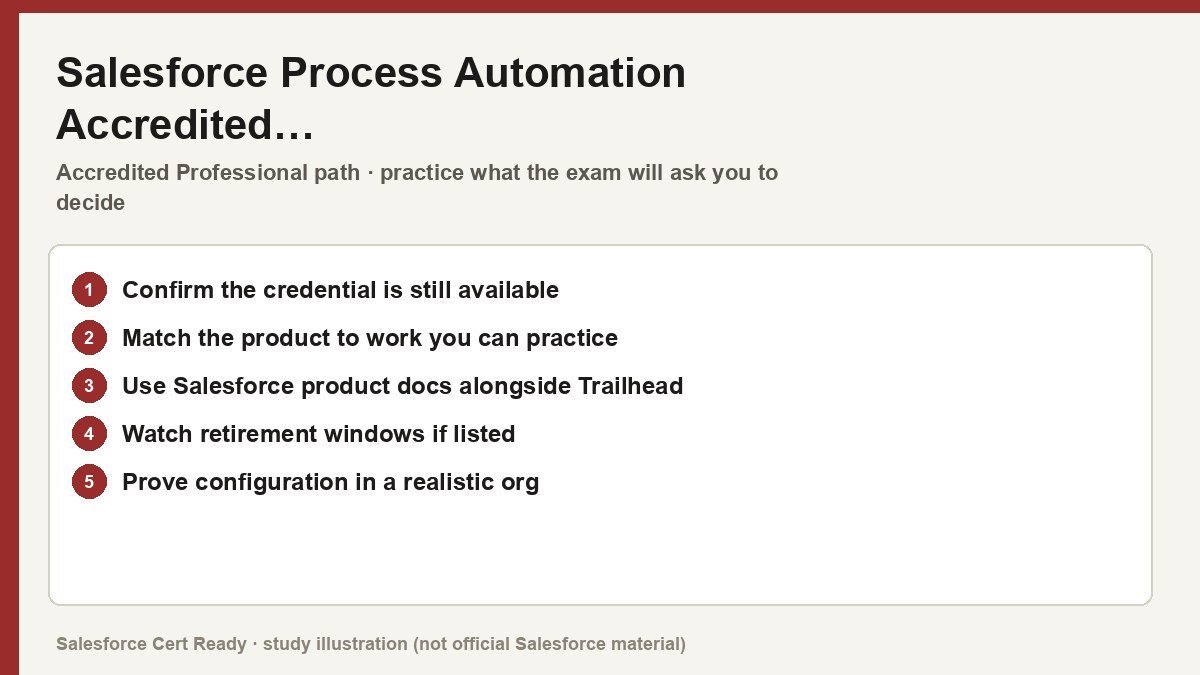
Study map for Salesforce Process Automation Accredited…. Confirm objectives on current Salesforce sources.
Salesforce Process Automation Accredited Professional
Catalog status checked July 19, 2026: Available; scheduled for retirement.
Salesforce says registration closes July 24, 2026, the last exam date is August 31, 2026, and the credential retires February 1, 2027.
Current credential snapshot
| Item | Current listing |
|---|---|
| Credential | Salesforce Process Automation Accredited Professional |
| Track | Accredited Professional |
| Level in source inventory | Specialty |
| Exam code in source inventory | AP-221 |
| Price in source inventory | $150 USD |
| Availability | Available; scheduled for retirement |
Exam format, objectives, pricing, and prerequisites can change. Confirm those details in Salesforce’s current exam guide before purchasing or scheduling an exam.
Study overview
⚡ Stop building manual workarounds and start orchestrating.Process Automation Accredited Professional
Mastering the art of low-code efficiency and scalable workflow design on the Salesforce platform.
At a Glance
| Feature | Details |
|---|---|
| Exam Code | AP-221 |
| Duration | 90 minutes |
| Questions | 60 multiple-choice / multiple-select |
| Passing Score | 68% (approx. 41 correct answers) |
| Cost | USD $150 |
| Delivery | Online proctored or onsite testing center |
| Prerequisites | None (Administrator or App Builder recommended) |
| Recommended Experience | 6+ months implementing process automation |
Who Should Take This
- Salesforce Consultants: Professionals who need to translate complex business requirements into efficient, automated workflows for clients.
- Senior Administrators: Power users responsible for maintaining system integrity while reducing manual data entry through
FlowandApprovals. - Platform Developers: Those looking to master the declarative side of automation before resorting to
Apexor custom code. - Business Analysts: Strategic thinkers who design the logic behind process improvements and need to understand platform capabilities and limits.
What You’ll Prove
This credential moves beyond basic “how-to” knowledge. It validates your ability to architect solutions that are not just functional, but scalable, maintainable, and aligned with Salesforce best practices. * You can evaluate complex business scenarios to select the optimal automation tool, balancing speed-to-market with system performance.
- You can design sophisticated
FlowsandOrchestrationsthat handle multi-step business processes and cross-object logic. - You can implement robust error handling and debugging strategies to ensure high-availability of automated services.
- You can manage the full lifecycle of an automation, from initial sandbox development and testing to production deployment and monitoring.
- You can integrate low-code solutions with external systems and data sources using standard platform capabilities.
Exam Outline
| Domain | Weight | What’s Covered |
|---|---|---|
| Tools and Best Practices | 32% | Capabilities/limitations of Flow Builder, Flow Orchestrator, and Approvals; design patterns for scalability. |
| Automation Basics | 27% | Benefits of automation; choosing the right tool; basic building blocks of all key types. |
| Integration | 23% | Standard integration capabilities of Flows; identifying when to use low-code vs. high-code customization. |
| Testing, Distribution, and Monitoring | 18% | Identifying test cases; declarative distribution options; monitoring Flow Interviews and management. |
💡 In Notion, convert each domain row into a toggle to nest your study notes underneath.
Suggested Study Path
- Audit the Exam Guide and use it as a literal checklist. If you can’t explain a bullet point to a colleague, you aren’t ready for that section.
- Review Partner Learning Camp curriculum. As an Accredited Professional exam, the core training material is housed in the PLC for Salesforce Partners.
- Build in a Sandbox to stress-test your knowledge of
Flowlimits. Specifically, practice withLoopelements,Collection Sort, andDecisionlogic. - Master the Migration tool. Understand the nuances of moving legacy
Workflow RulesandProcess Builderlogic intoFlow. - Focus on Error Handling. Learn how to use
Fault Pathsand interpretFlowerror emails—this is often the difference between a mid-level and senior practitioner. - Simulate the Exam using practice tests to get comfortable with the scenario-based question format and the 90-minute time constraint.
Watch Out For
- The Flow-First Shift: Salesforce is actively retiring older tools. Don’t waste time on deep
Workflow Rulelogic; focus heavily onFlow BuilderandFlow Orchestrator. - Governor Limit Blindness: Many questions test your knowledge of what happens when you hit
DMLlimits or the 2,000-element execution limit. - User vs. System Mode: Understanding exactly when a
Flowruns in the context of the user versus the system is a common “gotcha” on the exam. - Bulkification Gaps: Ensure you know how to handle collections. Building a
Flowthat works for one record but fails in a bulk upload is a classic real-world (and exam) failure.
Resources
- Official Exam Guide – Requires Partner Community access.
- Salesforce Help: Automation – Documentation on Flow and Approvals.
- Trailhead: Build Flows with Flow Builder – Foundational hands-on practice.
- Partner Community: Accredited Professional Page – Program updates and maintenance info.
Stop clicking and start flowing. If your solution requires 100 manual steps, you haven’t finished the job yet.
Official status sources
Catalog status last verified: 2026-07-19.