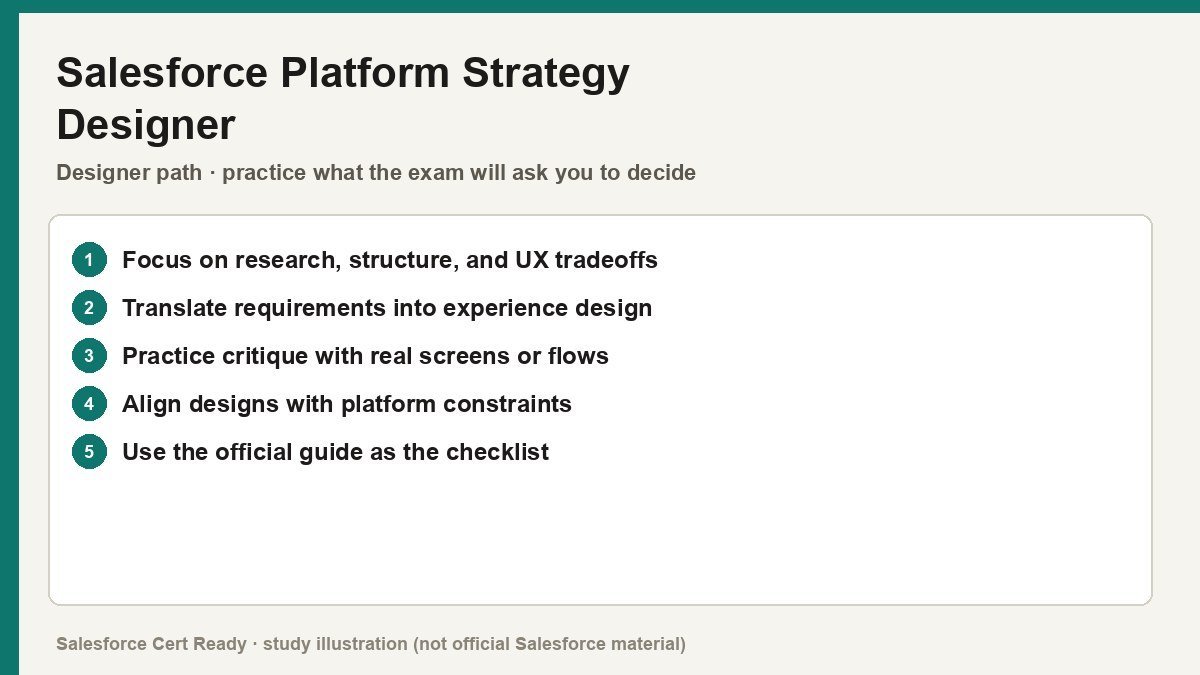
Study map for Salesforce Platform Strategy Designer. Confirm objectives on current Salesforce sources.
Salesforce Platform Strategy Designer
Catalog status checked July 19, 2026: Available.
Current credential snapshot
| Item | Current listing |
|---|---|
| Credential | Salesforce Platform Strategy Designer |
| Track | Designer |
| Level in source inventory | Mid |
| Exam code in source inventory | Plat-UX-102 |
| Price in source inventory | $200 USD |
| Availability | Available |
Exam format, objectives, pricing, and prerequisites can change. Confirm those details in Salesforce’s current exam guide before purchasing or scheduling an exam.
Study overview
🎯 Stop building features and start building value. This is the cert for those who bridge the gap between “can we build it?” and “should we build it?”Platform Strategy Designer
The definitive credential for experts who align business goals with human-centered design on the Salesforce platform.
At a Glance
| Category | Detail |
|---|---|
| Exam Code | Plat-UX-102 |
| Duration | 105 Minutes |
| Questions | 60 multiple-choice + 5 unscored |
| Passing Score | 70% |
| Cost | $200 USD |
| Delivery | Proctored online or on-site |
| Prerequisites | None |
| Recommended Experience | 3+ years Strategy Designer; 1-2 years Salesforce Platform; 2+ years leading complex projects |
Who Should Take This
- The Design Lead: You are comfortable facilitating co-creation workshops and using research to identify user pain points that business stakeholders might have missed.
- The Strategic Architect: You care as much about the
V2MOMand ROI models as you do about the technical schema, ensuring every feature serves a long-term roadmap. - The Senior Consultant: You have at least three years of experience guiding digital transformations and can confidently advocate for ethics and values in a room full of executives.
What You’ll Prove
This certification moves beyond system configuration to test your ability to create a common vision and lead the delivery of innovation. It validates that you can navigate both the tangible artifacts of design and the intangible dynamics of organizational change. * You can frame complex business problems into actionable challenge statements that pair objectives with specific user needs.
- You can facilitate alignment between cross-functional teams, including developers, admins, and business analysts, using empathy and advanced communication techniques.
- You can design measurable value propositions by mapping stakeholder needs to specific KPIs and building robust ROI models.
- You can advocate for design quality and ethical considerations throughout the product lifecycle to ensure desirability and viability.
Exam Outline
| Domain | Weight | What’s Covered |
|---|---|---|
| Value Design | 32% | Challenge framing, scoping, success metrics, research, and ideation. |
| Intangible Deliverables | 26% | Alignment, internal dynamics, change management, and advocacy. |
| Tools and Artifacts | 23% | Strategy documents, roadmaps, and connecting needs to Salesforce capabilities. |
| Leveraging Adjacent Roles | 19% | Collaboration with technical teams and knowing when to call experts. |
💡 In Notion, convert each domain row into a toggle to nest your study notes underneath.
Suggested Study Path
- Master the Pink Modules. Prioritize the specific Trailhead modules written for this certification; they contain the exact language and frameworks the exam expects.
- Internalize the Design Frameworks. You must be able to distinguish between
Desirability,Feasibility, andViabilityand know when to applyConsequence ScanningorInclusive Design. - Practice Challenge Framing. Learn to synthesize a business goal and a user problem into a single “How Might We” statement that sets the scope for a project.
- Learn the Salesforce Product Landscape. While this isn’t a technical admin exam, you must know enough about
Experience Cloud,Sales Cloud, andService Cloudto suggest high-level capabilities for a solution. - Review Scenario Logic. Go through sample questions and focus on why certain answers are “more right” in a strategic context—often the best answer involves more stakeholder alignment or better research.
Watch Out For
- The “Just Build It” Trap. Unlike developer exams, the answer here is rarely “build a flow.” If a question asks about a Detractor stakeholder, the answer is usually a conversation or discovery session, not a technical feature.
- Terminology Nuances. Salesforce uses very specific definitions for
Value DesignandRelationship Design. Don’t rely on your general industry knowledge; use their vocabulary. - Overlooking Ethics. This exam places significant weight on “Ethics by Design” and “Consequence Scanning.” Always look for the option that considers long-term impact and user exclusion.
- Metrics vs. Signals. Be clear on the difference between a hard metric (data) and a signal (behavioral observation) when defining success for a roadmap.
Resources
Stop memorizing button clicks and start leading the room. If you can survive a CIO’s neutral stare, you can pass this exam.
Official status sources
Catalog status last verified: 2026-07-19.