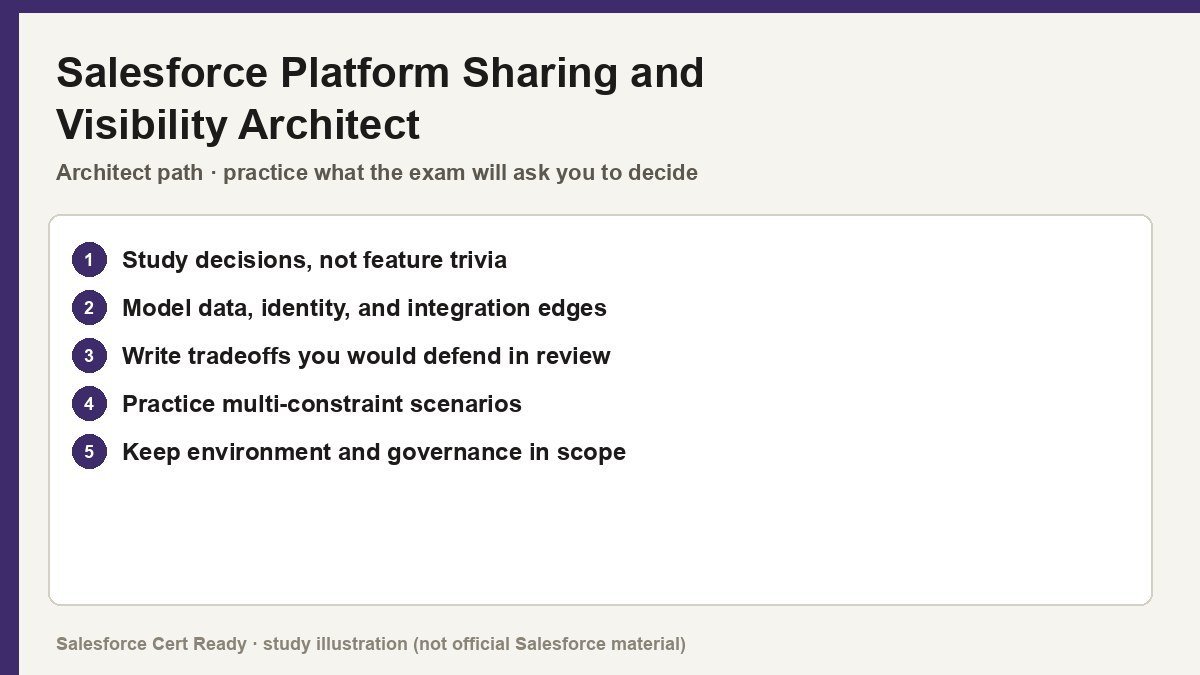
Study map for Salesforce Platform Sharing and Visibility Architect. Confirm objectives on current Salesforce sources.
Salesforce Platform Sharing and Visibility Architect
Catalog status checked July 19, 2026: Available.
Current credential snapshot
| Item | Current listing |
|---|---|
| Credential | Salesforce Platform Sharing and Visibility Architect |
| Track | Architect |
| Level in source inventory | Senior |
| Exam code in source inventory | Plat-Arch-205 |
| Price in source inventory | $400 USD |
| Availability | Available |
Exam format, objectives, pricing, and prerequisites can change. Confirm those details in Salesforce’s current exam guide before purchasing or scheduling an exam.
Study overview
🔐 Build security models that don’t leak data or break performance.Platform Sharing and Visibility Architect
The definitive credential for mastering record-level access and data security on the Salesforce platform.
At a Glance
| Category | Details |
|---|---|
| Exam Code | Plat-Arch-205 |
| Duration | 120 minutes |
| Questions | 60 multiple-choice |
| Passing Score | Verify on official guide |
| Cost | $400 USD |
| Delivery | Proctored online or at a testing center |
| Prerequisites | None |
| Recommended Experience | 2–3 years Salesforce experience; 4–5 years implementing complex security models |
Who Should Take This
- Aspiring Architects looking to complete the Designer track on their way to becoming a Application Architect or System Architect.
- Senior Administrators who manage complex orgs with sensitive data requirements and multi-layered sharing needs.
- Technical Consultants tasked with translating high-level business trust requirements into scalable technical configurations.
- Security Specialists focused on auditing data access and ensuring compliance across standard and custom object schemas.
What You’ll Prove
This certification validates your ability to design secure, scalable security models that balance the strict need for data privacy with the operational necessity of user productivity. You are demonstrating you can handle the “who sees what” problem at an enterprise scale. * You can design complex sharing models utilizing Organization-Wide Defaults, Role Hierarchies, and Sharing Rules.
- You can evaluate the performance impacts of
Large Data Volumes (LDV)on sharing recalculations and system responsiveness. - You can implement programmatic security using
Apex Sharingand therunAsmethod for testing visibility. - You can configure granular access for external users in Experience Cloud using
Sharing SetsandAccount Relationships. - You can articulate the trade-offs between various security tools, justifying when to use clicks versus code.
Exam Outline
| Domain | Weight | What’s Covered |
|---|---|---|
| Access to Records | 39% | OWD, Role Hierarchy, Sharing Rules, Manual Sharing, and Team access. |
| Permissions | 27% | Object and Field-level security via Profiles and Permission Sets. |
| Implications of Choice | 18% | Scalability, performance, and impact of the security model on system load. |
| Access to Other Data | 16% | Folders, Reports, Dashboards, and Document security. |
💡 In Notion, convert each domain row into a toggle to nest your study notes underneath.
Suggested Study Path
- Master the basics of declarative security by reviewing
OWDsettings and the “Least Privilege” principle. - Complete the Trailmix titled “Architect Journey: Sharing and Visibility” to build a hands-on foundation.
- Analyze complex scenarios where multiple sharing mechanisms overlap (e.g., how
Sharing Rulesinteract withTerritory Management). - Study programmatic sharing to understand how
Apex Managed Sharingdiffers from standard sharing and when to use it. - Review performance best practices specifically regarding
Ownership Data Skewand its effect on sharing recalculation. - Take a mock exam to practice interpreting wordy, scenario-based questions under a strict time limit.
Watch Out For
- The “Granular” Trap. Don’t assume the most restrictive setting is always best; excessive complexity in a sharing model often leads to performance bottlenecks and maintenance nightmares.
- Implicit Sharing. Many candidates forget the “hidden” sharing that happens automatically, such as Parent-Child implicit sharing between Accounts and Opportunities.
- LDV recalculation. Changing a sharing model in an org with millions of records can trigger a long-running background process; knowing how to mitigate this is critical for the exam.
Resources
- Official Exam Guide
- Trailmix: Architect Journey: Sharing and Visibility
- Salesforce Help: Sharing and Visibility DesignerGo earn that badge and stop the data leaks before they start. If you can explain the difference between a Sharing Set and a Sharing Rule to a stakeholder, you’re already halfway there.
Official status sources
Catalog status last verified: 2026-07-19.