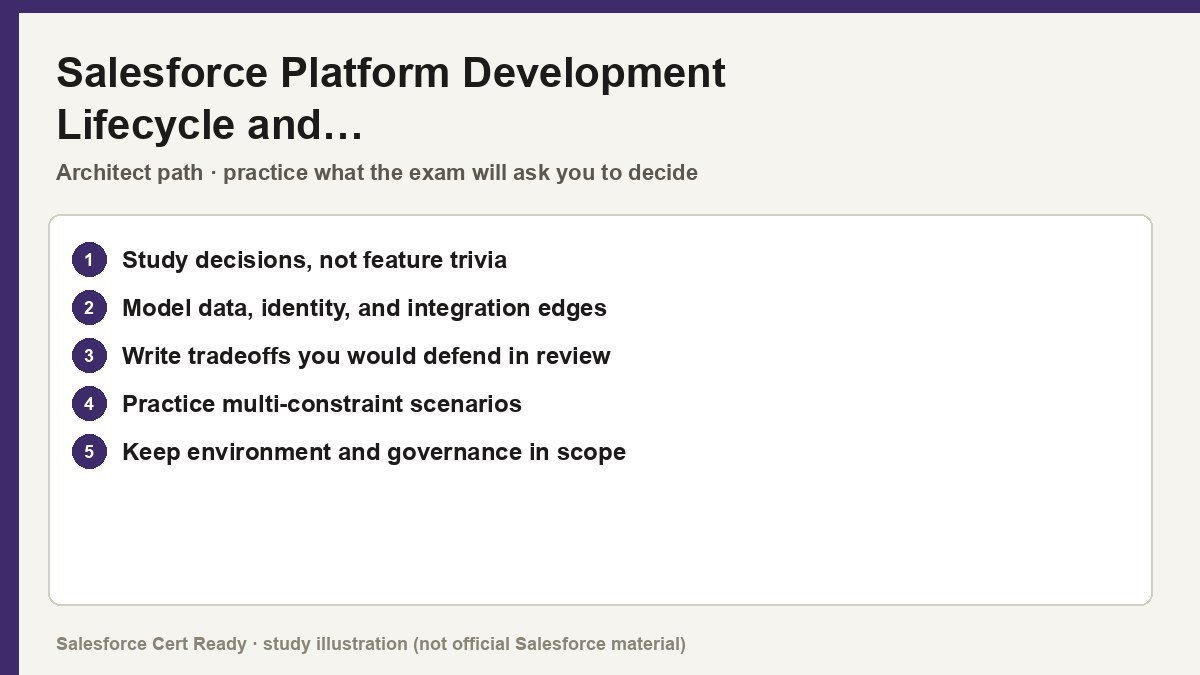
Study map for Salesforce Platform Development Lifecycle and…. Confirm objectives on current Salesforce sources.
Salesforce Platform Development Lifecycle and Deployment Architect
Catalog status checked July 19, 2026: Available.
Current credential snapshot
| Item | Current listing |
|---|---|
| Credential | Salesforce Platform Development Lifecycle and Deployment Architect |
| Track | Architect |
| Level in source inventory | Senior |
| Exam code in source inventory | Plat-Arch-202 |
| Price in source inventory | $400 USD |
| Availability | Available |
Exam format, objectives, pricing, and prerequisites can change. Confirm those details in Salesforce’s current exam guide before purchasing or scheduling an exam.
Study overview
🏗️ Build, test, and release with the confidence of an architect who has seen it all.Platform Development Lifecycle and Deployment Architect
Mastering Application Lifecycle Management, governance, and the art of the perfect release on the Salesforce platform.
At a Glance
| Feature | Details |
|---|---|
| Exam Code | Plat-Arch-202 |
| Duration | 105 Minutes |
| Questions | 60 Multiple-Choice |
| Passing Score | 65% |
| Cost | $400 USD |
| Delivery | Proctored (Onsite or Online) |
| Prerequisites | None |
| Recommended Experience | Advanced knowledge of ALM, DevOps, and governance frameworks |
🎯 Who Should Take This – The Aspiring CTA: Professionals on the journey toward the Certified Technical Architect board review who need this as a prerequisite for the System Architect credential.
- The DevOps Lead: Technical leads who manage complex development streams, branching strategies, and CI/CD pipelines for enterprise-scale orgs.
- The Senior Consultant: Architects who must design governance frameworks and justify environment strategies to both business and technical stakeholders.
- The Release Manager: Individuals responsible for coordinating seasonal Salesforce releases, hotfixes, and parallel development work without breaking production.
What You’ll Prove
This certification validates your ability to manage the entire software development lifecycle, ensuring that code and configuration move from a developer’s head to a user’s screen with minimal risk and maximum stability. – You can design a comprehensive environment strategy, selecting the right mix of Developer, Partial, and Full sandboxes for various project phases.
- You can recommend a development methodology (Agile vs. Waterfall) based on specific project risks and organizational maturity.
- You can implement governance structures, such as a Center of Excellence (CoE), to maintain cross-team alignment and architectural standards.
- You can manage complex release cycles, including metadata migrations,
Continuous Integration, and automated testing. - You can articulate the trade-offs of single-org vs. multi-org strategies and design appropriate backup/rollback plans.
Exam Outline
| Domain | Weight | What’s Covered |
|---|---|---|
| System Design | 15% | Scalable architectures, data models, and integration patterns. |
| Building | 14% | Code organization, configuration standards, and metadata management. |
| Testing | 14% | Unit testing, integration testing, and automated QA methodologies. |
| Deploying | 14% | Using Change Sets, Metadata API, and CI/CD pipelines. |
| Releasing | 13% | Managing seasonal upgrades and release coordination. |
| Planning | 13% | Environment strategy, risk management, and ALM maturity. |
| Operating | 10% | Ongoing maintenance, performance monitoring, and adoption. |
| ALM & Governance | 8% | Governance frameworks, CoE, and methodology selection. |
💡 In Notion, convert each domain row into a toggle to nest your study notes underneath.
Suggested Study Path
- Master the Sandbox Lifecycle. Understand exactly when to use each sandbox type and the implications of refresh intervals on your development velocity.
- Deep-Dive into Git-Based Workflows. Even if you don’t write the scripts, you must understand branching, merging, and how
Source Controlacts as the source of truth. - Internalize the 5 Stages of ALM. Be able to walk through Plan, Build, Test, Release, and Observe without hesitation.
- Learn the Metadata API Constraints. Know what can and cannot be deployed via API, and how tools like the
Salesforce CLIinteract with your org metadata. - Simulate Governance Scenarios. Practice recommending specific steering committee structures for large-scale enterprise conflicts.
- Review Testing Best Practices. Focus on the difference between unit testing, regression testing, and User Acceptance Testing (UAT).
⚠️ Watch Out For – The “Admin” Trap: Don’t get bogged down in how to create a field; focus on the impact of that field moving through five different environments.
- CI/CD Practicalities: The exam won’t ask you to write Jenkins files or CLI scripts, but it will ask you how those tools fit into a broader
ALMstrategy. - Sandbox Preview Windows: Pay close attention to the timing of seasonal releases and how “Preview” sandboxes can impact your testing window.
- Scenario Nuance: Questions often describe a “tight timeline” or “multiple teams.” The correct answer changes based on these constraints—speed vs. stability.
🔗 Resources – Official Salesforce Exam Guide
Stop guessing and start governing. Your production org—and your sanity—will thank you once you’ve mastered the deployment lifecycle.
Official status sources
Catalog status last verified: 2026-07-19.