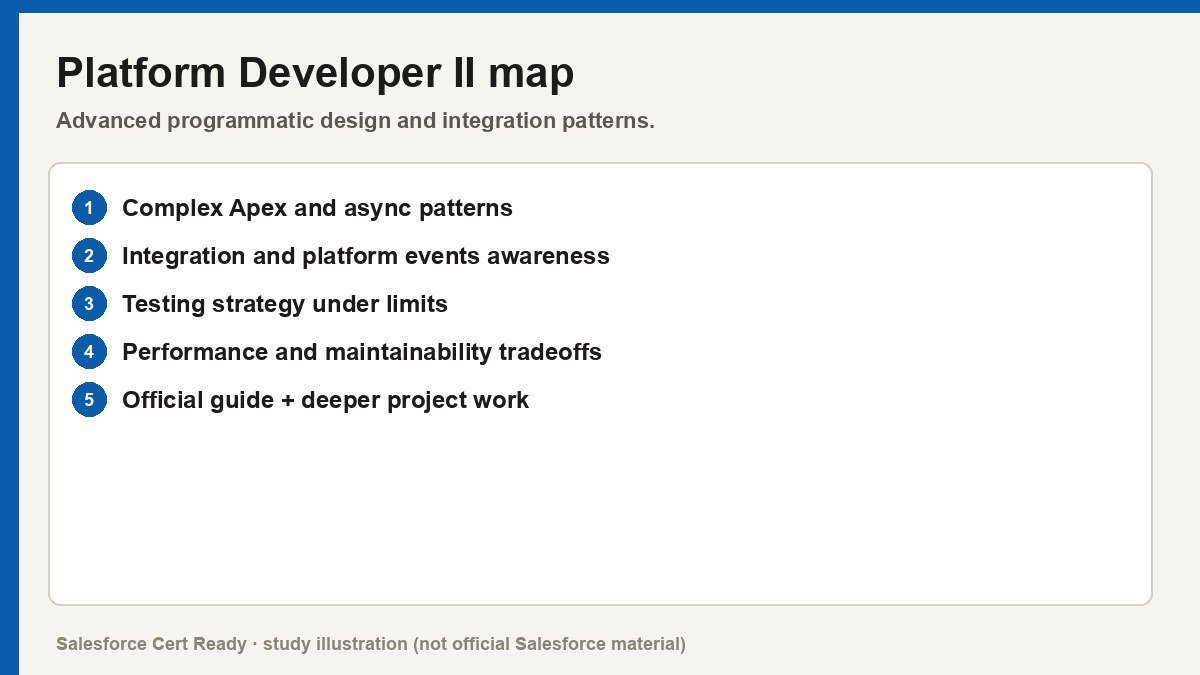
Build projects that force advanced design choices.
Salesforce Platform Developer II
Catalog status checked July 19, 2026: Available.
Current credential snapshot
| Item | Current listing |
|---|---|
| Credential | Salesforce Platform Developer II |
| Track | Developer |
| Level in source inventory | Mid |
| Exam code in source inventory | Plat-Dev-301 |
| Price in source inventory | $200 USD |
| Availability | Available |
Exam format, objectives, pricing, and prerequisites can change. Confirm those details in Salesforce’s current exam guide before purchasing or scheduling an exam.
Study overview
🚀 Stop building scripts; start architecting systems.Platform Developer II
The definitive validation for senior programmatic experts on the Salesforce Lightning Platform.
At a Glance
| Feature | Details |
|---|---|
| Exam Code | Plat-Dev-301 |
| Duration | 120 minutes |
| Questions | 60 multiple-choice/multiple-select (plus 5 unscored) |
| Passing Score | 70% |
| Cost | $200 USD (Retake: $100 USD) |
| Delivery | Proctored onsite or online |
| Prerequisites | Salesforce Certified Platform Developer I |
| Recommended Experience | 2–4 years as a developer; 1+ year design/deployment on Lightning |
🎯 Who Should Take This – The Senior Developer: You have moved past basic CRUD operations and are now managing complex business logic, custom integrations, and high-scale data volumes.
- The Aspiring Architect: You want to prove you understand the underlying mechanics of the platform, from
Apexgovernor limits to sophisticated sharing models and performance tuning. - The Full-Stack Specialist: You are comfortable jumping between
Lightning Web Components,Aura, andApexwhile ensuring the entire solution is testable and maintainable.
What You’ll Prove
This credential moves beyond knowing what a tool does and focuses on why and how to use it in complex, real-world scenarios. You are being tested on your ability to deliver production-grade code that doesn’t just work, but scales. – You can design and implement advanced programmatic solutions that follow object-oriented design patterns and reusability best practices.
- You can optimize application performance by identifying bottlenecks in
SOQLqueries,Apexloops, andUIrendering. - You can architect complex data models and sharing logic using both declarative features and
Apex Managed Sharing. - You can integrate Salesforce with external systems using
RESTandSOAPweb services, including handling asynchronous callouts and error state management. - You can execute a comprehensive testing and deployment strategy using mocks, stubs, and source-driven development tools.
Exam Outline
| Domain | Weight | What’s Covered |
|---|---|---|
| Process Automation, Logic, and Integration | 27% | Optimal programmatic vs. declarative solutions, Apex trigger best practices, error handling, transactional integrity, and asynchronous Apex. |
| User Interface | 20% | LWC and Aura event communication, Visualforce actions and partial refreshes, responsive design, and using static resources. |
| Testing, Debugging, and Deployment | 20% | Advanced testing with mocks/stubs, troubleshooting Apex and UI components, and formulating deployment processes for source-driven dev. |
| Performance | 18% | Identifying UI performance issues, optimizing SOQL for large data volumes (LDV), and resolving code inefficiencies. |
| Advanced Developer Fundamentals | 15% | Localization, multi-currency features, Apex Managed Sharing, and best practices for custom metadata and settings. |
💡 In Notion, convert each domain row into a toggle to nest your study notes underneath.
Suggested Study Path
- Master the Prerequisites. This is a two-part journey. Ensure you have completed the required Superbadges—specifically
Apex Specialist,Data Integration Specialist, andAdvanced Apex Specialist—as they cover the hands-on logic the exam expects. - Audit the Official Exam Guide. Review every bullet point in the syllabus. If you can’t explain the difference between a
Mockand aStubor why you’d useContinuationin a controller, spend a day in the documentation. - Build in a Developer Org. Theory will fail you here. Manually implement
Apex Managed Sharingand writeRESTcallouts that handle common HTTP error codes. Practice queryingHistoryobjects and working withLarge Data Volumes. - Deep Dive into Performance. Learn the specific
SOQLkeywords and indexing strategies required to handle millions of records. Understand theView StateinVisualforceand the@AuraEnabled(cacheable=true)annotation inLWC. - Simulate the Environment. Use practice exams to get used to the scenario-based questions. Focus on the “Choose 2” or “Choose 3” formats, as these are where most candidates lose points by missing edge cases.
⚠️ Watch Out For – The “Good Enough” Trap: In PDII, the question isn’t just “which code works?” it’s “which code is the best practice for performance and scalability?”
- Governor Limit Nuances: Don’t just know the limits; know the specific scenarios where they are triggered, such as total
SOQLqueries in a trigger context versus an asynchronous block. - Over-Engineering: Be careful with scenario questions that offer a programmatic solution when a declarative one (like
Flow) is more efficient or maintainable. - Testing Specifics: Pay close attention to testing requirements for
Batch Apex, specifically the limitations ofstartTest()andstopTest()when dealing with asynchronous code.
🔗 Resources – Official Salesforce Exam Guide
- Official Trailmix: Prepare for Your PDII Credential
- Developer Documentation: Apex Integration Services
- Trailhead Academy: Build Applications Programmatically (DEX450)
Stop memorizing and start understanding the ‘why’ behind the architecture. If you can explain the order of execution to a rubber duck without crying, you’re halfway there.
Official status sources
Catalog status last verified: 2026-07-19.