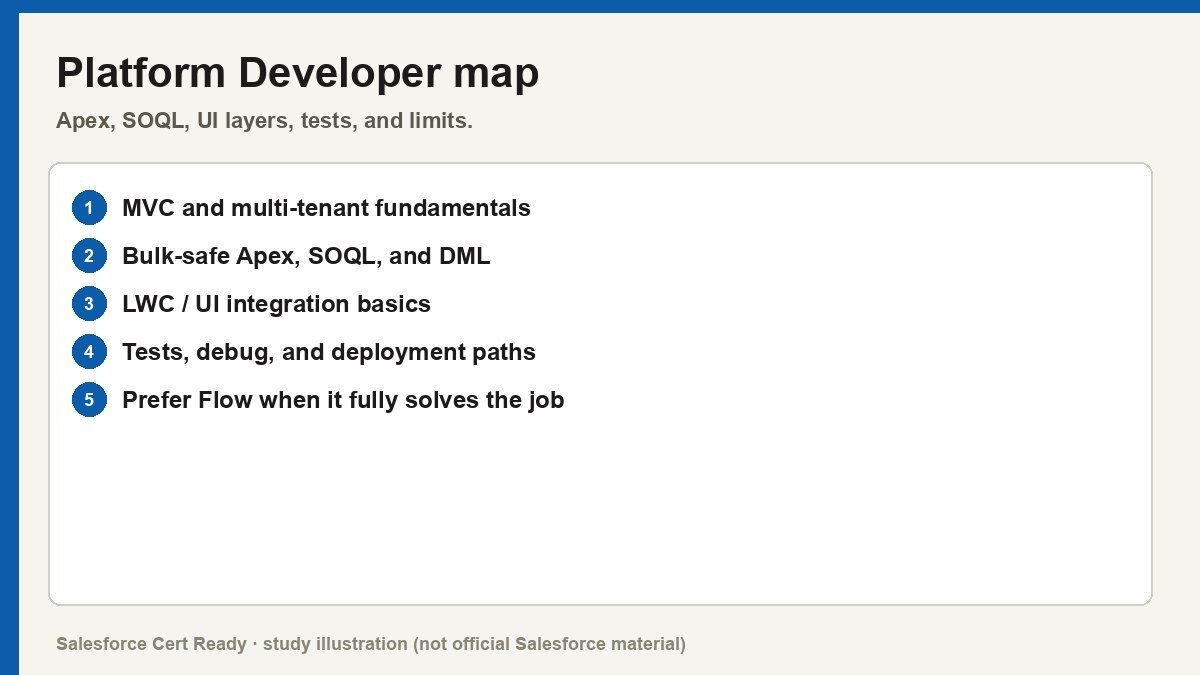
Prove bulkification and testing habits in a Developer Edition org.
Salesforce Platform Developer
Catalog status checked July 19, 2026: Available.
Current credential snapshot
| Item | Current listing |
|---|---|
| Credential | Salesforce Platform Developer |
| Track | Developer |
| Level in source inventory | Mid |
| Exam code in source inventory | Plat-Dev-201 |
| Price in source inventory | $200 USD |
| Availability | Available |
Exam format, objectives, pricing, and prerequisites can change. Confirm those details in Salesforce’s current exam guide before purchasing or scheduling an exam.
Study overview
⚡ Stop guessing if your code is “Salesforce-ready” and start proving it.Salesforce Certified Platform Developer I
The industry standard for programmatic development on the Lightning Platform.
At a Glance
| Metric | Value |
|---|---|
| Exam Code | Plat-Dev-201 |
| Duration | 110 minutes |
| Questions | 60 multiple-choice/multiple-select |
| Passing Score | 65% |
| Cost | $200 USD |
| Delivery | Proctored (Onsite or Online) |
| Prerequisites | None |
| Recommended Experience | 1-2 years experience as a developer |
Who Should Take This
- The Aspiring Developer: You have a solid grasp of object-oriented programming (Java, C#, JavaScript) and want to transition into the Salesforce ecosystem.
- The Power Admin: You’ve hit the limits of Flow and Formula Fields and are ready to master
Apex,SOQL, andLightning Web Components. - The Technical Consultant: You design solutions and need to know exactly when to recommend custom code over declarative configuration.
What You’ll Prove
This credential validates your ability to develop and deploy custom business logic and interfaces using the programmatic capabilities of the Lightning Platform. It’s not just about syntax; it’s about knowing the “Salesforce Way” of solving problems. * You can implement complex business logic using Apex triggers, classes, and asynchronous processing.
- You can design efficient data queries using
SOQLandSOSLwhile respecting multi-tenant governor limits. - You can build modern, reactive user interfaces using the
Lightning Web Component(LWC) framework. - You can write robust unit tests and use the
Salesforce CLIto manage the application lifecycle.
Exam Outline
| Domain | Weight | What’s Covered |
|---|---|---|
| Developer Fundamentals | 23% | MVC pattern, multi-tenancy, core CRM objects, and declarative vs. programmatic decisions. |
| Process Automation & Logic | 30% | Apex syntax, variables, control flow, triggers, SOQL, SOSL, and DML operations. |
| User Interface | 25% | LWC basics, Aura components, Visualforce pages, and custom styling. |
| Testing, Debugging & Deployment | 22% | Test classes, System.assert, debugging tools, Salesforce DX, and deployment environments. |
💡 In Notion, convert each domain row into a toggle to nest your study notes underneath.
Suggested Study Path
- Master the Fundamentals. Review the Salesforce schema and understand how custom objects relate to one another via Lookup and Master-Detail relationships.
- Code in a Sandbox. Don’t just read documentation. Set up a free Developer Edition org and build a custom
Apextrigger that processes records in bulk. - Learn to Query. Practice writing
SOQLqueries in the Developer Console. Ensure you understand how to filter indexed fields to avoid performance bottlenecks. - Prioritize Declarative Tools. Internalize the rule: if you can do it with a Flow, don’t use code. The exam frequently tests your ability to choose the most efficient path.
- Study Governor Limits. Memorize the key numbers—100
SOQLqueries, 150DMLstatements, and the 50,000 record limit for queries. - Run Practice Tests. Use reputable community resources to identify your weak spots in the four main domains before booking your seat.
Watch Out For
- The “Flow First” Trap: Salesforce heavily pushes declarative solutions. If a question offers a
Flowand anApex Triggeras solutions for a simple update, theFlowis almost always the “correct” answer. - Bulkification Failures: Any code snippet that performs a
SOQLquery or aDMLstatement inside aforloop is a red flag. These are classic “wrong” answers designed to test your knowledge of multi-tenant limits. - Partial Success: Understand the difference between
insert(all-or-nothing) andDatabase.insert(records, false)(partial success). The exam loves to test how errors are handled in bulk operations.
Resources
Go get that cert and finally explain to your parents why you can’t just “fix the Wi-Fi.” You’re a developer now; your time is too expensive for basic tech support.
Official status sources
Catalog status last verified: 2026-07-19.