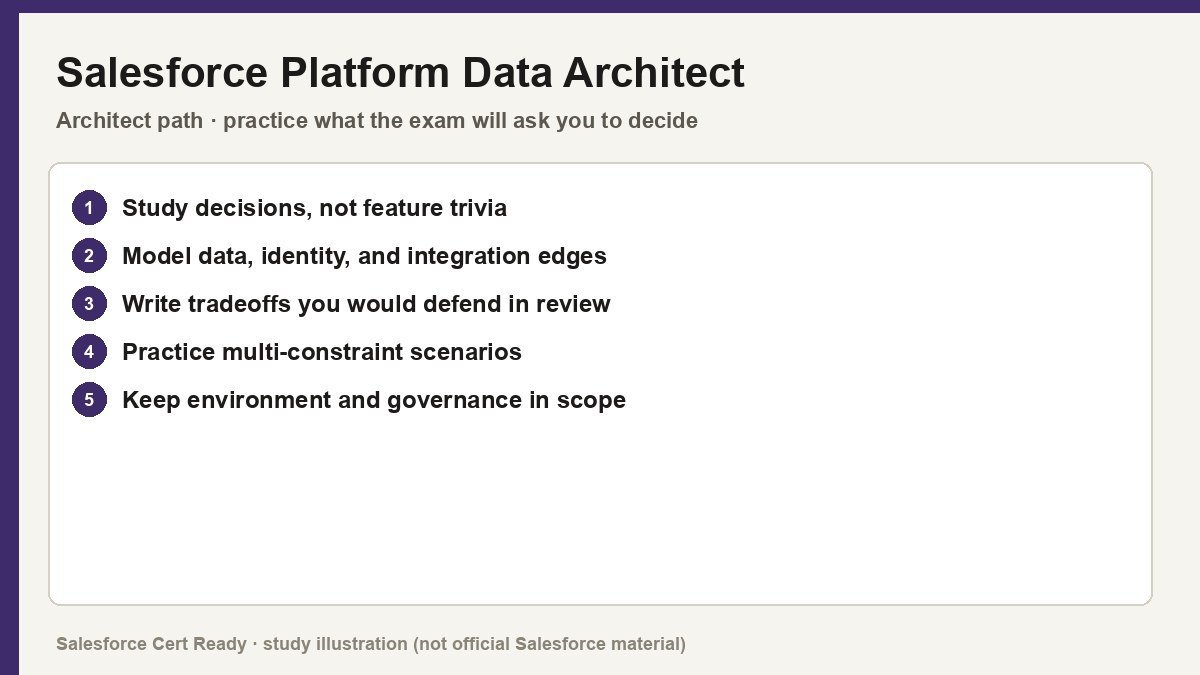
Study map for Salesforce Platform Data Architect. Confirm objectives on current Salesforce sources.
Salesforce Platform Data Architect
Catalog status checked July 19, 2026: Available.
Current credential snapshot
| Item | Current listing |
|---|---|
| Credential | Salesforce Platform Data Architect |
| Track | Architect |
| Level in source inventory | Senior |
| Exam code in source inventory | Plat-Arch-201 |
| Price in source inventory | $400 USD |
| Availability | Available |
Exam format, objectives, pricing, and prerequisites can change. Confirm those details in Salesforce’s current exam guide before purchasing or scheduling an exam.
Study overview
🏗️ Build for scale. Design for performance. Master the Customer 360 data engine.Platform Data Architect
The definitive credential for architects designing scalable, high-performance data solutions on the Salesforce Platform.
At a Glance
| Feature | Details |
|---|---|
| Exam Code | Plat-Arch-201 |
| Duration | 105 Minutes |
| Questions | 60 multiple-choice/multiple-select |
| Passing Score | 58% |
| Cost | USD 400 (plus tax); Retake USD 200 |
| Delivery | Proctored online or onsite at a testing center |
| Prerequisites | None |
| Recommended Experience | 2-3 years Salesforce experience; 5+ years in data-centric solutions |
Who Should Take This
- The Aspiring Application Architect: Professionals checking off a mandatory requirement for the
Application Architectpyramid. - The Data Strategist: Architects who manage
Large Data Volumes(LDV) and need to ensure system performance doesn’t degrade as the org grows. - The Integration Lead: Senior developers or consultants responsible for complex data migrations and multi-system synchronization.
- The Compliance Officer: Technical leads tasked with implementing
Data Governance,GDPRcompliance, andShield Platform Encryption.
What You’ll Prove
This exam shifts away from simple administration and focuses on architectural trade-offs. You aren’t just configuring; you are deciding which data structures will survive 100 million records without locking the system. * You can design scalable data models using Standard, Custom, External, and Big Objects based on specific business requirements.
- You can mitigate performance risks like
Data SkewandRecord Lockingby applying advanced indexing and sharing strategies. - You can architect enterprise-grade
Master Data Management(MDM) solutions to maintain a single source of truth across systems. - You can implement robust
Data Governanceframeworks that balance accessibility with strict global privacy regulations. - You can execute large-scale
Data MigrationsusingETLtools while respectingAPIlimits and ensuring data integrity.
Exam Outline
| Domain | Weight | What’s Covered |
|---|---|---|
| Data Modeling & Database Design | 25% | Relationship types, Big Objects, Data Skew, and metadata management. |
| Salesforce Data Management | 25% | Validation rules, Automation, and license-specific data persistence. |
| Large Data Volumes (LDV) | 20% | Indexing, Skinny Tables, Async processing, and LDV query performance. |
| Data Migration | 15% | Bulk API, Data Loader, ETL strategies, and migration planning. |
| Data Governance | 10% | Compliance (GDPR), Data Privacy, Retention, and Data Stewardship. |
| Master Data Management | 5% | Source of Truth, Matching & Merging, and cross-system harmonization. |
💡 In Notion, convert each domain row into a toggle to nest your study notes underneath.
Suggested Study Path
- Master the Trailhead Trailmix: Complete the official
Architect Journey: Data Architecturetrailmix to cover the fundamental documentation. - Review the Decision Guides: Read the Salesforce
Architect Decision Guidesspecifically for Data and Sharing to understand when to choose one tool over another. - Lab the Edge Cases: Create
Big Objectsand simulateParent-Child Data Skewin a developer edition to see the performance impact firsthand. - Learn the Tools: Study the specific capabilities and limits of the
Bulk API,Dataloader.io, and enterpriseETLpatterns. - Simulate the Scenario: Take high-quality practice exams to get used to the long, scenario-heavy question format that tests “best fit” rather than just “correct” answers.
Watch Out For
- The “External” Trap: Don’t default to
Salesforce ConnectorExternal Objectsfor everything; know exactly when the overhead and latency are justified versus native storage. - Sharing Calculation Overhead: Understand that complex
Data ModelsimpactSharing Rules. Adding a relationship isn’t just about data; it’s about the background calculation engine. - Big Object Limitations: Remember that
Big Objectsonly support a subset of features—no standard reports, no triggers, and very specificSOQLrequirements. - Data Skew Denial: Look out for scenarios involving “10,000+ child records.” This is a classic trigger for questions about
Account SkeworOwnership Skew.
Resources
- Official Exam Guide
- Architect Journey: Data Architecture Trailmix
- Salesforce Architect Decision Guides
- Developer Documentation: Large Data Volumes
Stop worrying about the 58% passing score and start worrying about your record locking errors. If you can handle a 10-million-row migration without crashing the org, you’re ready.
Official status sources
Catalog status last verified: 2026-07-19.