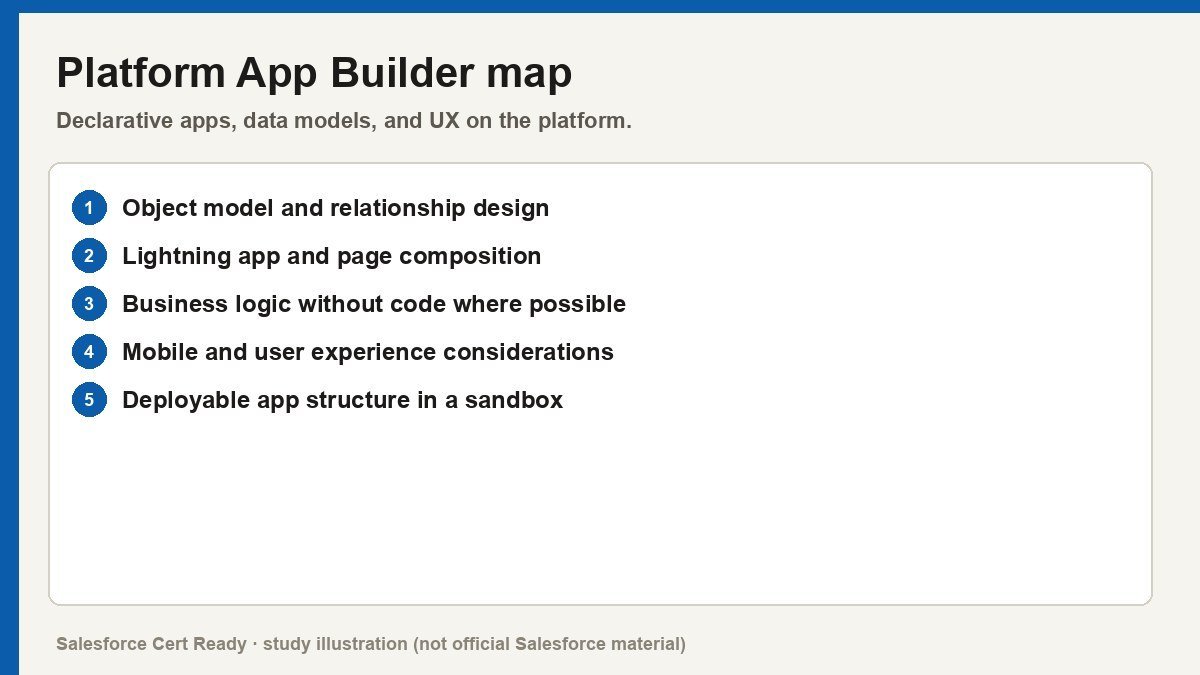
Build small apps that prove each exam domain.
Salesforce Platform App Builder
Catalog status checked July 19, 2026: Available.
Current credential snapshot
| Item | Current listing |
|---|---|
| Credential | Salesforce Platform App Builder |
| Track | Administrator |
| Level in source inventory | Mid |
| Exam code in source inventory | Plat-Admn-202 |
| Price in source inventory | $200 USD |
| Availability | Available |
Exam format, objectives, pricing, and prerequisites can change. Confirm those details in Salesforce’s current exam guide before purchasing or scheduling an exam.
Study overview
🛠️ Build smarter, not harder. Master the declarative side of the Lightning Platform.Salesforce Certified Platform App Builder
The essential credential for professionals building custom business logic and data models without code.
At a Glance
| Feature | Details |
|---|---|
| Exam Code | Plat-Admn-202 |
| Duration | 105 minutes |
| Questions | 60 multiple-choice/multiple-select (plus 5 unscored) |
| Passing Score | 63% |
| Cost | USD 200 (Retake: USD 100) |
| Delivery | Onsite or online proctored |
| Prerequisites | None |
| Recommended Experience | 6 months to 1 year of experience building applications on the Lightning Platform |
Who Should Take This
- The Declarative Developer: You prefer building with
Flow,Schema Builder, andLightning App Builderbefore ever considering a line of Apex code. - The Power Administrator: You have mastered standard object configuration and are ready to prove you can design complex custom data models and multi-step automation.
- The Solution Architect: You need to validate your ability to translate business requirements into scalable, secure, and mobile-optimized Salesforce applications.
What You’ll Prove
This certification validates that you understand the boundaries of the platform. You aren’t just a builder; you are a designer who knows how to structure data for reporting and how to automate processes while avoiding recursion. * You can design custom data models, user interfaces, and business logic using only declarative tools.
- You can manage application security, including object-level, field-level, and record-level access.
- You can deploy applications using
Change Setsand understand the lifecycle ofSandboxes. - You can optimize the mobile experience using global and object-specific actions and layouts.
- You can identify when a requirement exceeds declarative limits and requires a programmatic solution.
Exam Outline
| Domain | Weight | What’s Covered |
|---|---|---|
| Salesforce Fundamentals | 23% | AppExchange, Standard Objects, Security Model, Reporting |
| Data Modeling and Management | 22% | Relationship Types, Schema Builder, Field Types, Data Import/Export |
| Business Logic and Process Automation | 28% | Flow Builder, Formula Fields, Validation Rules, Approval Processes |
| User Interface | 17% | Lightning App Builder, Custom Buttons/Links, Lightning Components |
| App Deployment | 10% | Change Sets, Sandbox Types, Application Lifecycle Management |
💡 In Notion, convert each domain row into a toggle to nest your study notes underneath.
Suggested Study Path
- Audit the Exam Guide to identify your weakest domains among the five core sections.
- Complete the official Trailmix “Prepare for your Salesforce Platform App Builder Exam” to get hands-on with specific scenarios.
- Build a custom app from scratch in a Developer Edition org, focusing on complex
Master-Detailrelationships andRecord-Triggered Flows. - Master the Flow Builder as it represents the largest portion of the automation section; know when to use a
Screen Flowvs. anAutolaunched Flow. - Review deployment tools specifically focusing on the limitations of
Change Setsand the different types ofSandboxes(Developer, Full, Partial). - Take practice exams to get used to the scenario-based question format where multiple answers might seem correct at first glance.
Watch Out For
- The “When to Code” Trap: Many questions describe a complex requirement. Your job is to know exactly where
Flowends andApexbegins. Don’t pick a programmatic answer if a declarative one exists. - Relationship Ramifications: Understand the deep differences between
LookupandMaster-Detailrelationships, specifically how they affect record deletion and security inheritance. - Field Type Conversion: Memorize what happens when you change a field type (e.g.,
CheckboxtoTextorNumbertoCurrency). Know which conversions result in data loss. - Automation Recursion: Be careful with field updates that might re-trigger the same automation. The exam tests your ability to design “clean” automation.
Resources
- Official Exam Guide
- Official Trailmix: Prepare for Your Exam
- Study for the Platform App Builder Exam (Trailhead)
- Salesforce Ben Practice Test
- Focus on Force Study Guide
Stop overthinking the clicks and start thinking about the architecture. If you can build a Space Station in a Trailhead project, you can pass this exam.
Official status sources
Catalog status last verified: 2026-07-19.