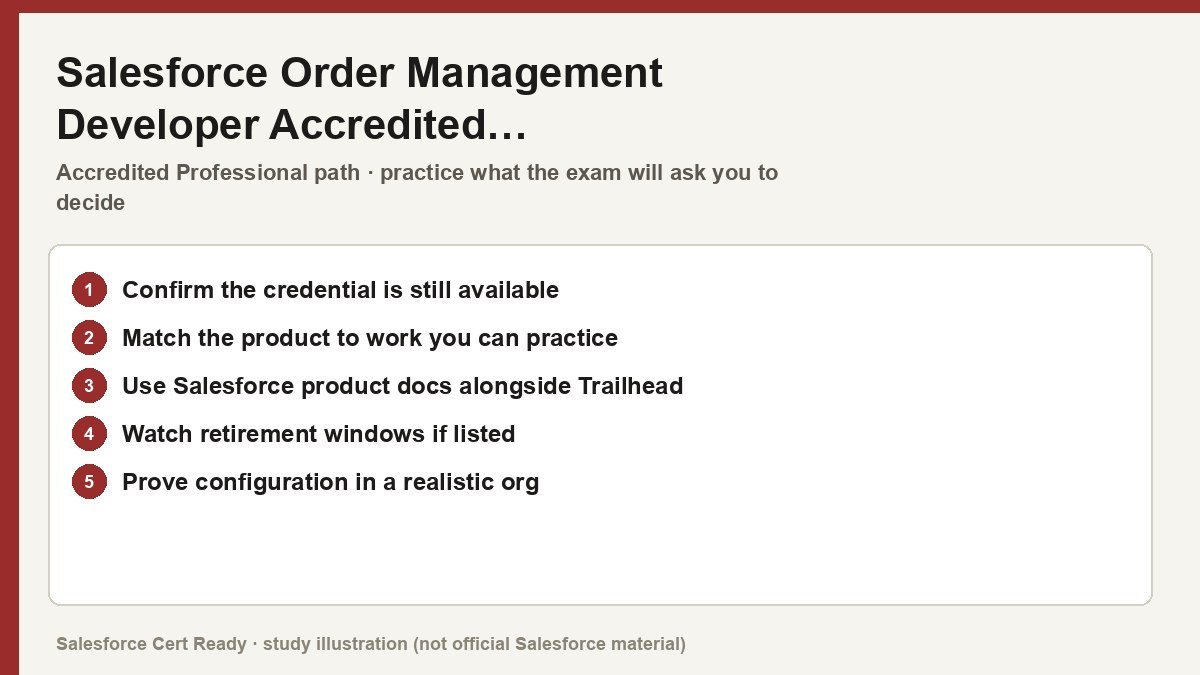
Study map for Salesforce Order Management Developer Accredited…. Confirm objectives on current Salesforce sources.
Salesforce Order Management Developer Accredited Professional
Catalog status checked July 19, 2026: Available; scheduled for retirement.
Salesforce says registration closes July 24, 2026, the last exam date is August 31, 2026, and the credential retires February 1, 2027.
Current credential snapshot
| Item | Current listing |
|---|---|
| Credential | Salesforce Order Management Developer Accredited Professional |
| Track | Accredited Professional |
| Level in source inventory | Specialty |
| Exam code in source inventory | AP-220 |
| Price in source inventory | $150 USD |
| Availability | Available; scheduled for retirement |
Exam format, objectives, pricing, and prerequisites can change. Confirm those details in Salesforce’s current exam guide before purchasing or scheduling an exam.
Study overview
📦 Master the mechanics of high-scale commerce fulfillment.Order Management Developer Accredited Professional
Validate your expertise in extending and customizing the Salesforce Order Management lifecycle for complex enterprise environments.
At a Glance
| Feature | Details |
|---|---|
| Exam Code | AP-220 |
| Duration | 90 minutes |
| Questions | 65 (Multiple Choice/Select) |
| Passing Score | 70% |
| Cost | $150 USD |
| Delivery | Kryterion Webassessor / Pearson VUE |
| Prerequisites | None (Partner Learning Camp access required) |
| Recommended Experience | 2-3 years of Salesforce platform experience with a focus on custom development and integration. |
Who Should Take This
- The Technical Consultant: You are the lead on implementation projects, translating business requirements into technical specs for order lifecycle state machines.
- The Apex Developer: You have experience writing custom
Invocable Actionsand handling complexAPIcalls for third-party payment or tax services. - The Commerce Architect: You need to understand the data flow between
B2C Commerce,Omnichannel Inventory, and theOrder Summaryobject.
What You’ll Prove
This credential proves you can move beyond out-of-the-box functionality to build resilient, automated fulfillment engines. You aren’t just clicking buttons; you are architecting the logic that keeps commerce moving. * You can implement complex data models, including converting historical data into Order Summary objects while maintaining relational integrity.
- You can integrate external systems using
Omnichannel Inventory(OCI) headless APIs and custom payment gateways. - You can extend the core platform by creating reusable
Apexactions andLightning Web Componentsfor the Order Management console. - You can optimize order processing by leveraging the
Composite APIand high-performance batch processing patterns. - You can troubleshoot sophisticated integration errors and deployment lifecycle issues across multiple clouds.
Exam Outline
| Domain | Weight | What’s Covered |
|---|---|---|
| Data Management | 17% | Data model, ERDs, historical data loads, and real-time API calls. |
| Domain Knowledge | 17% | System landscapes, integration prioritization, and mapping business value. |
| Platform Integration | 13% | B2C/B2B Commerce connectivity, OCI activation, and low-code connectors. |
| Platform Development | 23% | Invoices, Payment Tokens, Apex actions, and testing strategies. |
| Reference Frameworks | 10% | Mainstreet framework, Self-Service Cartridges, and non-product tooling. |
| Omnichannel Inventory | 13% | Headless APIs, inventory positioning, and cross-cloud integration. |
| Advanced Use Cases | 7% | Remorse periods, fraud detection, and bulk order handling. |
💡 In Notion, convert each domain row into a toggle to nest your study notes underneath.
Suggested Study Path
- Master the Data Model. Study the
Order Summaryhierarchical object graph. You must understand howOrder,Fulfillment Order, andReturn Orderinteract. - Review the Partner Learning Camp. Complete the Order Management Foundations for Developers curriculum. This is the primary source of truth for the exam.
- Practice with Headless APIs. Get hands-on with the
OCI(Omnichannel Inventory) APIs. Understand the timing and payload requirements for inventory reservations. - Build Custom Actions. Practice creating
Apexactions that can be called fromFlow Builder. This is critical for the “Platform Development” section. - Explore Reference Implementations. Dig into the
Mainstreetframework for historical data imports and theSelf-Service Cartridge. - Simulate Advanced Scenarios. Work through use cases like fraud check holds or modifying the fulfillment flow for partial shipments.
Watch Out For
- The Composite API Trap: Ensure you know when to use the
Composite APIto handle related objects in a single call versus standardRESTcalls. - Historical Data Constraints: Moving legacy data into
Order Summaryobjects isn’t a simple import; it requires specific conversion logic and object mapping. - Flow vs. Apex: Know the trade-offs. While
Flow Builderis preferred for visual debugging, you’ll needApexfor complex logic like custom payment token management. - OCI Configuration: Pay close attention to the specific steps for activating
Omnichannel InventorybetweenB2C CommerceandOrder Management.
Resources
- Official Order Management Developer Exam Guide
- Trailhead: Salesforce Order Management for B2C Commerce
- Omnichannel Inventory Documentation
- Salesforce Partner Community: Accredited Professional Navigator
Stop moving orders manually like it’s 1999. Get certified and automate the chaos.
Official status sources
Catalog status last verified: 2026-07-19.