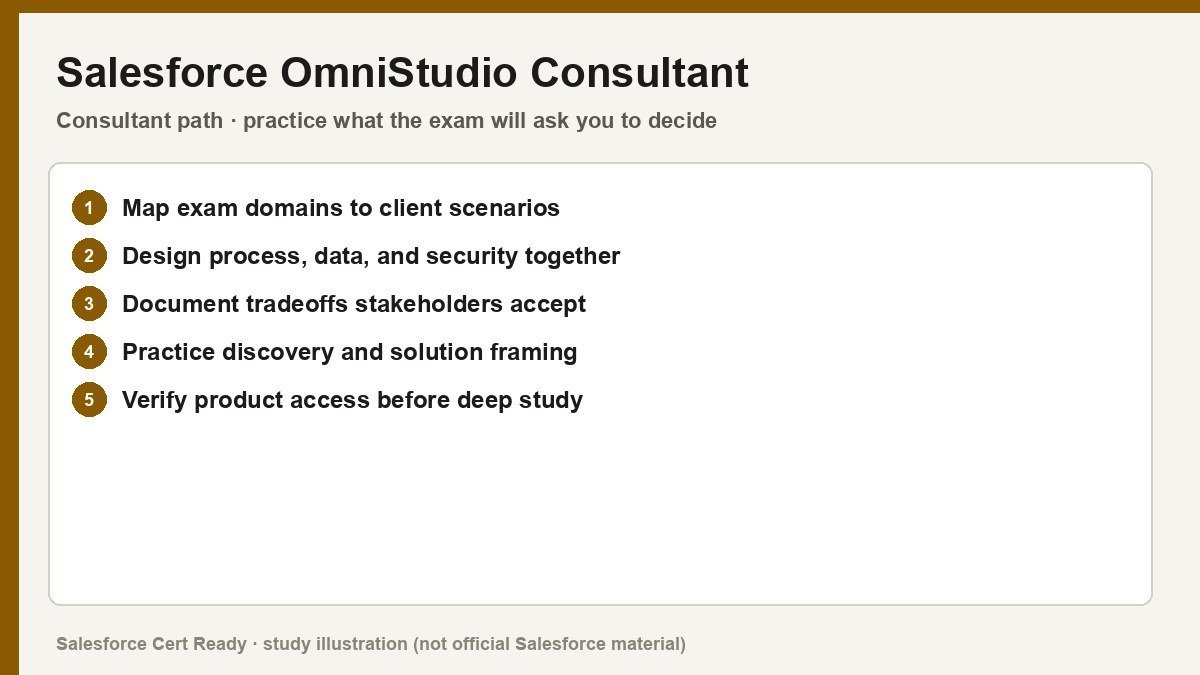
Study map for Salesforce OmniStudio Consultant. Confirm objectives on current Salesforce sources.
Salesforce OmniStudio Consultant
Catalog status checked July 19, 2026: Available.
Current credential snapshot
| Item | Current listing |
|---|---|
| Credential | Salesforce OmniStudio Consultant |
| Track | Consultant |
| Level in source inventory | Senior |
| Exam code in source inventory | Plat-Con-201 |
| Price in source inventory | $200 USD |
| Availability | Available |
Exam format, objectives, pricing, and prerequisites can change. Confirm those details in Salesforce’s current exam guide before purchasing or scheduling an exam.
Study overview
🏗️ Build elegant, model-driven digital processes without the code debt.Salesforce Certified OmniStudio Consultant
Validating expertise in solution design using the OmniStudio declarative suite.
At a Glance
| Feature | Details |
|---|---|
| Exam Code | Plat-Con-201 |
| Duration | 105 Minutes |
| Questions | 60 scored, 5 unscored (65 total) |
| Passing Score | 68% |
| Cost | $200 USD ($100 retake) |
| Delivery | Online proctored or onsite testing center |
| Prerequisites | None |
| Recommended Experience | 1+ year Salesforce experience; 2–5 years in consulting or solution design |
Who Should Take This
- Digital Transformation Consultants who need to translate complex business requirements into automated, industry-specific digital processes.
- Solution Architects focused on building scalable, maintainable front-end experiences using low-code tools rather than custom LWC.
- Business Analysts with a technical lean who want to design the logical flow and data mapping for customer-facing interactions.
- Industry Specialists working within Vlocity or Salesforce Industries clouds (Communications, Health, Financial Services) where OmniStudio is the standard.
What You’ll Prove
This credential confirms you aren’t just a builder, but a designer who knows which tool to pull from the belt to solve a specific business friction point. It focuses on the “why” and “how” of solutioning rather than raw syntax. * You can architect front-end user experiences by grouping Customer 360 data into intuitive, actionable FlexCards.
- You can map multi-step business processes into guided
OmniScriptworkflows that ensure data integrity and user alignment. - You can design efficient data patterns using
Integration Proceduresto minimize server calls and respect governor limits. - You can perform rigorous fit/gap analyses to determine when OmniStudio capabilities meet requirements versus when custom logic is mandatory.
- You can evaluate the trade-offs between different data tools, such as choosing between a
DataRaptor Turbo Extractand a standardDataRaptor Extract.
Exam Outline
| Domain | Weight | What’s Covered |
|---|---|---|
FlexCards |
23% | Capabilities, use cases, designing for requirements, and grouping Customer 360 info. |
OmniScript |
27% | Structure, process validation, mapping business steps to components, and guided flows. |
Data Tools |
23% | Integration Procedures, DataRaptors, Decision Matrices, and Expression Sets. |
Best Fit Solutioning |
27% | Requirement simplification, process mapping, best practices, and fit/gap analysis. |
💡 In Notion, convert each domain row into a toggle to nest your study notes underneath.
Suggested Study Path
- Master the core four by getting hands-on with
FlexCards,OmniScripts,Integration Procedures, andDataRaptorsin a Trailhead Playground. - Review the Consultant Trailmix on Trailhead, specifically focusing on the documentation for the
Business Rules Engine. - Analyze the data hierarchy to understand when to use
DataRaptor Turbo(single object + parent) versusDataRaptor Extract(multiple related objects). - Practice solution mapping by taking a complex business process (like an insurance claim or service move) and sketching the logic in a flow chart before building.
- Study the Best Practices guide to learn about
Integration Procedurecaching and how to useBlocksto organizeOmniScripts.
Watch Out For
- The DataRaptor vs. Integration Procedure Trap: Remember that
DataRaptorsonly touch Salesforce data. If the scenario involves an external API or multiple sources, the answer is almost alwaysIntegration Procedure. - Display vs. Input confusion: On the exam, if the requirement is only to display data, think
FlexCards. If the requirement involves data entry or a process, thinkOmniScript. - Ignoring the “Turbo” speed: Salesforce loves to test your ability to optimize. If you only need data from one object and its immediate parents,
DataRaptor Turbo Extractis the “best practice” choice because it’s faster. - Over-complicating logic: Don’t forget
Calculation MatricesandProcedures. If the requirement involves complex math or looking up values in a table, don’t try to build that logic into a standardDataRaptor.
Resources
- Official Salesforce Exam Guide
- Prepare for your OmniStudio Consultant Credential Trailmix
- OmniStudio Documentation Home
- Design and Administer an OmniStudio Solution (OMS335)
Stop building monolithic code and start designing declarative solutions that won’t break during the next release. Go get that cert and prove you’re more than just a configuration clicker.
Official status sources
Catalog status last verified: 2026-07-19.