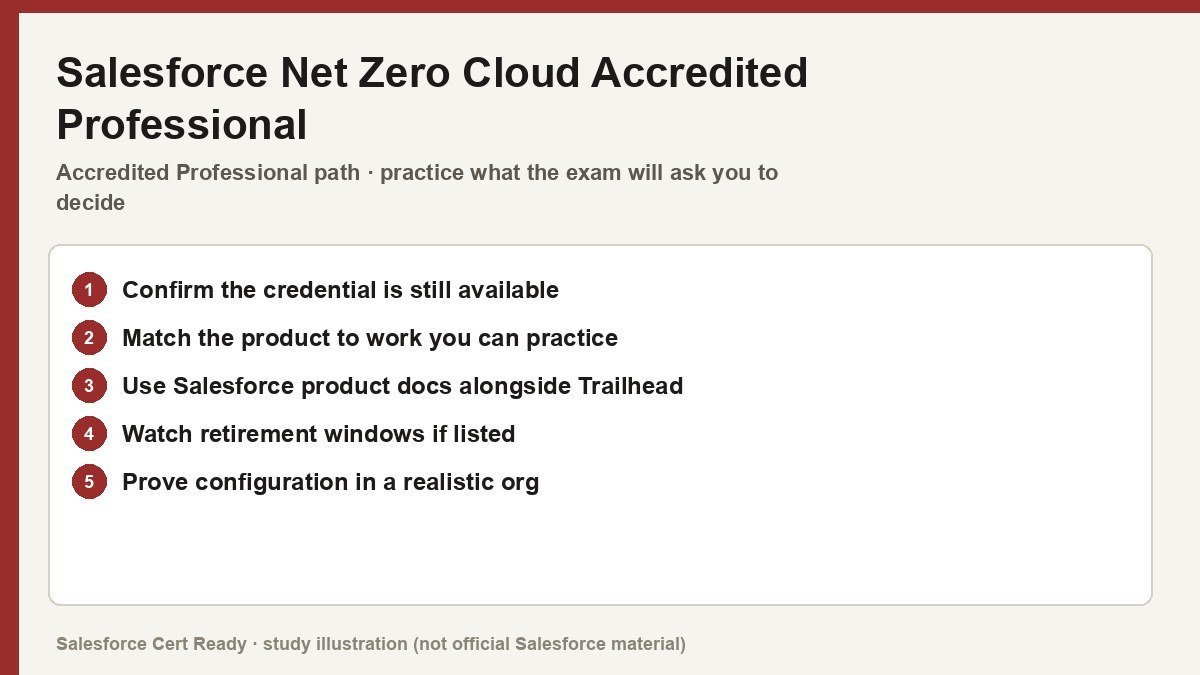
Study map for Salesforce Net Zero Cloud Accredited Professional. Confirm objectives on current Salesforce sources.
Salesforce Net Zero Cloud Accredited Professional
Catalog status checked July 19, 2026: Available; scheduled for retirement.
Salesforce says registration closes July 24, 2026, the last exam date is August 31, 2026, and the credential retires February 1, 2027.
Current credential snapshot
| Item | Current listing |
|---|---|
| Credential | Salesforce Net Zero Cloud Accredited Professional |
| Track | Accredited Professional |
| Level in source inventory | Specialty |
| Exam code in source inventory | AP-218 |
| Price in source inventory | $150 USD |
| Availability | Available; scheduled for retirement |
Exam format, objectives, pricing, and prerequisites can change. Confirm those details in Salesforce’s current exam guide before purchasing or scheduling an exam.
Study overview
Proven expertise in operationalizing sustainability and ESG reporting on the Salesforce platform.
Net Zero Cloud Accredited Professional
Mastering carbon accounting, climate action planning, and disclosure management.
At a Glance
| Feature | Details |
|---|---|
| Exam Code | AP-218 |
| Duration | 75 Minutes |
| Questions | 55 Multiple Choice / Multiple Select |
| Passing Score | 61% |
| Cost | USD $150 |
| Delivery | Online Proctored |
| Prerequisites | None Required |
| Recommended Experience | Practitioners with sustainability knowledge and experience implementing Net Zero Cloud solutions. |
Who Should Take This
- Salesforce Consultants: Functional or technical leads responsible for mapping complex ESG business requirements to out-of-the-box Salesforce features.
- Business Analysts: Professionals focused on gathering sustainability data requirements and determining appropriate levels of access and reporting outputs.
- Solution Architects: Technical designers who need to integrate external utility data, ERP systems, and travel management platforms with the
Net Zero Clouddata model. - Sustainability Analysts: ESG specialists who need to translate Greenhouse Gas (GHG) protocols into automated carbon footprint calculations and disclosures.
What You’ll Prove
This credential validates your ability to translate environmental strategy into measurable outcomes. You aren’t just memorizing dashboards; you’re proving you can architect a system of record for an organization’s entire carbon footprint. * You can design custom approval processes and declarative automation to ensure sustainability data quality and auditability.
- You can configure
Emission FactorsandEmission Factor Librariesto convert activity data (kWh, miles, liters) intoCO2emetrics. - You can implement complex data models involving
Stationary Combustion,Mobile Combustion, andScope 3categories like business travel. - You can leverage
CRM Analytics (CRMA)to build visualizations that align with major frameworks like GRI, TCFD, and CDP.
Exam Outline
| Domain | Weight | What’s Covered |
|---|---|---|
| Discovery | 24% | Use case prioritization, mapping requirements to NZC features, and determining reporting boundaries. |
| Design | 31% | Solution architecture, data modeling for Scope 1-3, UX planning, and reporting strategy. |
| Implementation | 45% | Configuration of NZC settings, data integration, Utility Data Connections, and Target Setting. |
💡 In Notion, convert each domain row into a toggle to nest your study notes underneath.
Suggested Study Path
- Master the Data Model. Spend significant time understanding how
Energy Userecords relate toCarbon Footprintrecords and how emissions are aggregated. - Review GHG Protocols. Familiarize yourself with the differences between Scope 1, Scope 2 (Location-based vs. Market-based), and Scope 3 emissions categories.
- Hands-on Configuration. Set up a developer org to practice configuring
Emission Factorsand creatingSustainability Scorecardsto see calculations in action. - Learn the Integration Patterns. Understand how to use
MuleSoftorSalesforce Connectto ingest data from utility providers or building management systems. - Practice Disclosure Reporting. Review the out-of-the-box templates for GRI and TCFD to understand how NZC maps data to these global standards.
Watch Out For
- Calculation Logic Pitfalls: Be clear on how an
Emission Factormultiplier is applied to activity units. Small errors here break the entire carbon footprint. - Scope 2 Distinctions: The exam frequently tests the difference between
Location-Based(grid average) andMarket-Based(contractual instruments like RECs) methods. - Data Migration Order: Importing sustainability data requires a specific sequence—ensure you know which objects (like
Stationary Asset Environmental Source) must exist first. - Permissions Complexity: Pay close attention to who needs access to
Sustainability Disclosuresversus who enters daily energy usage data.
Resources
- Official Exam Guide – Access the full curriculum in the Partner Learning Camp (PLC).
- Net Zero Cloud Documentation – The definitive source for object relationships and setup steps.
- Trailhead: Net Zero Cloud Basics – Free self-paced learning module for fundamental concepts.
- Greenhouse Gas Protocol – External reference for the standards that Net Zero Cloud is built upon.
Stop moving spreadsheets around and start building a real climate strategy. Passing this means you’re officially ready to help save the planet, one data point at a time.
Official status sources
Catalog status last verified: 2026-07-19.