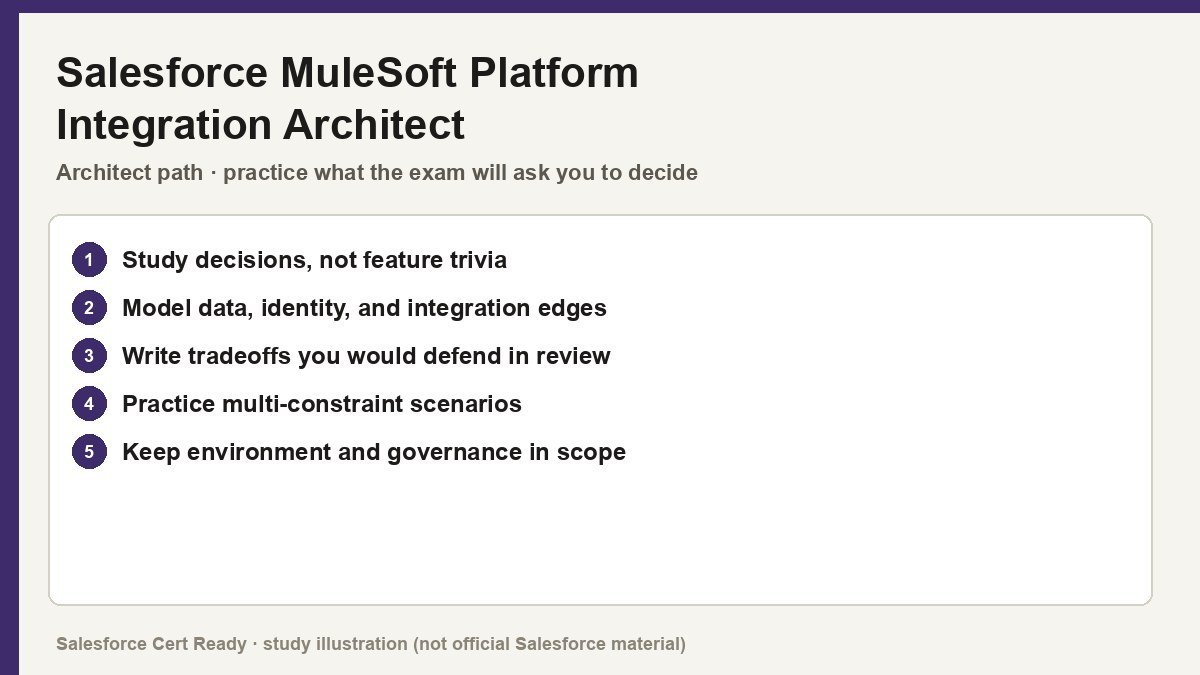
Study map for Salesforce MuleSoft Platform Integration Architect. Confirm objectives on current Salesforce sources.
Salesforce MuleSoft Platform Integration Architect
Catalog status checked July 19, 2026: Available.
Current credential snapshot
| Item | Current listing |
|---|---|
| Credential | Salesforce MuleSoft Platform Integration Architect |
| Track | Architect |
| Level in source inventory | Senior |
| Exam code in source inventory | Mule-Arch-202 |
| Price in source inventory | $400 USD |
| Availability | Available |
Exam format, objectives, pricing, and prerequisites can change. Confirm those details in Salesforce’s current exam guide before purchasing or scheduling an exam.
Study overview
⚡ Bridge the gap between business requirements and technical execution on the Anypoint Platform.Salesforce Certified MuleSoft Platform Integration Architect
Validating the ability to lead Anypoint Platform implementations and drive the technical quality of integration solutions.
At a Glance
| Feature | Details |
|---|---|
| Exam Code | Mule-Arch-202 |
| Duration | 120 minutes |
| Questions | 60 multiple-choice |
| Passing Score | 70% |
| Cost | $400 USD |
| Delivery | Online proctored or onsite testing center |
| Prerequisites | None |
| Recommended Experience | Advanced experience leading Anypoint implementations and overseeing DevOps and governance. |
Who Should Take This
- Solution Architects who need to translate functional and non-functional requirements into robust integration interfaces and implementations.
- Technical Architects responsible for an organization’s
Anypoint Platformstrategy, including governance, compliance, and operationalization. - Senior Developers ready to transition into a strategic role focusing on architecture decisions, trade-offs, and enterprise-grade best practices.
What You’ll Prove
This credential validates your technical leadership and ability to design scalable, secure, and resilient integration solutions that drive digital transformation. You aren’t just building flows; you are governing the entire ecosystem. * You can design high-level architectures using API-led connectivity, including System, Process, and Experience layers.
- You can select the appropriate deployment approach and configuration for
Anypoint Platformacross various control and runtime plane options. - You can advise technical teams on performance, scalability, reliability, and monitoring to meet strict enterprise non-functional requirements.
- You can enforce security standards through
OAuth 2.0, mutualTLS, and robust identity and access management policies. - You can oversee the automation of interaction with the platform using
CI/CDpipelines andMuleSoft-provided Maven plugins.
Exam Outline
| Domain | Weight | What’s Covered |
|---|---|---|
| Runtime Plane Technology Architecture | 15% | CloudHub (1.0 vs 2.0), Runtime Fabric, hybrid deployments, and high availability. |
| Designing and Developing Mule Applications | 15% | Mule 4 class loader isolation, flow structuring, and efficient module usage. |
| Applying DevOps and Operations | 14% | CI/CD pipelines, Anypoint Monitoring, Visualizer, and logging configurations. |
| Integration Paradigms | 10% | API-led connectivity, event-driven APIs, and message brokers. |
| Non-Functional Requirements (NFRs) | 15% | Reliability patterns, idempotency, and performance optimization (threading, streaming). |
| Security and Persistence | 17% | OAuth, TLS, secret management, and handling persistent data. |
| Initiating and Testing Solutions | 13% | Requirement differentiation, MUnit design, and performance testing. |
💡 In Notion, convert each domain row into a toggle to nest your study notes underneath.
Suggested Study Path
- Master the Deployment Models. Deeply understand the trade-offs between
CloudHub,Runtime Fabric, and customer-hosted runtimes. Know when to use which for specific residency or resource needs. - Review API-led Connectivity. Internalize the purpose of each layer. Be prepared to justify why a specific logic belongs in a
Process APIversus aSystem APIin a complex scenario. - Deep Dive into DevOps. Review the
Mule Maven plugincapabilities and how to automate deployments. StudyAnypoint Monitoringfeatures and how they provide visibility into the application network. - Solve for NFRs. Practice designing for reliability. Understand how to use
Dead Letter Queues, retry mechanisms, andObject Storesto ensure no data is lost during transit. - Practice Scenario-Based Questions. The exam focuses on trade-offs. Use practice exams to learn how to identify the “best” enterprise-ready solution rather than just the “working” one.
Watch Out For
- The “Working” vs. “Best” Option. Multiple answers may be technically functional. Always select the one that aligns with enterprise architectural principles and long-term scalability.
- CloudHub 2.0 Specifics. Ensure you understand the architectural shifts in
CloudHub 2.0, such as the move to a shared containerized infrastructure and how it differs fromCloudHub 1.0worker models. - Class Loader Isolation. Don’t ignore the technicalities of how
Mule 4handles module isolation. It’s a common technical hurdle on the exam that developers often overlook.
Resources
- Official MuleSoft Integration Architect Exam Guide
- Anypoint Platform Architecture: Integration Solutions (ARC730)
- MuleSoft Documentation: Deployment Options
- MuleSoft Developer Tutorials
Stop building point-to-point messes and start architecting a real network. If you fail, just call it a “discovery phase” and try again.
Official status sources
Catalog status last verified: 2026-07-19.