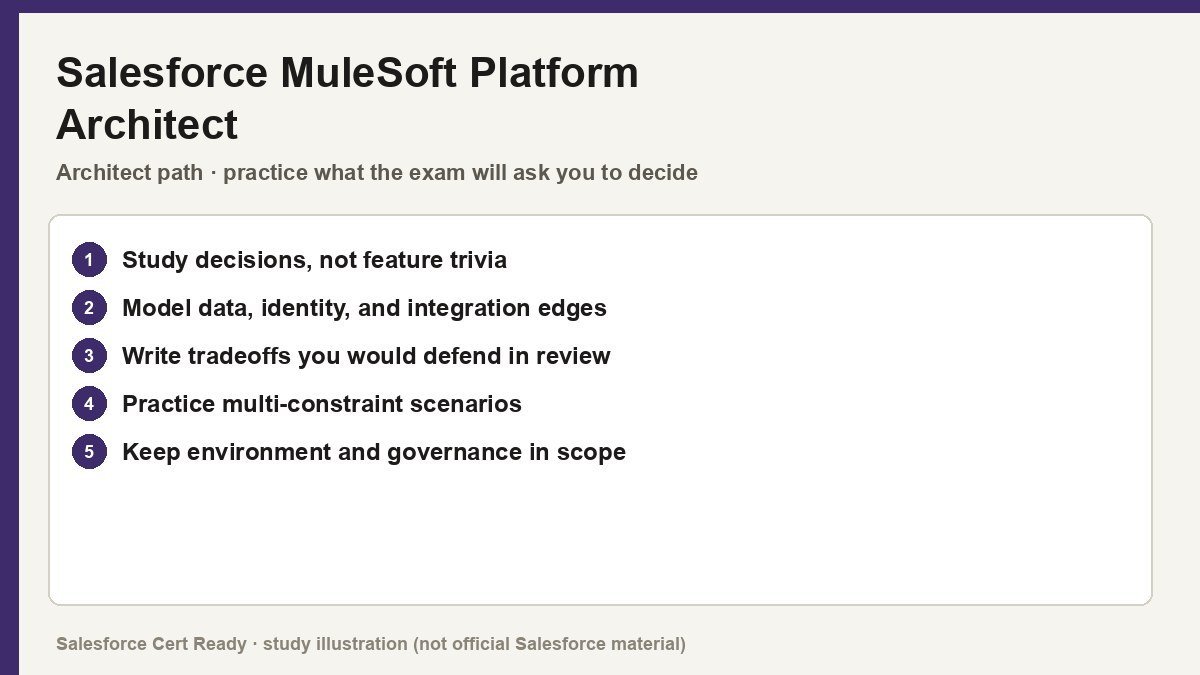
Study map for Salesforce MuleSoft Platform Architect. Confirm objectives on current Salesforce sources.
Salesforce MuleSoft Platform Architect
Catalog status checked July 19, 2026: Available.
Current credential snapshot
| Item | Current listing |
|---|---|
| Credential | Salesforce MuleSoft Platform Architect |
| Track | Architect |
| Level in source inventory | Senior |
| Exam code in source inventory | Mule-Arch-201 |
| Price in source inventory | $400 USD |
| Availability | Available |
Exam format, objectives, pricing, and prerequisites can change. Confirm those details in Salesforce’s current exam guide before purchasing or scheduling an exam.
Study overview
☁️ Build the blueprint for an effective enterprise application network.Salesforce Certified MuleSoft Platform Architect
The standard for defining and leading Anypoint Platform strategy and API-led connectivity.
At a Glance
| Item | Details |
|---|---|
| Exam Code | Mule-Arch-201 |
| Duration | 120 Minutes |
| Questions | 60 Multiple-choice |
| Passing Score | 70% |
| Cost | $400 USD |
| Delivery | Online proctored or Onsite testing center |
| Prerequisites | None |
| Recommended Experience | Experience defining Anypoint Platform strategy and directing API-led connectivity across an organization. |
🎯 Who Should Take This – Solution Architects who need to design high-level integration strategies that align with business goals and infrastructure constraints.
- Integration Architects responsible for establishing the technical foundations, governance, and organizational standards for
MuleSoftadoption. - Technical Leads moving into strategic roles who want to master the transition from building individual integrations to managing an entire application network.
- Senior Developers ready to prove they can optimize platform deployment and drive multi-line of business (LoB) scale.
What You’ll Prove
This certification validates your ability to think beyond a single project. You are demonstrating that you can architect a sustainable, scalable ecosystem where APIs are treated as reusable products rather than just technical glue. – You can design an effective application network using the three-layer architecture of System, Process, and Experience APIs.
- You can establish organizational foundations, including the creation of a Center for Enablement (
C4E) and key performance indicators (KPIs). - You can govern APIs across the lifecycle by applying appropriate security policies,
SLAtiers, and versioning strategies. - You can optimize deployment topologies, selecting the right
CloudHubworker configurations and networking features likeVPCand load balancers. - You can monitor and analyze application networks to ensure reliability, performance, and visibility for technical and business stakeholders.
Exam Outline
| Domain | Weight | What’s Covered |
|---|---|---|
| Explaining Application Network Basics | 7% | API-led connectivity, web API characteristics, and API tiers. |
| Establishing Foundations | 10% | C4E setup, MuleSoft Catalyst, and control/runtime plane hosting. |
| Designing and Sharing APIs | 10% | API dependencies, reusable assets in Exchange, and versioning. |
| Layered API Architecture | 12% | System, Process, and Experience layer assignment and data modeling. |
| Governing Web APIs | 17% | API Manager instances, security policies, and NFR support. |
| Architecting and Deploying | 11% | Auto-discovery, VPC requirements, and runtime plane options. |
| Deploying to CloudHub | 11% | Object Store usage, worker sizing, and reliability predictions. |
| Meeting API Quality Goals | 10% | Caching vs. OS, resilience strategies, and horizontal scaling. |
| Monitoring and Analyzing | 12% | Anypoint Platform metrics, alerting, and logging configurations. |
💡 In Notion, convert each domain row into a toggle to nest your study notes underneath.
Suggested Study Path
- Master API-led Connectivity by internalizing the specific responsibilities of System, Process, and Experience layers. You must be able to categorize any given business requirement into one of these buckets instantly.
- Review Platform Foundations with a focus on
MuleSoft Catalystand theC4Emodel. Understand the “why” behind organizational changes, not just the technical setup. - Deep Dive into API Governance by studying
API ManagerandAPI Gateway. Know which policies (OAuth 2.0, Rate Limiting, etc.) apply to which layers and how to handleSLAtiers. - Learn CloudHub Topologies including the differences between Shared and Dedicated Load Balancers,
VPCconfigurations, and how worker sizing impacts performance. - Analyze Quality Attributes to understand the trade-offs between horizontal scaling, caching strategies, and using
Object Storefor persistence. - Practice with Real Scenarios by taking mock exams that focus on decision-making rather than rote memorization. The exam is heavy on “Given a scenario, what is the best approach?”
⚠️ Watch Out For – Layer Confusion: Don’t mistake a Process API for a System API just because it touches a database. Focus on the ownership and rate of change defined in the official docs.
- CloudHub Networking: Pay close attention to the limitations of the Shared Load Balancer (
SLB) versus the Dedicated Load Balancer (DLB), especially regarding custom certificates and vanity URLs. - Object Store Limits: Understand the difference between
Object Store v1andv2, and specifically when to useOSversus an external database or caching layer for persistence. - Versioning Nuance: Know exactly what triggers a major version increment versus a minor one. The exam often tests your ability to manage breaking changes without killing client implementations.
🔗 Resources – Official MuleSoft Platform Architect Exam Guide
- Anypoint Platform Architecture: Application Networks (ARC720)
- MuleSoft Catalyst Knowledge Hub
- Trailblazer Community: MuleSoft Group
Stop thinking about integrations as one-off plumbing projects. Pass this and start building the actual engine that runs the enterprise.
Official status sources
Catalog status last verified: 2026-07-19.