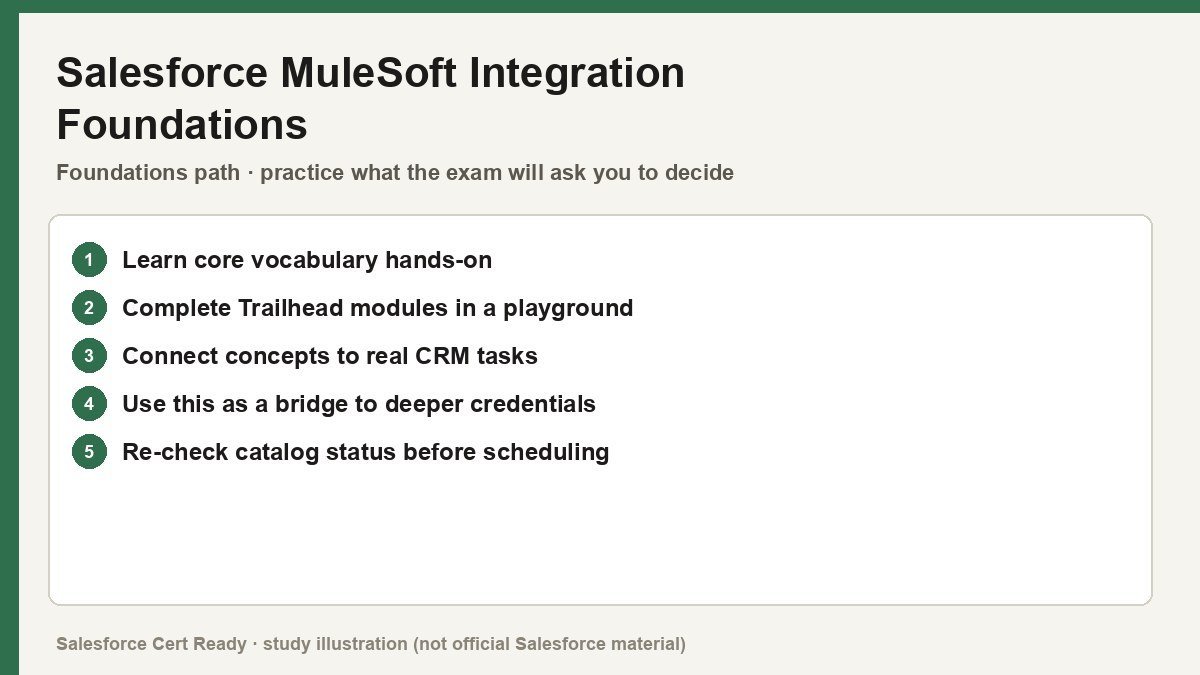
Study map for Salesforce MuleSoft Integration Foundations. Confirm objectives on current Salesforce sources.
Salesforce MuleSoft Integration Foundations
Catalog status checked July 19, 2026: Available.
Current credential snapshot
| Item | Current listing |
|---|---|
| Credential | Salesforce MuleSoft Integration Foundations |
| Track | Foundations |
| Level in source inventory | Entry |
| Exam code in source inventory | Mule-101 |
| Price in source inventory | $75 USD |
| Availability | Available |
Exam format, objectives, pricing, and prerequisites can change. Confirm those details in Salesforce’s current exam guide before purchasing or scheduling an exam.
Study overview
🔌 Stop building point-to-point spaghetti and start architecting for agility with API-led connectivity.MuleSoft Integration Foundations
Mastering the core concepts of Anypoint Platform and the modern integration lifecycle.
At a Glance
| Feature | Details |
|---|---|
| Exam Code | Mule-101 |
| Duration | 70 Minutes |
| Questions | 40 multiple-choice (plus 5 unscored) |
| Passing Score | 70% |
| Cost | $75 USD |
| Delivery | Onsite or Online Proctored |
| Prerequisites | None |
| Recommended Experience | Interest in MuleSoft project teams and basic knowledge of API terminology |
Who Should Take This
- Aspiring Integration Pros: Individuals looking to join a MuleSoft project team as an informed member with a solid grasp of
API-led connectivity. - Project Managers: Leaders who need to understand the roles, responsibilities, and lifecycle phases of a typical integration project to manage timelines and stakeholders effectively.
- IT Operations & Owners: Professionals who oversee integration products and need to distinguish between various
IaaS,PaaS, andSaaSmodels within the enterprise ecosystem. - Developers & Architects: Technical team members new to the MuleSoft ecosystem who want to validate their understanding of
Anypoint Platformcomponents before diving into more advanced certifications.
What You’ll Prove
This certification validates your ability to navigate the strategic and technical landscape of modern system integration. It shifts the focus from “how to code” to “how to connect” using industry-standard patterns and the MuleSoft methodology. * You can identify the specific roles and responsibilities within a MuleSoft project team, from design to management.
- You can explain the core benefits of
Anypoint Platformfor both system integration and comprehensive API management. - You can distinguish between legacy point-to-point approaches and modern, reusable API-led connectivity strategies.
- You can classify various types of virtualization, computing, and storage infrastructure required by enterprise-grade systems.
- You can interpret essential integration terminology such as
message,variable, andspecificationwithin the MuleSoft context. - You can deconstruct complex business problems into their fundamental integration use cases and technical constituents.
Exam Outline
| Domain | Weight | What’s Covered |
|---|---|---|
| Project Lifecycle & Roles | 17% | Steps of design, implement, and manage stages; project team responsibilities. |
| Core Concepts & Terminology | 20% | Essential integration vocabulary; IaaS vs. PaaS vs. SaaS; system scalability. |
| Common Problems & Solutions | 17% | Legacy vs. modern approaches; identifying use cases for end-to-end solutions. |
| Technical Complexities | 18% | Patterns in integration development; purpose of different integration technologies. |
| Anypoint Platform: Integration | 18% | Components and benefits of the platform for connecting disparate systems. |
| Anypoint Platform: API Management | 10% | Product-centric API lifecycle; governing and managing APIs within the ecosystem. |
💡 In Notion, convert each domain row into a toggle to nest your study notes underneath.
Suggested Study Path
- Understand the Methodology: Start by deeply internalizing the
API-led connectivityphilosophy. It is the bedrock of this exam and dictates how MuleSoft views “good” architecture. - Learn the Lifecycle: Memorize the stages of the MuleSoft API lifecycle—Design, Implementation, and Management. Know which
Anypoint Platformtools (likeDesign CenterorAPI Manager) apply to each. - Review Core Infrastructure: Ensure you can clearly explain the difference between cloud service models (
IaaS,PaaS,SaaS) and why a customer would choose a MuleSoft-hosted runtime over a customer-hosted one. - Analyze Team Roles: Study the specific tasks assigned to an
API Developerversus anIntegration Architect. Expect questions on who builds the implementation versus who defines the contract. - Practice with Mock Questions: Use sample questions to get used to the phrasing of “most suitable” or “predominant pattern” scenarios, especially regarding composition patterns.
- Review Spring ’24 Updates: Ensure your study materials align with the latest release, as questions are updated to reflect the most recent platform enhancements.
Watch Out For
- Tightly vs. Loosely Coupled: Don’t confuse these. In MuleSoft-land, tight coupling (high dependency) is usually the “bad” legacy characteristic you are trying to move away from.
- The IT Delivery Gap: Understand exactly how reusable assets (APIs) help close this gap. It’s not just about “working faster,” it’s about shifting from production to consumption.
- Runtime Plane Nuances: Be careful with deployment options. Know the trade-offs between
CloudHub(low effort, fast time-to-market) and customer-managed infrastructure (higher control, higher effort). - Composition Patterns: Pay attention to the difference between sequential processing (waiting for a previous step) and aggregation (gathering data from multiple sources).
Resources
- Official MuleSoft Exam Guide
- MuleSoft Training: Anypoint Platform Fundamentals
- Trailhead: MuleSoft Basics
- Anypoint Platform Documentation
- MuleSoft Community Groups
Get your terminology straight and stop calling everything “an API” when it’s really a point-to-point mess. Pass this, and you’ll at least be the person in the meeting who knows why the project is actually failing.
Official status sources
Catalog status last verified: 2026-07-19.