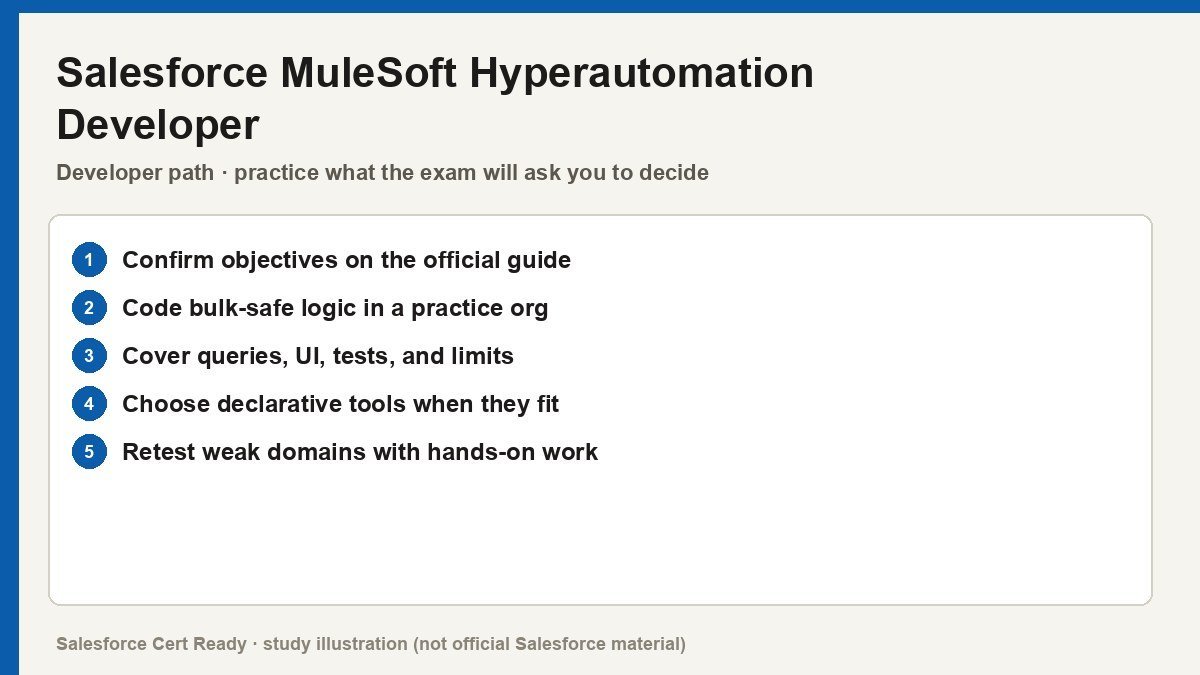
Study map for Salesforce MuleSoft Hyperautomation Developer. Confirm objectives on current Salesforce sources.
Salesforce MuleSoft Hyperautomation Developer
Catalog status checked July 19, 2026: Available; scheduled for retirement.
Salesforce says registration closes July 24, 2026, the last exam date is August 31, 2026, and the credential retires February 1, 2027.
Current credential snapshot
| Item | Current listing |
|---|---|
| Credential | Salesforce MuleSoft Hyperautomation Developer |
| Track | Developer |
| Level in source inventory | Senior |
| Exam code in source inventory | Mule-Dev-202 |
| Price in source inventory | $200 USD |
| Availability | Available; scheduled for retirement |
Exam format, objectives, pricing, and prerequisites can change. Confirm those details in Salesforce’s current exam guide before purchasing or scheduling an exam.
Study overview
🤖 Master the art of connecting everything with everything else.Salesforce Certified MuleSoft Hyperautomation Developer
Bridging the gap between Salesforce Flow, MuleSoft RPA, and Anypoint Platform.
At a Glance
| Category | Details |
|---|---|
| Exam Code | Mule-Dev-202 |
| Duration | 90 Minutes |
| Questions | 60 Multiple-choice |
| Passing Score | 70% |
| Cost | $200 USD (Retake: $100 USD) |
| Delivery | Proctored (Onsite or Online) |
| Prerequisites | None (MuleSoft Developer I highly recommended) |
| Recommended Experience | Expertise in Composer, RPA, Anypoint, and Flow |
Who Should Take This
- The Integration Architect: You are responsible for designing end-to-end automation strategies that connect legacy systems without APIs to modern cloud platforms.
- The Automation Developer: You already build complex
Salesforce Flowsolutions but need to incorporateMuleSoft RPAandComposerfor cross-platform data synchronization. - The MuleSoft Engineer: You are pivoting from traditional API-led connectivity to business-led automation using low-code tools like
ComposerandRobotic Process Automation.
What You’ll Prove
This certification validates your ability to orchestrate a symphony of automation tools. You aren’t just building scripts; you are designing resilient, scalable systems that eliminate manual toil across the entire enterprise. * You can identify the correct tool for a specific automation scenario, choosing between RPA for UI-based tasks and Anypoint for API-led integrations.
- You can design complex workflows using
Flow Orchestratorto manage multi-user, multi-step workstreams that span several days or departments. - You can implement robust error handling and fault-tolerant patterns within
MuleSoft ComposerandRPAto ensure data integrity. - You can manage the full lifecycle of an
RPAbot, from initial evaluation inRPA Managerto deployment and active monitoring. - You can leverage
Anypoint Exchangeto catalog and share assets, ensuring that your automation components are reusable and discoverable by the wider team.
Exam Outline
| Domain | Weight | What’s Covered |
|---|---|---|
| Hyperautomation Best Practices | 20% | Scenarios, tool selection, design patterns, and fault handling. |
| MuleSoft Composer | 12% | System connections, data mapping, and flow control logic. |
| MuleSoft RPA | 17% | Designing, building, testing, and deploying RPA processes. |
| Salesforce Flow | 13% | Building hyperautomation workflows and invokable actions. |
| Anypoint Platform APIs | 15% | Delivering and managing APIs within an automation project. |
| API Management | 7% | Monitoring endpoints and managing policies. |
| Anypoint Exchange | 8% | Cataloging, sharing, and reusing integration assets. |
| Flow Orchestrator | 8% | Coordinating parallel, multi-user workstreams and exit conditions. |
💡 In Notion, convert each domain row into a toggle to nest your study notes underneath.
Suggested Study Path
- Master the Big Three. Spend dedicated time in a sandbox configuring
Salesforce Flow,MuleSoft Composer, andMuleSoft RPAto understand where one tool’s capability ends and the next begins. - Review API Governance. Brush up on
Anypoint API ManagerandExchangespecifically regarding how to publish and monitor the endpoints that your automation flows will consume. - Deep Dive into RPA Lifecycle. Memorize the stages of an RPA process within
MuleSoft RPA Managerand the specificBPMNsymbols used for process modeling. - Learn Flow Orchestration. Focus on the difference between
StagesandSteps, and how to useEvaluation Flowsto control the movement of a record through a complex process. - Practice Scenario Logic. Go through sample questions that force you to choose between
Composer(simple, fast) andAnypoint(complex, high-volume) for specific data integration needs.
Watch Out For
- The “Everything is a Bot” Trap. Don’t default to
RPAjust because it’s flashy; if an API exists, useComposerorAnypointfor better reliability and performance. - Governor Limit Blindness. Remember that
Salesforce Flowwithin a hyperautomation context still respects standard DML and SOQL limits; bulkification is not optional. - Deployment Complexity. Pay close attention to how
RPAbots are assigned toMuleSoft RPA Botsand the infrastructure requirements likeRuntime Fabricfor specific AWS or hybrid setups.
Resources
- Official Salesforce Exam Guide
- Official MuleSoft Hyperautomation Trailmix
- ADX350: Build Salesforce Hyperautomation Solutions
- MuleSoft Documentation: RPA Best Practices
Stop drawing boxes on whiteboards and start making the systems talk to each other. Go pass this thing and get back to actually building something cool.
Official status sources
Catalog status last verified: 2026-07-19.