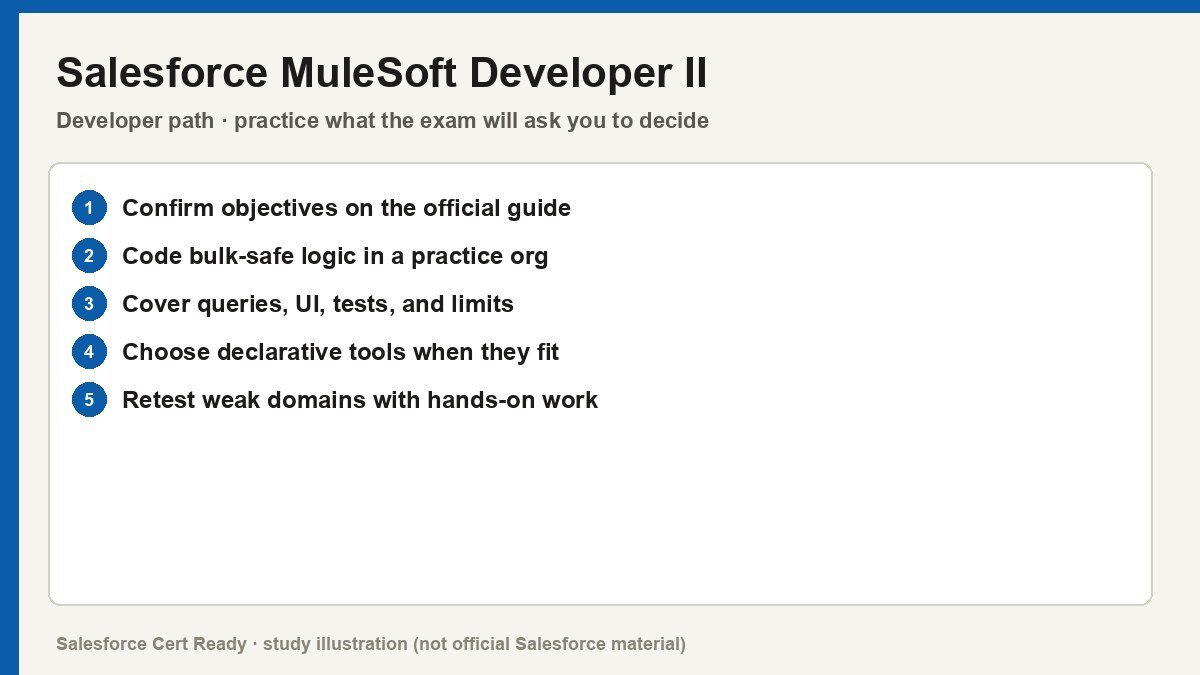
Study map for Salesforce MuleSoft Developer II. Confirm objectives on current Salesforce sources.
Salesforce MuleSoft Developer II
Catalog status checked July 19, 2026: Available.
Current credential snapshot
| Item | Current listing |
|---|---|
| Credential | Salesforce MuleSoft Developer II |
| Track | Developer |
| Level in source inventory | Senior |
| Exam code in source inventory | Mule-Dev-301 |
| Price in source inventory | $200 USD |
| Availability | Available |
Exam format, objectives, pricing, and prerequisites can change. Confirm those details in Salesforce’s current exam guide before purchasing or scheduling an exam.
Study overview
Beyond the basics: Build, secure, and scale enterprise integrations.
Salesforce Certified MuleSoft Developer II
The advanced credential for seasoned integration architects and senior developers.
At a Glance
| Feature | Details |
|---|---|
| Exam Code | Mule-Dev-301 |
| Duration | 120 minutes |
| Questions | 60 multiple-choice (plus up to 5 unscored) |
| Passing Score | 70% |
| Cost | USD $200 (Retake: $100) |
| Delivery | Proctored online or onsite testing center |
| Prerequisites | Salesforce Certified MuleSoft Developer (Level 1) |
| Experience | Professional experience with Mule 4, Maven, and DevOps |
Who Should Take This
- Senior MuleSoft Developers who have moved past basic flows and are now managing complex, production-ready APIs in a
DevOpsenvironment. - Integration Architects looking to validate their hands-on technical depth in performance tuning, advanced security, and modular application design.
- Backend Engineers responsible for the full lifecycle of
Anypoint Platformdeployments, including automated builds and monitoring strategy.
What You’ll Prove
This certification validates that you aren’t just building integrations that work, but integrations that last. It shifts the focus from “how to use a connector” to “how to build a performant, monitorable, and secure ecosystem.” * You can implement production-ready APIs using advanced API Manager policies, server-side caching, and custom OOTB configurations.
- You can architect modular Mule applications that leverage
Mavenfor automated deployment and consistent dependency management. - You can ensure high reliability and performance by implementing fault-tolerant message passing via
VMandAnypointMQ. - You can secure data at rest and in transit through environment-dependent properties and
TLSmutual authentication. - You can optimize complex data transformations using advanced
DataWeavefunctions and efficient script logic.
Exam Outline
| Domain | Weight | What’s Covered |
|---|---|---|
| API Exposure | 13% | Versioning, custom API policies, server-side caching, and webhooks. |
| Maintainability & Modularity | 25% | Maven optimization, automated deployments, MUnit testing, and custom libraries. |
| Monitoring | 15% | Health check endpoints, correlation IDs, log aggregation, and Anypoint Monitoring. |
| Performance & Reliability | 27% | ObjectStore persistence, AnypointMQ, Scatter-Gather error handling, and client-side caching. |
| Security | 20% | TLS mutual authentication, secure properties, and certificate management. |
💡 In Notion, convert each domain row into a toggle to nest your study notes underneath.
Suggested Study Path
- Audit your prerequisites. Ensure your Level 1 certification is active. This isn’t just a formality; the Level 2 exam assumes you have mastered everything in the Level 1 syllabus.
- Complete the advanced coursework. Attend or review materials for
Anypoint Platform Development: Production-Ready Development Practices(DEX660) andProduction-Ready Integrations(DEX670). These are the blueprints for the exam. - Master the Maven POM. Spend significant time understanding how to modularize applications. You should be comfortable configuring
Mavenfor automated deployments toCloudHubor on-prem runtimes. - Deep-dive into DataWeave. Go beyond simple mappings. Practice using
DataWeavemodules, custom functions, and handling complexJSON/XMLschemas with high performance in mind. - Simulate production failures. Build flows that use
Scatter-GatherandObjectStore. Purposefully break them to understand how compensating transactions and persistent storage behave under stress. - Take the official practice test. Use the
Trailhead Academypractice exam to gauge your pacing. Focus on the “why” behind incorrect answers, especially in the scenario-based questions.
Watch Out For
- Policy Scope Confusion: Distinguishing between policies applied at the
API Managerlevel versus logic implemented directly within theMuleflow is a frequent source of lost points. - ObjectStore Nuances: Understand the difference between
OSv2inCloudHubversus local persistence. Questions often test which deployment model supports specific TTL or persistence requirements. - MUnit is Not Optional: You will be tested on how to execute tests via
Mavenand how to mock specific components. Don’t skip the testing section. - TLS Handshakes: Know your way around
KeyStoresandTrustStores. You need to know how to implement mutualTLS(two-way SSL) on both the client and server side.
Resources
- Official Salesforce Exam Guide
- MuleSoft Documentation: Anypoint Platform
- Trailhead: MuleSoft Maintenance Modules
- MuleSoft Developer Community & Meetups
Level 1 proved you can build. Level 2 proves you can be trusted with the keys to the production environment. Stop overthinking the DataWeave syntax and start thinking about the architectural trade-offs.
Official status sources
Catalog status last verified: 2026-07-19.