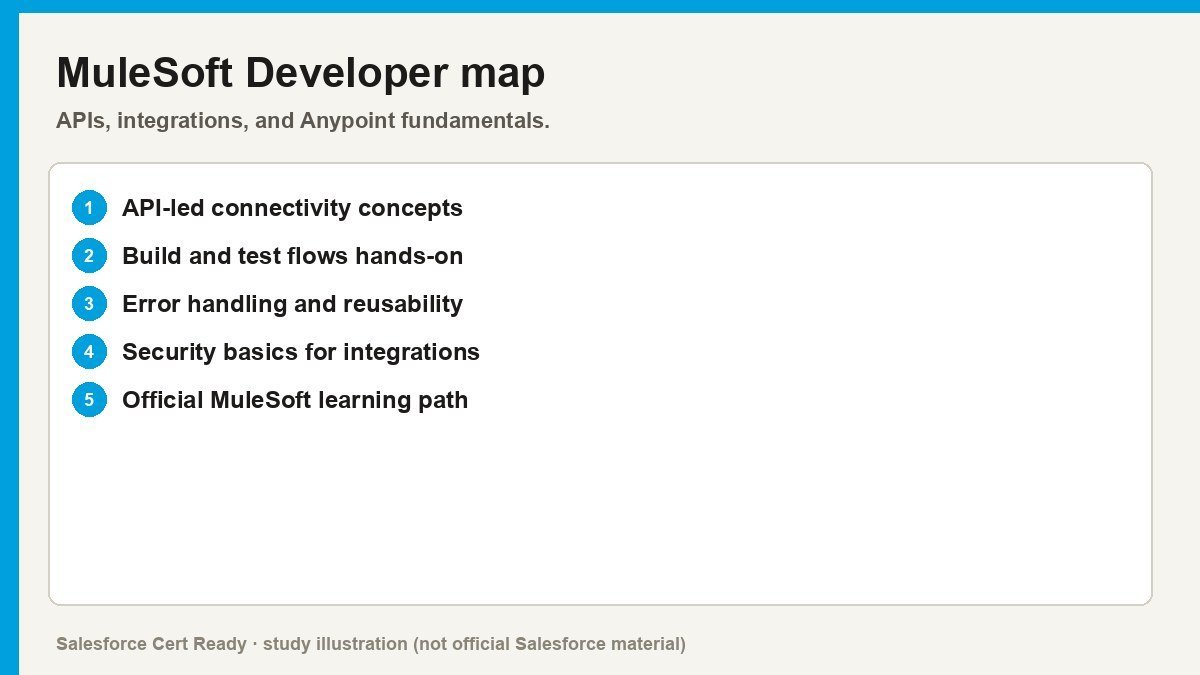
Integration credentials need real project practice.
Salesforce MuleSoft Developer
Catalog status checked July 19, 2026: Available.
Current credential snapshot
| Item | Current listing |
|---|---|
| Credential | Salesforce MuleSoft Developer |
| Track | Developer |
| Level in source inventory | Mid |
| Exam code in source inventory | Mule-Dev-201 |
| Price in source inventory | $200 USD |
| Availability | Available |
Exam format, objectives, pricing, and prerequisites can change. Confirm those details in Salesforce’s current exam guide before purchasing or scheduling an exam.
Study overview
🏗️ Connect everything. Build anything. Ship faster.MuleSoft Certified Developer – Level 1
The definitive validation for the Mule 4 integration specialist.
At a Glance
| Metric | Details |
|---|---|
| Exam Code | MCD-Level 1 |
| Duration | 120 minutes |
| Questions | 60 multiple-choice |
| Passing Score | 70% |
| Cost | $200 USD |
| Delivery | Proctored online or at a testing center |
| Prerequisites | None |
| Recommended Experience | Experience on basic Mule 4 projects with guidance and supervision |
Who Should Take This
- The Aspiring Integrator: You have a foundational understanding of Java or another object-oriented language and want to specialize in the
Anypoint Platformecosystem. - The Ecosystem Developer: You are a Salesforce or web developer looking to expand your toolkit with enterprise-grade API-led connectivity and integration patterns.
- The Technical Architect in Training: You need to master the implementation details of Mule 4 before moving into high-level solution design.
- The Professional Up-skiller: You want to validate your ability to design, build, test, and manage basic APIs and integrations under limited supervision.
What You’ll Prove
This certification proves you aren’t just a coder; you understand the “productization” of APIs. It validates that you can navigate the entire integration lifecycle—from defining a contract in RAML to deploying a secure application in CloudHub. * You can build and manage basic APIs and integrations moving from Anypoint Platform to Anypoint Studio and back.
- You can design RAML-based API specifications that define resources, methods, and reusable data types.
- You can transform complex data structures using the
DataWeave2.0 expression language to map fields between disparate systems. - You can implement robust error handling using global handlers, try scopes, and specific propagation/continuation logic.
- You can navigate the
Mule Eventdata structure, specifically managing payloads, attributes, and variables. - You can deploy applications to production-ready environments and configure basic API governance through
API Manager.
Exam Outline
| Domain | Weight | What’s Covered |
|---|---|---|
| Creating Application Networks | 7% | API-led connectivity, C4E model, and modern API characteristics. |
| Designing APIs | 8% | RAML syntax, methods, parameters, and API specifications. |
| Accessing & Modifying Events | 10% | Mule event structure, DataWeave basics, and target parameters. |
| Structuring Mule Applications | 10% | Flow references, subflows, properties files, and project modularity. |
| Building API Implementation | 7% | APIkit router, manual implementations, and response mapping. |
| Using Connectors | 10% | Database, File, FTP, and retrieval/combination of data. |
| Processing Records | 10% | For Each scopes, Batch jobs, and data persistence. |
| Transforming Data | 10% | DataWeave functions, modules, type coercion, and filtering. |
| Routing Events | 8% | Choice routers, Scatter-Gather, and event validation. |
| Handling Errors | 8% | On-Error Propagate vs. Continue, Try scopes, and custom mapping. |
| Debugging & Troubleshooting | 5% | MUnit basics, root cause analysis, and debugger usage. |
| Deploying & Managing | 7% | CloudHub deployment, API Manager, and Auto-discovery. |
💡 In Notion, convert each domain row into a toggle to nest your study notes underneath.
Suggested Study Path
- Master the Fundamentals. Enroll in the
Anypoint Platform Development: Fundamentals (DEX401)course. It is the gold standard for this exam and covers the vast majority of the technical objectives. - Build Your Own POC. Don’t just watch videos. Download
Anypoint Studioand complete the DIY exercises. You need muscle memory for configuring connectors and writing DataWeave scripts. - Learn the Mule Event Lifecycle. Spend extra time understanding how the message moves through a flow. If you don’t understand the difference between
payloadandattributesat any given step, the exam will trip you up. - Deep Dive into Error Handling. This is a frequent “make-or-break” section. Build a flow that intentionally fails and observe how
On-Error PropagateandOn-Error Continueaffect the parent flow and the HTTP response code. - Take Practice Exams. Use the official self-assessment quiz. If you are consistently hitting 80% or higher, you are ready for the proctored attempt.
Watch Out For
- The “Continue” Trap: Many candidates confuse
On-Error Continuewith “retrying.” It actually stops the execution and returns a success (200 OK) response to the caller. Know exactly when the state returns to the parent flow. - Variable Scope in Scatter-Gather: Remember that variables created inside a
Scatter-Gatherroute are not automatically merged back into the main event in the same way payloads are. - RAML URI vs. Query Parameters: Pay attention to when to use a URI parameter (resource identification) versus a query parameter (filtering/sorting). The exam loves to test this distinction.
- Target Variables: Using a
Target Variablein a connector prevents the current payload from being overwritten. Forgetting this leads to logic errors in your transformations.
Resources
- Official MuleSoft Certification Guide
- Course: Anypoint Platform Development: Fundamentals
- MuleSoft Documentation: DataWeave Reference
- Trailhead: Getting Started with Anypoint Platform
- MuleSoft Community Meetups
Stop worrying about the 2-hour timer and start worrying about your error handlers. If you can build a stable flow in your sleep, the cert is just a formality.
Official status sources
Catalog status last verified: 2026-07-19.