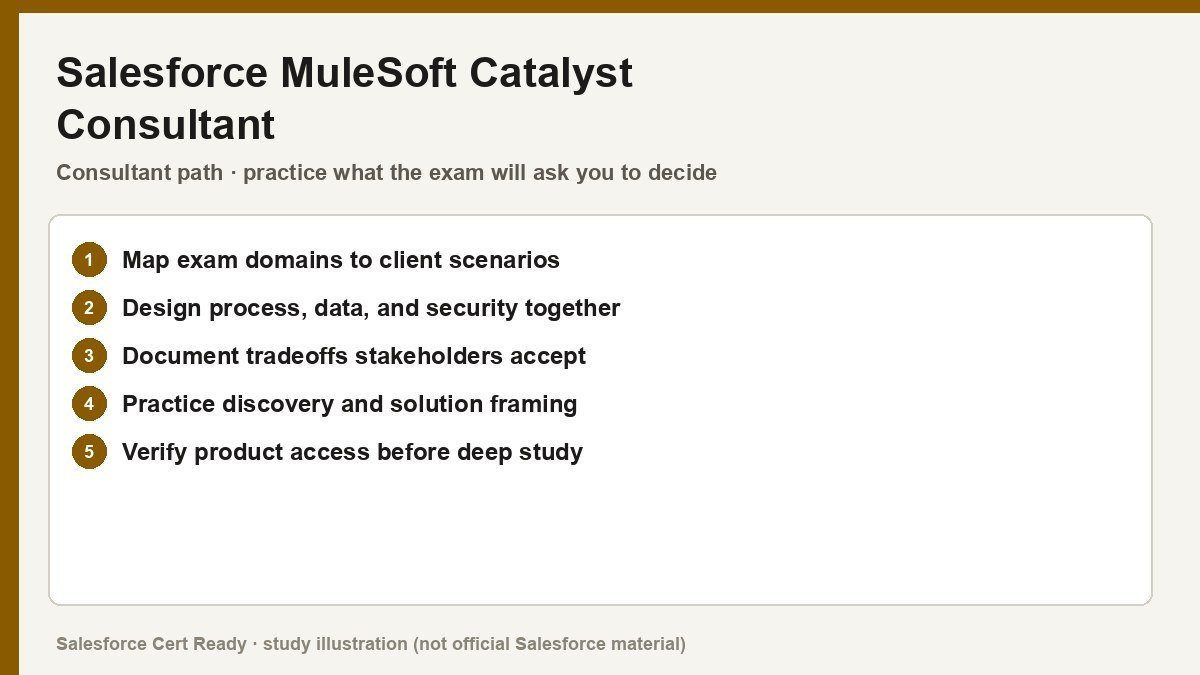
Study map for Salesforce MuleSoft Catalyst Consultant. Confirm objectives on current Salesforce sources.
Salesforce MuleSoft Catalyst Consultant
Catalog status checked July 19, 2026: Available; scheduled for retirement.
Salesforce says registration closes July 24, 2026, the last exam date is August 31, 2026, and the credential retires February 1, 2027.
Current credential snapshot
| Item | Current listing |
|---|---|
| Credential | Salesforce MuleSoft Catalyst Consultant |
| Track | Consultant |
| Level in source inventory | Senior |
| Exam code in source inventory | Mule-Con-201 |
| Price in source inventory | $200 USD |
| Availability | Available; scheduled for retirement |
Exam format, objectives, pricing, and prerequisites can change. Confirm those details in Salesforce’s current exam guide before purchasing or scheduling an exam.
Study overview
💎 Stop delivering projects and start delivering business outcomes.Salesforce Certified MuleSoft Catalyst Consultant
Mastering the outcome-driven methodology for composable architecture and organizational enablement.
At a Glance
| Feature | Details |
|---|---|
| Exam Code | Mule-Con-201 |
| Duration | 90 Minutes |
| Questions | 45 multiple-choice questions |
| Passing Score | 70% (32/45 correct) |
| Cost | $200 USD (One free retake included) |
| Delivery | Online proctored or onsite testing center |
| Prerequisites | None |
| Experience | 4–8 weeks prep; integration or consulting background recommended |
Who Should Take This
- Business Consultants who need to identify high-value business outcomes and align stakeholders across technical and business functions.
- Integration Architects moving beyond technical delivery to focus on building composable enterprises and scalable API strategies.
- Program Managers responsible for establishing a
Center for Enablement(C4E) and driving organizational change management. - MuleSoft Partners seeking to validate their expertise in the official Catalyst methodology for professional services engagements.
What You’ll Prove
This credential validates your ability to act as a bridge between business strategy and technical implementation. It proves you don’t just build APIs; you build systems that drive measurable ROI. * You can categorize business environment drivers, visions, and KPIs into a logical network of influences.
- You can design composable solutions using
Domain-Driven Design(DDD), Bounded Contexts, and high functional cohesion. - You can differentiate between Catalyst Playbooks (consistent 4-phase approach) and Delivery Approaches (unique, focus-specific steps).
- You can implement the
C4Emodel to decentralize development and maximize asset reuse across the enterprise. - You can reframe the value of the Catalyst approach when teams or stakeholders begin to diverge from best practices.
Exam Outline
| Domain | Weight | What’s Covered |
|---|---|---|
| Catalyst Fundamentals | 22% | Methodology components, engagement types, roles, and asset lifecycles. |
| Catalyst Knowledge Hub | 7% | Navigating playbooks, filtering assets, and leveraging the COVEO search. |
| Architecting with Catalyst | 13% | Separating platform from solutions and bridging business-tech gaps. |
| Realize Business Outcomes | 11% | Defining SMART KPIs, stakeholder alignment, and scope management. |
| Design Composable Solutions | 20% | API-led connectivity, EDA, batch patterns, and idempotency. |
| Establish a C4E | 15% | Organizational models, governance, and evangelizing reuse. |
| Positioning & Reframing | 12% | Handling objections to scope changes and methodology adoption. |
💡 In Notion, convert each domain row into a toggle to nest your study notes underneath.
Suggested Study Path
- Take the Trailhead course titled “Delivering Successful Business Outcomes with Catalyst” to internalize the core pillars.
- Explore the Knowledge Hub to understand the six Playbooks (Business Outcomes, Anypoint Platform, Projects, C4E, Internal Support, Training).
- Internalize the four phases—Plan for Success, Establish the Foundation, Build to Scale, and Measure Impact—which apply to every playbook.
- Study architectural principles such as
Functional Cohesion,Logical Decoupling, and how to architect for long-term goals vs. short-term wins. - Practice scenario-based questions that force you to choose the best way to handle stakeholder objections or scope creep.
- Simulate the exam environment using a 90-minute timer for 45 questions to ensure you can maintain a 2-minute-per-question pace.
Watch Out For
- Confusing Playbooks vs. Delivery Approaches. Remember that Playbooks follow the consistent 4-phase cycle, while Delivery Approaches are unique and targeted toward partners.
- The C4E vs. CoE distinction. The exam tests your understanding of why a
C4E(enablement) is superior to a traditionalCoE(centralized control) for scaling. - Misunderstanding API-led connectivity. It isn’t just about REST; you need to know how these principles apply to
Event-Driven Architecture(EDA) and batch processing. - Overlooking “Everything is a Product.” Catalyst shifts away from “Project” thinking. If an answer choice prioritizes a one-off project over a reusable product, it’s likely a distractor.
Resources
- Official Exam Guide
- Catalyst Knowledge Hub (Requires Anypoint Login)
- Metrics Toolkit GitHub
- Trailhead: MuleSoft Catalyst Basics
Now go pass this thing and stop reinventing the wheel. Your stakeholders (and your sanity) will thank you.
Official status sources
Catalog status last verified: 2026-07-19.