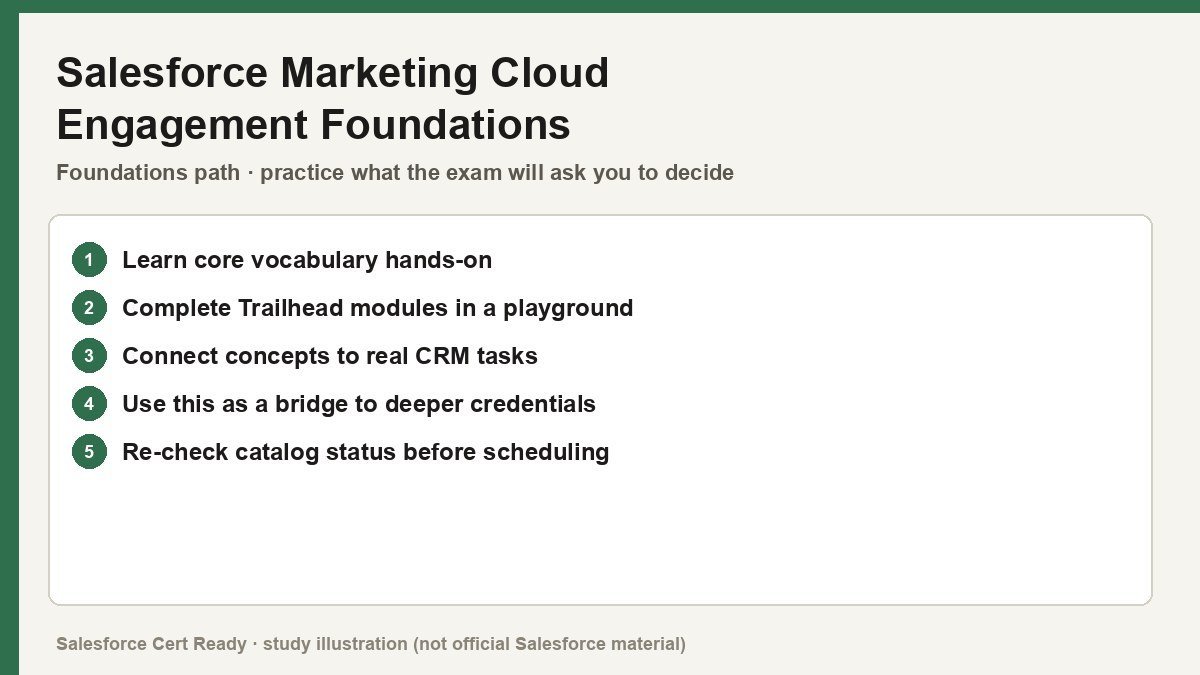
Study map for Salesforce Marketing Cloud Engagement Foundations. Confirm objectives on current Salesforce sources.
Salesforce Marketing Cloud Engagement Foundations
Catalog status checked July 19, 2026: Available.
Current credential snapshot
| Item | Current listing |
|---|---|
| Credential | Salesforce Marketing Cloud Engagement Foundations |
| Track | Foundations |
| Level in source inventory | Entry |
| Exam code in source inventory | MC-101 |
| Price in source inventory | $75 USD |
| Availability | Available |
Exam format, objectives, pricing, and prerequisites can change. Confirm those details in Salesforce’s current exam guide before purchasing or scheduling an exam.
Study overview
⚡ Your entry point into the world of multi-channel digital marketing.Marketing Cloud Engagement Foundations
A foundational credential for marketing professionals in the Salesforce ecosystem.
At a Glance
| Feature | Detail |
|---|---|
| Exam Code | MC-101 |
| Duration | 70 Minutes |
| Questions | 40 multiple-choice (plus ~5 unscored) |
| Passing Score | 65% |
| Cost | $75 USD |
| Delivery | Online proctored or Onsite testing center |
| Prerequisites | None |
| Recommended Experience | 0-6 months using Marketing Cloud Engagement |
🎯 Who Should Take This – Digital Marketing Beginners who are new to the Salesforce platform and want to validate their baseline knowledge of marketing automation.
- Salesforce Administrators looking to expand their cross-cloud expertise into the marketing domain without starting with advanced technical tracks.
- Career Changers exploring roles in marketing technology (MarTech) who need a credible, entry-level certification to bolster their resume.
- Junior Marketers currently using
Email StudioorJourney Builderwho want to ensure they follow Salesforce best practices and compliance standards.
What You’ll Prove
This certification demonstrates your grasp of how Marketing Cloud Engagement solves business challenges through automated communication. It confirms you understand the “why” behind marketing strategies and the “how” of the platform’s core interface. – You can identify the correct use cases for Business Units, Permissions, and Account Structures to maintain a clean instance.
- You can differentiate between
Subscriber Key,Contact Key, andContact IDto maintain accurate data relationships. - You can execute basic email campaign tasks, including content creation in
Content Builderand managing sends via theSend Wizard. - You can configure simple, linear customer journeys in
Journey Builderusing standardEntry SourcesandActivities. - You can interpret standard email metrics like
Bounce Rate(hard vs. soft),Open Rate, andUnsubscribe Rateto troubleshoot deliverability.
Exam Outline
| Domain | Weight | What’s Covered |
|---|---|---|
| Marketing Concepts | 28% | Privacy laws (GDPR, CAN-SPAM), opt-in processes, and general campaign metrics. |
| Engagement Basics | 22% | Platform navigation, Business Units, account structure, and official support resources. |
| Email Sending & Journeys | 22% | Content Builder templates, Journey Builder activation, and Send Classification settings. |
| Data Management | 18% | Data Extension properties, attributes, and import methods using the Import Wizard. |
| Reporting & Analytics | 10% | Locating tracking data, interpreting send results, and identifying deliverability issues. |
💡 In Notion, convert each domain row into a toggle to nest your study notes underneath.
Suggested Study Path
- Complete the official Trailmix on Trailhead to get hands-on experience with the
Marketing Cloud Engagementinterface and basic terminology. - Master the Privacy Laws by specifically comparing the requirements of
CAN-SPAM,GDPR, andCCPAas they apply to email design and consent. - Practice Data Modeling by learning when to use
ListsversusData Extensionsand understanding the crucial role of theSubscriber Key. - Build a Journey in a sandbox or via simulation to understand how
Entry Sources,Wait Activities, andDecision Splitsfunction in sequence. - Review the Send Flow step-by-step, ensuring you know how to validate content, select an audience, and choose the right
Delivery Profile. - Take a Practice Exam to get comfortable with the three-option multiple-choice format and scenario-based questions typical of this level.
⚠️ Watch Out For – The “Double Negative” Trap: Some questions use phrasing like “Which of these is NOT a requirement…” or include double negatives in the options. Read every word twice.
- Key Confusion: Do not walk into the exam without a firm grasp on the difference between a
Subscriber Key(unique identifier) and aPrimary Key(database uniqueness). - Compliance nuances:
CAN-SPAMrequirements (like physical address presence) are frequently tested alongsideGDPRdata subject rights. Know the specific differences. - Bounce Classification: Ensure you can clearly distinguish a
Hard Bounce(permanent failure) from aSoft Bounce(temporary failure) and how the platform handles them over time.
🔗 Resources – Official Salesforce Exam Guide
- Trailhead: Get to Know Marketing Cloud Engagement
- Trailhead: Create and Send Targeted Emails
- Trailblazer Community: Certification Exam Resources
Stop overthinking the technicalities and focus on the marketing logic. If you know how a newsletter gets from a database to an inbox legally, you’re already halfway there.
Official status sources
Catalog status last verified: 2026-07-19.