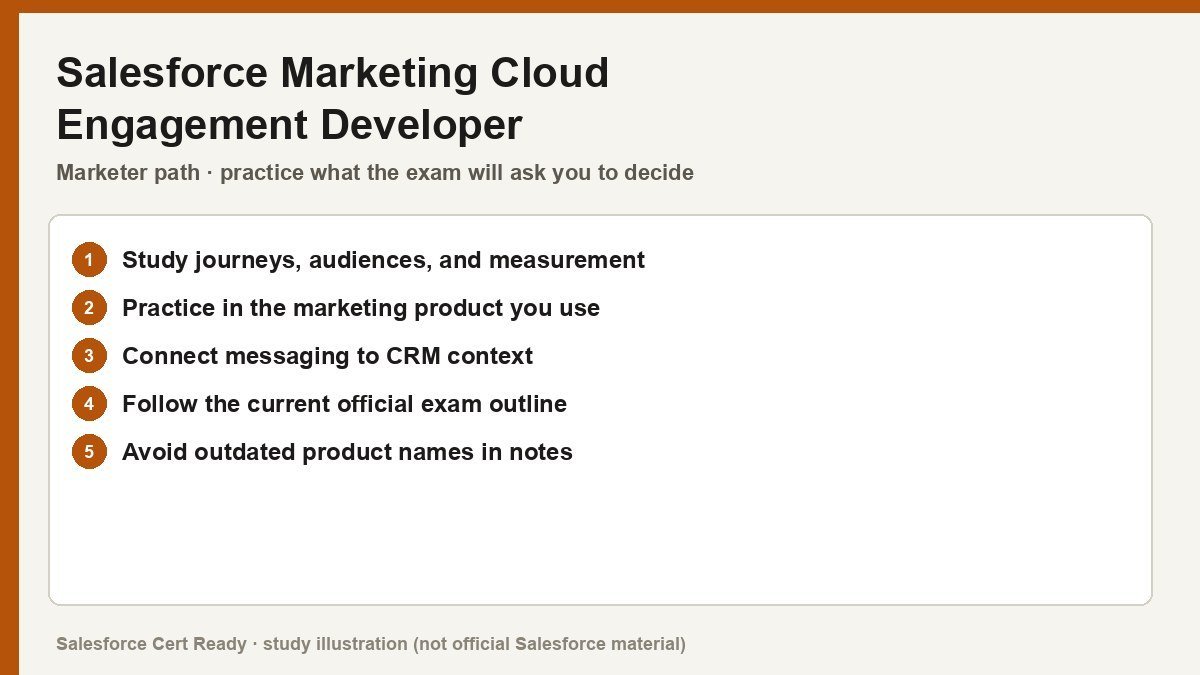
Study map for Salesforce Marketing Cloud Engagement Developer. Confirm objectives on current Salesforce sources.
Salesforce Marketing Cloud Engagement Developer
Catalog status checked July 19, 2026: Available.
Current credential snapshot
| Item | Current listing |
|---|---|
| Credential | Salesforce Marketing Cloud Engagement Developer |
| Track | Marketer |
| Level in source inventory | Senior |
| Exam code in source inventory | MCE-Dev-201 |
| Price in source inventory | $200 USD |
| Availability | Available |
Exam format, objectives, pricing, and prerequisites can change. Confirm those details in Salesforce’s current exam guide before purchasing or scheduling an exam.
Study overview
⚡️ Stop sending plain text. Start building programmable marketing.Marketing Cloud Engagement Developer
The technical backbone of personalized multi-channel customer journeys.
At a Glance
| Item | Details |
|---|---|
| Exam Code | MCE-Dev-201 |
| Duration | 105 minutes |
| Questions | 60 multiple-choice + 5 unscored |
| Passing Score | 63% |
| Cost | $200 (Retake $100) |
| Delivery | Online Proctored or Test Center |
| Prerequisites | Salesforce Certified Marketing Cloud Email Specialist |
| Recommended Experience | 6-12 months hands-on experience in Marketing Cloud |
Who Should Take This
- The Full-Stack Marketer: You already know how to build emails, but you want to move beyond drag-and-drop to handle complex data and logic.
- The Integration Engineer: You are the person responsible for connecting external systems to Marketing Cloud via REST and SOAP APIs.
- The Data Architect: You design the complex data extensions and
SQLqueries that power high-scale segmentation and automation.
What You’ll Prove
This certification validates that you aren’t just a platform user, but a platform builder. It confirms you can handle the programmatic side of Salesforce’s most powerful marketing tool, from writing efficient AMPscript to managing the OAuth flow for secure integrations. * You can design complex Contact Builder models that relate data across multiple channels using a single Contact Key.
- You can program dynamic content using
AMPscriptandSSJSto create hyper-personalized messages. - You can integrate external databases and applications using the
RESTandSOAPAPIs. - You can manage large-scale data sets using
SQLQuery Activities withinAutomation Studio. - You can secure customer data by implementing encryption and following platform security best practices.
Exam Outline
| Domain | Weight | What’s Covered |
|---|---|---|
| Programmatic Languages | 35% | AMPscript syntax, SSJS for landing pages, and best practices. |
| API | 22% | REST vs SOAP, OAuth authentication, and response handling. |
| Data Management | 22% | SQL queries, imports, extracts, and Send Log configuration. |
| Data Modeling | 14% | Contact Builder, Attribute Groups, and Contact Delete. |
| Security | 7% | Data encryption, account permissions, and platform security. |
💡 In Notion, convert each domain row into a toggle to nest your study notes underneath.
Suggested Study Path
- Master the Basics by completing the
Marketing Cloud Engagement Developer Basicsmodule on Trailhead to understand the developer toolset. - Drill into AMPscript by practicing
Lookup,LookupRows, andFOR/NEXTloops. This section is the single biggest part of the exam. - Explore the APIs by using a tool like Postman to make
RESTandSOAPrequests against a test instance. - Learn SQL for MC because standard
SQLhas limits in Marketing Cloud; focus specifically onJoinsandData Views. - Simulate the Exam by taking practice tests and aiming for a consistent 75%+ score to ensure you’re ready for the 63% pass mark.
Watch Out For
- SSJS vs AMPscript: Don’t confuse where each runs.
AMPscriptis king for email performance, whileSSJSis better for complex logic onCloudPages. - API Authentication: The exam frequently tests the
OAuthflow. Know exactly how to get and use an access token in your headers. - Contact Delete: Understand the “Order of Operations” when deleting contacts. It’s a common pitfall that can lead to data inconsistencies if done wrong.
- Sync vs Async: Be clear on which API methods are synchronous and which are asynchronous, especially when handling bulk data.
Resources
- Official Exam Guide
- Trailmix: Prepare for your Developer Credential
- Marketing Cloud Developer Center
- Salesforce Stack Exchange
Stop building emails that just look good. Start building emails that actually work.
Official status sources
Catalog status last verified: 2026-07-19.