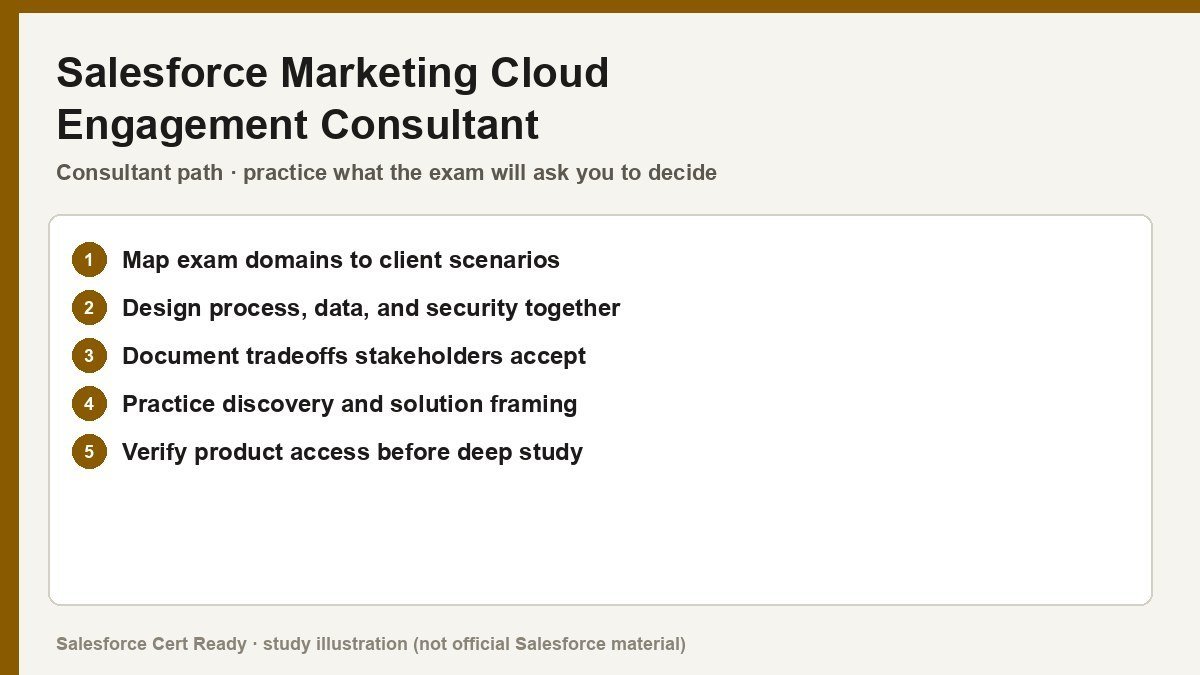
Study map for Salesforce Marketing Cloud Engagement Consultant. Confirm objectives on current Salesforce sources.
Salesforce Marketing Cloud Engagement Consultant
Catalog status checked July 19, 2026: Available.
Current credential snapshot
| Item | Current listing |
|---|---|
| Credential | Salesforce Marketing Cloud Engagement Consultant |
| Track | Consultant |
| Level in source inventory | Mid |
| Exam code in source inventory | MCE-Con-201 |
| Price in source inventory | $200 USD |
| Availability | Available |
Exam format, objectives, pricing, and prerequisites can change. Confirm those details in Salesforce’s current exam guide before purchasing or scheduling an exam.
Study overview
💬 The architect’s badge for cross-channel orchestration.Salesforce Certified Marketing Cloud Engagement Consultant
Validating the ability to design and implement strategic, multi-channel marketing solutions.
At a Glance
| Feature | Details |
|---|---|
| Exam Code | MCE-Con-201 |
| Duration | 105 minutes |
| Questions | 60 multiple-choice + 5 unscored |
| Passing Score | 67% |
| Cost | $200 USD |
| Delivery | Online proctored or On-site testing center |
| Prerequisites | Marketing Cloud Engagement Administrator |
| Recommended Experience | 6+ months implementation or 5+ successful projects |
Who Should Take This
- The Lead Consultant: You are the primary driver behind scoping requirements, defining
Business Unithierarchies, and translating business pain points into technical workflows. - The Solution Architect: You spend your days mapping data flows between
Sales CloudandMarketing Cloud Connectwhile ensuring high deliverability and system performance. - The Implementation Partner: You have handled at least five go-live events and can confidently navigate
Automation Studio,Journey Builder, and complexSQLqueries. - The Technical Marketer: You are moving beyond simple email sends and into the world of
AMPscript,SSJS, and sophisticated programmatic personalization.
What You’ll Prove
This credential proves you can handle the “big picture” of an enterprise Marketing Cloud environment. It isn’t just about knowing where the buttons are; it’s about making high-stakes decisions regarding data architecture and multi-channel strategy. * You can architect complex data models using Contact Builder and ensure data integrity across multiple Business Units.
- You can integrate external systems using
SFTP,APIs, andMarketing Cloud Connectto maintain a single source of truth. - You can automate advanced customer lifecycles by nesting activities in
Automation Studioand building multi-exit journeys inJourney Builder. - You can troubleshoot technical bottlenecks in
Reply Mail Management,Sender Authentication Package (SAP), and programmatic scripting. - You can optimize campaign performance through advanced segmentation,
SQLdata views, and custom preference centers.
Exam Outline
| Domain | Weight | What’s Covered |
|---|---|---|
| Data Modeling and Management | 21% | Contact Builder, Data Extensions, Contact Delete, and subscriber filters. |
| Integration | 20% | Marketing Cloud Connect, APIs, SFTP configurations, and Distributed Marketing. |
| Automation | 20% | Journey Builder, Automation Studio activities, and complex workflow design. |
| Discovery and Architecture | 16% | Requirement gathering, Business Unit hierarchy, and SAP impact analysis. |
| Account Configuration | 12% | Reply Mail Management, Users, Roles, and setup administration. |
| Messaging | 11% | Mobile Studio features, AMPscript basics, and personalization strategies. |
💡 In Notion, convert each domain row into a toggle to nest your study notes underneath.
Suggested Study Path
- Verify your prerequisite by ensuring your
Marketing Cloud Engagement Administratorcert is active; you cannot register for this exam without it. - Master the Data Views by studying the
SQLschema for system tables like_Click,_Open, and_Sent, as these are high-value targets for scenario questions. - Deep dive into MC Connect to understand the specific requirements for the
Salesforce System Userand howSynchronized Data Extensionsbehave. - Practice programmatic logic by reviewing the differences between
AMPscript,Guide Template Language, andSSJSfor dynamic content delivery. - Simulate discovery sessions by reviewing case studies on when to recommend
Enterprise 2.0vs. other account types based on brand isolation needs. - Take a timed mock exam to get used to the “best solution” format, where multiple answers are technically possible but only one follows Salesforce best practices.
Watch Out For
- SAP vs. Private Domains: Don’t get tripped up on the nuances of
Sender Authentication Package. Know exactly what is included in the package vs. what must be purchased as a standalone add-on. - Automation Studio vs. Journey Builder: Pay close attention to scenario-based questions asking for the “most efficient” tool. If the requirement involves real-time triggers or high-frequency updates, one is often better than the other.
- The Contact Delete process: Understand the technical implications and the suppressed destination status. This is a common pitfall for those used to standard
CRMdeletions. - Reply Mail Management (RMM): Be ready to troubleshoot why a reply isn’t being forwarded correctly or how a
DNSmisconfiguration might break the loop.
Resources
- Official Salesforce Exam Guide
- Official Trailmix: Prepare for your Consultant Credential
- Marketing Cloud Developer Documentation
- Trailblazer Community – Marketing Cloud Group
Stop overthinking your SQL joins and just take the test. You’ve been building journeys in your sleep anyway; might as well get the badge for it.
Official status sources
Catalog status last verified: 2026-07-19.