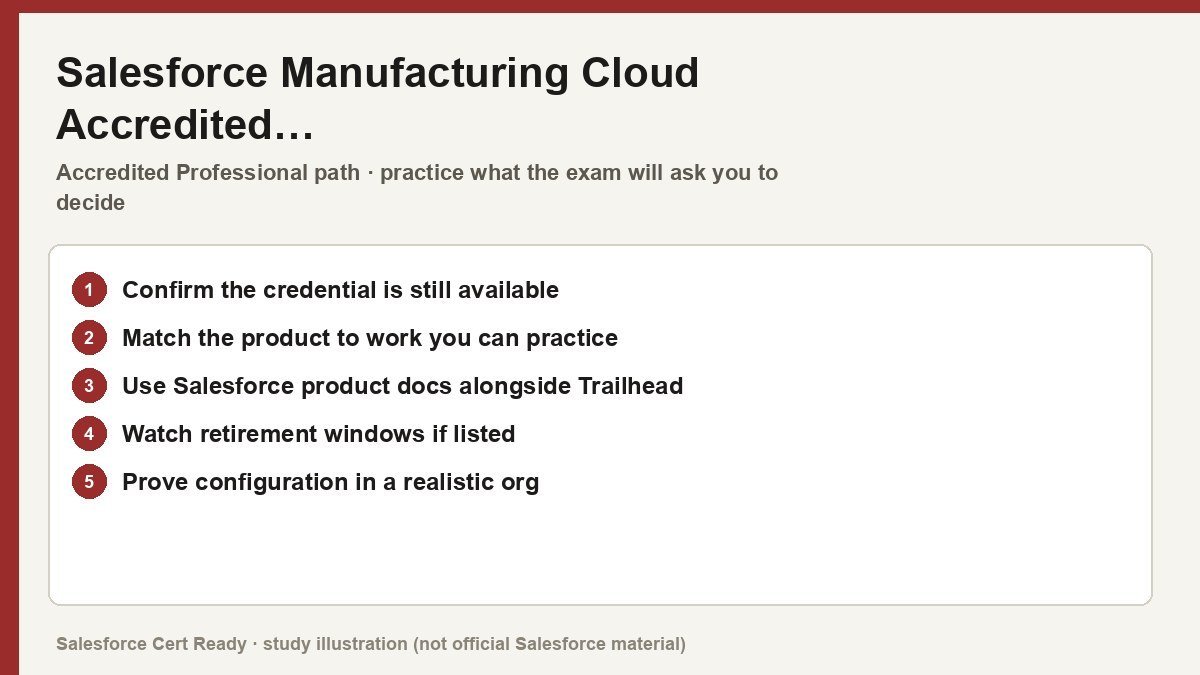
Study map for Salesforce Manufacturing Cloud Accredited…. Confirm objectives on current Salesforce sources.
Salesforce Manufacturing Cloud Accredited Professional
Catalog status checked July 19, 2026: Available.
Current credential snapshot
| Item | Current listing |
|---|---|
| Credential | Salesforce Manufacturing Cloud Accredited Professional |
| Track | Accredited Professional |
| Level in source inventory | Specialty |
| Exam code in source inventory | AP-213 |
| Price in source inventory | $150 USD |
| Availability | Available |
Exam format, objectives, pricing, and prerequisites can change. Confirm those details in Salesforce’s current exam guide before purchasing or scheduling an exam.
Study overview
🏗️ Build a unified view of volume and revenue across the manufacturing value chain.Manufacturing Cloud Accredited Professional
Mastering the industry-specific data model for sales agreements and forecasting.
At a Glance
| Metric | Value |
|---|---|
| Exam Code | AP-213 |
| Duration | 75 Minutes |
| Questions | 50-55 |
| Passing Score | 68% |
| Cost | $150 USD |
| Delivery | Online Proctored (Partner Learning Camp / Kryterion) |
| Prerequisites | None (Salesforce Admin recommended) |
| Recommended Experience | 2-3 years as a Cloud Consultant; 1-2 years in Manufacturing Cloud |
🎯 Who Should Take This – Industry Consultants: You specialize in translating complex manufacturing requirements—like run-rate business and long-term contracts—into technical Salesforce architectures.
- Salesforce Architects: You need to design scalable data models that handle high-volume
Sales Agreementrecords and complexAdvanced Account Forecasting. - Partner Implementation Leads: You are responsible for the end-to-end delivery of Manufacturing Cloud, from initial discovery to
UATand final deployment.
What You’ll Prove
The Accredited Professional exam validates your ability to bridge the gap between back-office ERP data and front-office sales execution. You aren’t just a configurator; you are a business architect who understands how to align demand and supply. – You can design industry-specific solutions using the Manufacturing Cloud data model to replace legacy spreadsheets and siloed ERP views.
- You can configure sophisticated forecasting engines that incorporate
Sales Agreements,Opportunities, and historical order data. - You can implement partner engagement frameworks using
Experience Cloud for Manufacturingto streamline collaboration with distributors and dealers. - You can leverage
CRM Analytics for Manufacturingto provide actionable insights into account health and agreement performance. - You can manage the end-to-end lifecycle of
Rebate Managementto drive channel loyalty and incentivize volume.
Exam Outline
| Domain | Weight | What’s Covered |
|---|---|---|
| Discovery | 18% | Requirements gathering, analyzing current business processes, identifying integration points with ERPs, and defining project scope. |
| Design | 28% | Creating technical architecture, mapping capabilities to Sales Agreements and Forecasting, and performing gap analysis for customizations. |
| Configure and Build | 38% | Setting up Sales Agreements, Account Manager Targets, Manufacturing Intelligence, and Service Experience configurations. |
| Validate and Deploy | 16% | Data migration strategy, facilitating User Acceptance Testing (UAT), system performance monitoring, and rollout execution. |
💡 In Notion, convert each domain row into a toggle to nest your study notes underneath.
Suggested Study Path
- Complete the Partner Learning Camp curriculum. This is the primary source of truth for Accredited Professional exams. Focus on the “Manufacturing Cloud” learning path.
- Master the Sales Agreement lifecycle. Understand the statuses from
DrafttoActivatedand how to handleRenewalsandCancellationsusing the standard objects. - Deep dive into Forecasting. Learn the difference between
Account Based ForecastingandAdvanced Account Forecasting, specifically how to configureData Processing Engine (DPE)jobs. - Hands-on with Rebate Management. Spin up a trial org and practice configuring
Rebate Programs,Payout Scales, andTransaction Journals. - Review ERP Integration patterns. Study how
OrdersandInvoicesfrom external systems update theActualsin your sales agreements.
⚠️ Watch Out For – DPE Complexity: The Data Processing Engine is powerful but tricky. Pay close attention to how it aggregates data for forecasts and rebates; it’s a frequent source of exam scenarios.
- Metric Mapping: Know which field types (Number, Currency, Percent) are available when mapping custom metrics between
Sales Agreement ProductsandSchedules. - Legacy vs. Advanced Forecasting: Ensure you can distinguish when a client needs the standard forecasting versus the more flexible
Advanced Account Forecasting. - License Requirements: Don’t get caught out on which features require specific add-on licenses, particularly for
CRM AnalyticsandExperience Cloud.
🔗 Resources – Official Exam Guide
- Partner Learning Camp: Manufacturing Cloud Curriculum
- Salesforce Help: Learn About Manufacturing Cloud
- Manufacturing Cloud Developer Guide
Stop managing your manufacturing run-rate in Excel. Pass this exam, build the system, and finally give your supply chain team a forecast they can actually trust.
Official status sources
Catalog status last verified: 2026-07-19.