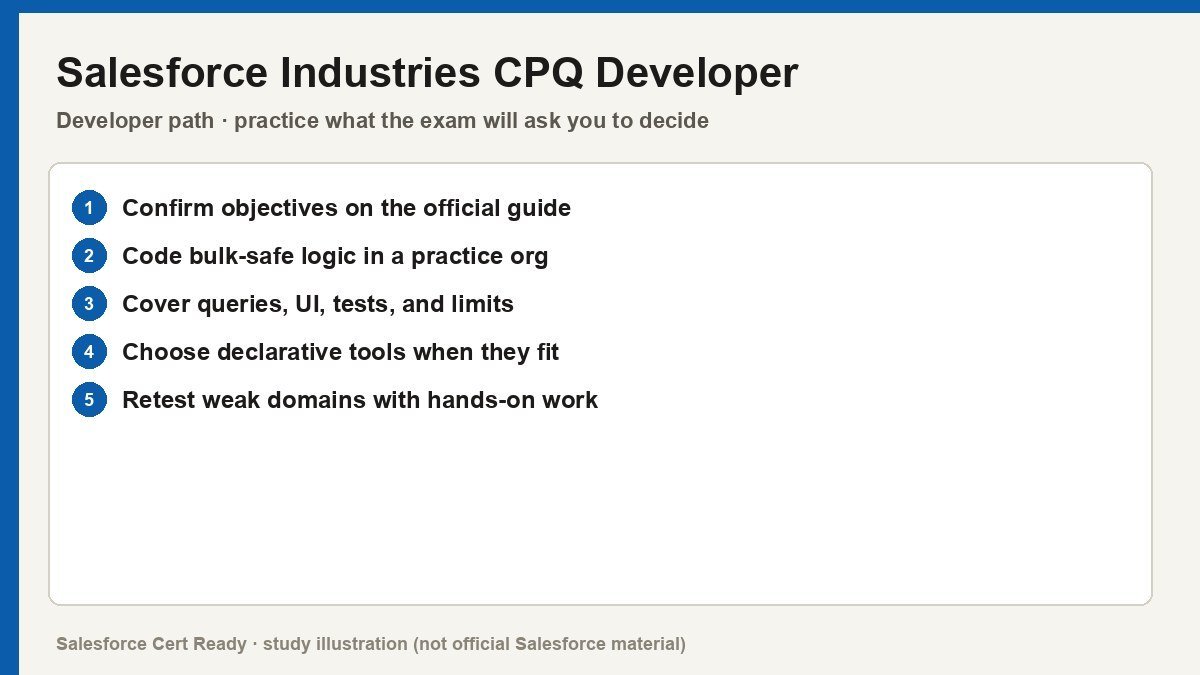
Study map for Salesforce Industries CPQ Developer. Confirm objectives on current Salesforce sources.
Salesforce Industries CPQ Developer
Catalog status checked July 19, 2026: Available; scheduled for retirement.
Salesforce says registration closes July 24, 2026, the last exam date is August 31, 2026, and the credential retires February 1, 2027.
Current credential snapshot
| Item | Current listing |
|---|---|
| Credential | Salesforce Industries CPQ Developer |
| Track | Developer |
| Level in source inventory | Mid |
| Exam code in source inventory | Ind-Dev-201 |
| Price in source inventory | $200 USD |
| Availability | Available; scheduled for retirement |
Exam format, objectives, pricing, and prerequisites can change. Confirm those details in Salesforce’s current exam guide before purchasing or scheduling an exam.
Study overview
⚡ Master the specialized world of Communications, Media, and Energy & Utilities CPQ.Salesforce Certified Industries CPQ Developer
Validating the ability to design and implement complex, industry-specific quote flows.
At a Glance
| Feature | Details |
|---|---|
| Exam Code | Ind-Dev-201 |
| Duration | 105 Minutes |
| Questions | 60-65 multiple-choice/multiple-select |
| Passing Score | 63% |
| Cost | $200 USD ($100 Retake) |
| Delivery | Online proctored or onsite testing center |
| Prerequisites | None (Platform Administrator recommended) |
| Recommended Experience | 1 year working with Industries CPQ; 3-6 months implementation experience |
Who Should Take This
- Industries Developers: You are building technical solutions specifically for the Communications, Media, or Energy & Utilities sectors.
- Technical Consultants: You design the architectural backbone of quote-to-order processes for high-volume, complex product catalogs.
- CPQ Specialists: You have outgrown standard CPQ and need to master
OmniStudiointegrations and industry-native pricing logic.
What You’ll Prove
This certification demonstrates that you can navigate the nuanced technical landscape of Salesforce Industries (formerly Vlocity). You aren’t just clicking buttons; you are engineering the logic that ensures a multi-site telecom order doesn’t break when a promotion is applied. * You can build complex product catalogs using Product Bundles, Object Type Hierarchies, and Attributes.
- You can configure advanced pricing logic including
Attribute-Based PricingandPricing Planoverrides. - You can implement
Context RulesandAdvanced Rulesto enforce order accuracy and eligibility. - You can integrate front-end experiences using
Digital Commerce (DC) APIsandCart-Based APIs. - You can troubleshoot failed pricing calculations, broken rule logic, and API request/response errors.
Exam Outline
| Domain | Weight | What’s Covered |
|---|---|---|
| Products | 20% | Bundles, Object Types, Attributes, Cardinality, and Inheritance. |
| Troubleshooting | 20% | Fixing pricing, rules, and API parameters; EPC and Maintenance jobs. |
| Pricing | 17% | Pricing Variables, Pricing Plans, Cost/Margin, and Adjustments. |
| Rules | 12% | Context Rules, Advanced Rules, and Product Configuration procedures. |
| APIs | 12% | DC vs. Cart APIs, methods, parameters, and Sales Catalogs. |
| Ordering & Quoting | 12% | Asset-Based Ordering (ABO), Multi-site quoting, and Cart UX. |
| Promotions & Discounts | 7% | Promo configuration, Adjustments, and Formula/Roll-up usage. |
💡 In Notion, convert each domain row into a toggle to nest your study notes underneath.
Suggested Study Path
- Master the Foundation: Spend significant time on
Object Type Hierarchies. If you don’t understand how attributes inherit from parent objects, the Products domain will sink your score. - Lab Your Rules: Build out
Context Rulesfrom scratch. Practice mappingContext Dimensionsand understand the difference between eligibility and compatibility. - API Deep Dive: Memorize the specific methods and required parameters for the
Digital Commerce API. Know when to use aGETversus aPOSTfor cart operations. - Learn the Pricing Engine: Trace the execution of a
Pricing Plan. You need to know exactly when the engine applies a manual override versus a promotion-driven adjustment. - Practice ABO Scenarios: Walk through
Asset-Based Orderingflows (Move, Add, Change, Disconnect). The exam loves scenarios where an existing customer modifies a complex subscription. - Focus on Troubleshooting: Don’t just learn how to build it; learn why it fails. Review the
EPCmaintenance jobs and common API error codes.
Watch Out For
- Standard CPQ Distractors: If an answer suggests using standard Salesforce CPQ objects (like
SBQQ__Quote__c) for an Industries problem, it is almost certainly a distractor. - Cardinality Logic: Pay close attention to
Minimum,Maximum, andDefaultcardinality settings. These drive the validation logic in the cart. - The “Wait” Period: Industries CPQ relies on
Maintenance Jobs. If your changes aren’t appearing, you likely forgot to run theProduct Hierarchy MaintenanceorRefresh Platform Cachejobs. - OmniStudio Overlap: While not an OmniStudio exam, you must understand how
Integration ProceduresandDataRaptorsfeed data into the CPQ engine.
Resources
- Official Exam Guide
- Trailmix: Prepare for Industries CPQ Developer
- Partner Learning Camp: Industries CPQ Foundation
- Developer Documentation: Cart-Based APIs
Stop second-guessing your pricing plans and start building them. If you can handle a multi-site telecom bundle, you can handle this exam.
Official status sources
Catalog status last verified: 2026-07-19.