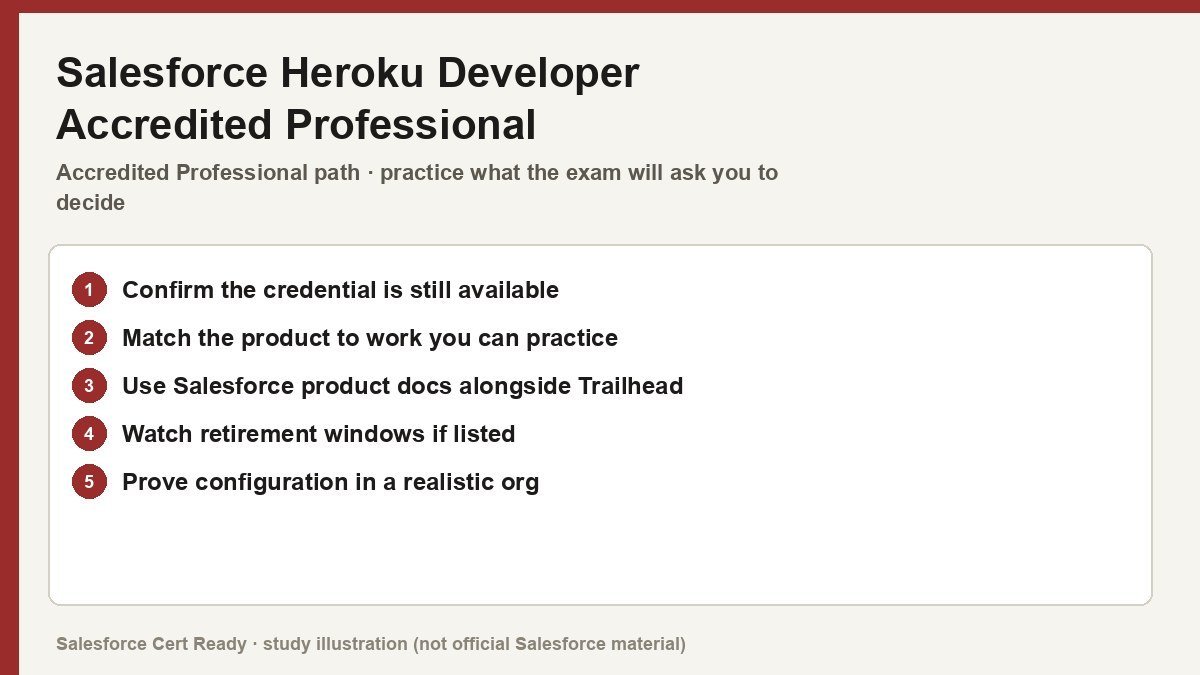
Study map for Salesforce Heroku Developer Accredited Professional. Confirm objectives on current Salesforce sources.
Salesforce Heroku Developer Accredited Professional
Catalog status checked July 19, 2026: Available; scheduled for retirement.
Salesforce says registration closes July 24, 2026, the last exam date is August 31, 2026, and the credential retires February 1, 2027.
Current credential snapshot
| Item | Current listing |
|---|---|
| Credential | Salesforce Heroku Developer Accredited Professional |
| Track | Accredited Professional |
| Level in source inventory | Specialty |
| Exam code in source inventory | AP-225 |
| Price in source inventory | $150 USD |
| Availability | Available; scheduled for retirement |
Exam format, objectives, pricing, and prerequisites can change. Confirm those details in Salesforce’s current exam guide before purchasing or scheduling an exam.
Study overview
Deploy like a pro and master the 12-factor application lifecycle on the world’s favorite PaaS.
Heroku Developer Accredited Professional
Validating the technical expertise required to build, scale, and integrate modern applications on the Heroku Platform.
At a Glance
| Feature | Details |
|---|---|
| Exam Code | AP-225 |
| Duration | 90 Minutes |
| Questions | 60-65 (Multiple-choice/Multiple-select) |
| Passing Score | 68% |
| Cost | USD 150 (Retake: USD 150) |
| Delivery | Online proctored or Onsite (Kryterion/Pearson VUE) |
| Prerequisites | None explicitly required |
| Recommended Experience | 1+ years of hands-on experience with the Heroku Platform |
Who Should Take This
- Hands-on Developers: You are comfortable with the
Heroku CLIand spend your days pushing code, managing dynos, and configuring add-ons for production environments. - Technical Architects: You need to design scalable, secure cloud architectures that integrate seamlessly with Salesforce and other third-party backing services.
- DevOps Specialists: You are responsible for implementing
CI/CDpipelines, managing automated testing, and ensuring high availability for global applications.
What You’ll Prove
This credential moves beyond basic “getting started” knowledge. It tests your ability to navigate the nuances of the Heroku ecosystem, from slug compilation to complex event-driven data architectures. * You can architect applications that strictly adhere to the 12-Factor Methodology for maximum portability and resilience.
- You can manage the full deployment lifecycle using
Heroku Git,Docker, andHeroku Pipelines. - You can configure sophisticated data integrations between Heroku and Salesforce using
Heroku ConnectandWebhooks. - You can secure applications using
ACM(Automated Certificate Management), custom SSL endpoints, and Private Space security features. - You can optimize application performance by selecting the correct
Dynotypes and scaling strategies based on traffic patterns.
Exam Outline
| Domain | Weight | What’s Covered |
|---|---|---|
| Apps & Runtime | 12% | Dyno types (Web, Worker, One-off), Process types, and platform building blocks. |
| Building & Deployment | 8% | Buildpacks, Slug creation, and deployment strategies. |
| Operations | 12% | Horizontal/Vertical scaling and high-traffic event management. |
| Elements & Marketplace | 3% | Add-ons, official vs. third-party Buildpacks, and Heroku Buttons. |
| Continuous Delivery | 10% | Heroku Flow, Pipelines, Review Apps, and Heroku CI. |
| Data (Postgres/Redis) | 8% | Heroku Postgres (forks, followers, dataclips) and Heroku Key-Value Store (Redis). |
| Data (Kafka & Add-ons) | 8% | Apache Kafka on Heroku for event streaming and third-party data add-ons. |
| Security & Compliance | 13% | SSL, ACM, and designing secure solutions in Private Spaces. |
| Integrations | 13% | Heroku Connect features, Salesforce APIs, and Webhooks. |
| Architecting Apps | 13% | Deep dive into 12-Factor Methodology and best practices. |
💡 In Notion, convert each domain row into a toggle to nest your study notes underneath.
Suggested Study Path
- Audit the 12 Factors. Visit
12factor.net. This isn’t just theory; it’s the backbone of the exam. Understand why “Store config in the environment” and “Treat logs as event streams” are non-negotiable. - Master the Data Layer. Focus on
Heroku Connectsynchronization patterns and the difference between aFollowerdatabase and aFork. Know when to reach forRedisvs.Postgres. - Lab the Deployment Flow. Use the
CLIto create aPipeline. Practice promoting a slug from staging to production and understand exactly what happens during theSlugcompilation process. - Deep Dive into Security. Memorize the limitations of
ACM(no wildcards, no IPv6) and when you need to pay for a customSSL Endpointor move to aPrivate Space. - Review the Dev Center. Search for “Heroku Exec”, “Heroku Dynos”, and “Log Drains”. The official documentation is the source of truth for all technical limits.
Watch Out For
- The SSL Nuances: Many candidates trip up on the differences between
ACM,SSL Endpoint, andSni Endpoint. Note which ones support older browsers and which ones are free. - Connect Sync Rules: Understand how
Heroku Connecthandles conflict resolution and which Salesforce APIs it uses under the hood for Bulk vs. Streaming data. - Dyno Sleeping: Be crystal clear on which Dyno tiers sleep after inactivity (Free/Hobby) and which provide dedicated resources.
- The 12 Factors vs. Reality: The exam tests the ideal 12-factor state. If a question asks how to handle local file storage, the 12-factor answer is usually “don’t do it—use an external service.”
Resources
- Official Exam Guide (Partner Learning Camp)
- Heroku Dev Center Documentation
- Trailhead: Develop Apps with Heroku
- The Twelve-Factor App Manifesto
Stop overthinking the YAML and start mastering the architecture. Pass this, and you’re officially more than just a “git push heroku master” developer.
Official status sources
Catalog status last verified: 2026-07-19.