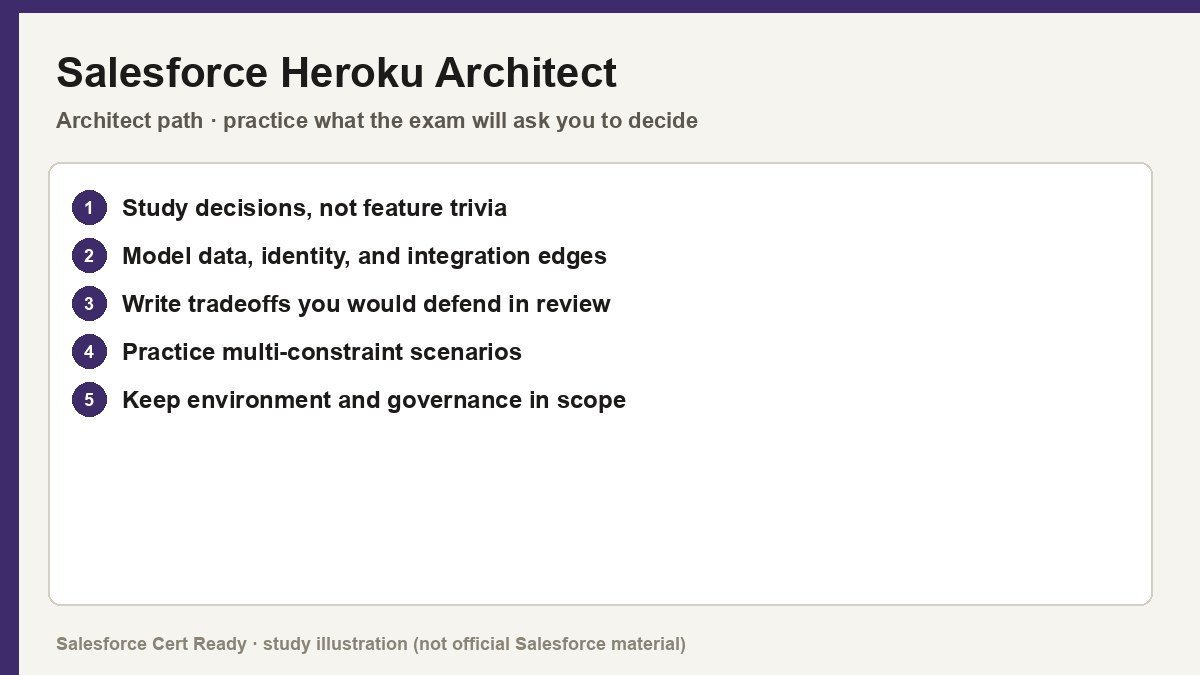
Study map for Salesforce Heroku Architect. Confirm objectives on current Salesforce sources.
Salesforce Heroku Architect
Catalog status checked July 19, 2026: Available.
Current credential snapshot
| Item | Current listing |
|---|---|
| Credential | Salesforce Heroku Architect |
| Track | Architect |
| Level in source inventory | Mid |
| Exam code in source inventory | Plat-Arch-206 |
| Price in source inventory | $400 USD |
| Availability | Available |
Exam format, objectives, pricing, and prerequisites can change. Confirm those details in Salesforce’s current exam guide before purchasing or scheduling an exam.
Study overview
🚀 Build and scale enterprise apps without managing the underlying infrastructure.Salesforce Certified Heroku Architect
The elite standard for designing and optimizing high-scale applications on the Heroku PaaS.
At a Glance
| Feature | Details |
|---|---|
| Exam Code | Plat-Arch-206 |
| Duration | 105 minutes |
| Questions | 60 multiple-choice/multiple-select |
| Passing Score | 72% |
| Cost | $400 USD |
| Delivery | Proctored online or at a testing center |
| Prerequisites | None |
| Recommended Experience | Significant experience architecting on Heroku and the Salesforce ecosystem |
🎯 Who Should Take This – The Cloud Architect: Professionals who design large-scale application architectures and need to validate their mastery of the Heroku platform.
- The Senior Developer: Lead engineers who build and deploy complex, mission-critical apps and want to move into senior architectural or DevOps roles.
- The Salesforce Consultant: Experts advising clients on when and how to offload heavy compute tasks or high-volume data from the
Salesforcecore toHeroku.
What You’ll Prove
The exam isn’t just about knowing which buttons to click; it’s about making high-stakes trade-offs between performance, security, and cost in enterprise environments. – You can design resilient, stateless application architectures that adhere to the 12-factor app methodology.
- You can prescribe appropriate data persistence strategies using
Heroku Postgres,Redis, andApache Kafka. - You can secure enterprise workloads using
Private Spaces,Shield, and advanced networking likeVPNorVPC Peering. - You can integrate cross-platform systems using
Heroku Connectand event-driven patterns to bypassSalesforceAPI limits. - You can optimize resources by selecting the right
Dynotypes and scaling strategies for production traffic spikes.
Exam Outline
| Domain | Weight | What’s Covered |
|---|---|---|
| Heroku Enterprise | 28% | Private Spaces, Shield, Enterprise Teams, and compliance-heavy architectures. |
| Data | 17% | Postgres followers/dataclips, Redis caching, and streaming with Apache Kafka. |
| Architect Applications | 15% | 12-factor methodology, microservices orchestration, and stateless design. |
| Integrations | 15% | Heroku Connect sync patterns, External IDs, and Salesforce platform events. |
| Security | 15% | Common vs Private runtime, VPN connections, and SSL/TLS management. |
| Heroku Platform | 10% | Buildpacks, Slugs, Dyno management, and the Elements Marketplace. |
💡 In Notion, convert each domain row into a toggle to nest your study notes underneath.
Suggested Study Path
- Master the Twelve Factors: Internalize the
12-factor appmanifesto. It is the philosophical foundation of the exam and dictates how you should approach state, config, and concurrency. - Deep Dive into Data: Spend significant time on
Heroku Connectsync behaviors andApache Kafkause cases. Know when to use aFollower databaseversus aDataclip. - Audit the Enterprise Stack: Understand the specific value proposition of
Heroku ShieldandPrivate Spaces. You will be tested on which features are required for specific regulatory (PCI/HIPAA) or networking needs. - Learn the “Connect” Nuances: Study the limits of
Heroku Connect. Know howExternal IDsimpact synchronization and how to handle high-volume data writes back toSalesforce. - Watch the Architect’s Perspective: Review official Salesforce webinar videos featuring the actual exam writers. Hearing an architect explain why a certain pattern fails is worth ten hours of reading.
⚠️ Watch Out For – Generic Cloud Advice: Heroku has a very specific “opinionated” way of doing things. Applying standard AWS or Azure patterns that violate 12-factor principles will lead to incorrect answers.
- The “Add-on” Trap: Don’t just know that an add-on exists; know how they are shared across apps and how their lifecycle affects your
Slugsize and deployment speed. - Platform Event Latency: Be careful with integration questions. Understand the trade-offs between
CDC(Change Data Capture) viaHeroku Connectversus manualPlatform Eventsfor real-time needs. - Dyno Mismanagement: You must know the exact differences between
Standard,Performance, andPrivatedynos. Selecting the wrong type for a high-traffic scenario is a classic pitfall.
🔗 Resources – Official Salesforce Exam Guide
- Official Trailmix: Prepare for Your Heroku Architect Credential
- Heroku Dev Center (The Bible)
- The 12-Factor App Manifesto
Stop over-engineering your hobby projects and start architecting for the enterprise. If you can handle the 12 factors, you can handle this exam.
Official status sources
Catalog status last verified: 2026-07-19.