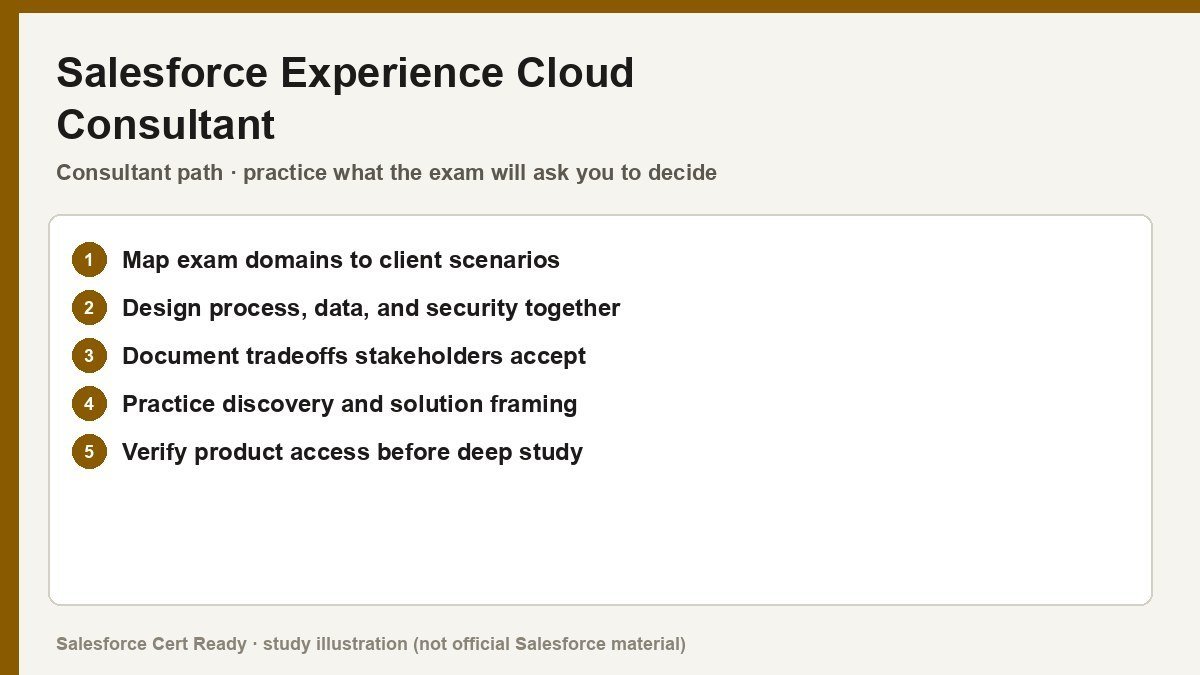
Study map for Salesforce Experience Cloud Consultant. Confirm objectives on current Salesforce sources.
Salesforce Experience Cloud Consultant
Catalog status checked July 19, 2026: Available.
Current credential snapshot
| Item | Current listing |
|---|---|
| Credential | Salesforce Experience Cloud Consultant |
| Track | Consultant |
| Level in source inventory | Mid |
| Exam code in source inventory | EX-Con-101 |
| Price in source inventory | $200 USD |
| Availability | Available |
Exam format, objectives, pricing, and prerequisites can change. Confirm those details in Salesforce’s current exam guide before purchasing or scheduling an exam.
Study overview
🌐 Stop building internal silos. Start building digital experiences that actually scale.Experience Cloud Consultant
Master the art of multi-channel engagement, partner portals, and customer self-service.
At a Glance
| Category | Details |
|---|---|
| Exam Code | EX-Con-101 |
| Duration | 105 Minutes |
| Questions | 60 multiple-choice/multiple-select |
| Passing Score | 65% |
| Cost | $200 USD |
| Delivery | Online or Onsite Proctored |
| Prerequisites | Platform Administrator |
| Recommended Experience | 6+ months implementing or administering Experience Cloud |
🎯 Who Should Take This – Implementation Consultants: You lead workshops, gather requirements, and bridge the gap between business needs and Experience Builder capabilities.
- Experienced Administrators: You’ve managed an org for a while and are now moving into the specialized world of external user management and portal security.
- Solution Architects: You need to understand the structural limitations of
Customer Communityvs.Partner Communitylicenses to design scalable systems. - Technical Leads: You supervise the deployment of
Lightning Bolttemplates and need to know where declarative ends and custom code begins.
What You’ll Prove
This certification validates your ability to deploy high-performance digital spaces using Salesforce’s declarative toolset. You aren’t just making things look pretty; you are architecting secure, data-driven environments for external stakeholders. – You can architect secure sharing models specifically for external users, leveraging Sharing Sets and Account Relationships.
- You can configure sophisticated authentication flows, including
Self-Registration,Social Sign-On, andLogin Discovery. - You can deploy and brand
Experience Buildersites using standard templates,LWCcomponents, and custom themes. - You can implement advanced content strategies using
Salesforce CMSandKnowledgeintegration. - You can manage the full lifecycle of a site, from initial template selection to SEO optimization and
Google Analyticsintegration.
Exam Outline
| Domain | Weight | What’s Covered |
|---|---|---|
| Administration, Setup, and Configuration | 25% | Experience Workspaces, site creation, SEO, custom domains, and Change Management. |
| Sharing, Visibility, and Licensing | 17% | External user licenses, Sharing Sets, Share Groups, and External Account Hierarchies. |
| Branding, Personalization, and Content | 15% | Audience Targeting, Salesforce CMS, branding sets, and Knowledge for sites. |
| User Creation and Authentication | 13% | Person Accounts, Self-Registration, Single Sign-On, and Guest User Profile security. |
| Templates and Themes | 10% | Customer Service, Partner Central, LWR templates, and Lightning Bolt distribution. |
| Experience Cloud Basics | 8% | Use cases for external sites, personas, and navigating Experience Builder. |
| Customization Considerations | 7% | Declarative vs. Programmatic limits and Lightning Locker basics. |
| Adoption and Analytics | 5% | Dashboards, AppExchange insight packages, and Reputation/Gamification. |
💡 In Notion, convert each domain row into a toggle to nest your study notes underneath.
Suggested Study Path
- Verify your prerequisite by ensuring your
Platform Administratorcredential is active and you understand core sharing rules. - Complete the official Trailmix provided by Salesforce, focusing heavily on the
Experience Cloud BasicsandSharingmodules. - Build a Partner Portal in a developer edition or sandbox to practice configuring
Lead DistributionandDeal Registration. - Master the License Matrix until you can instinctively choose between
Customer Community,Customer Community Plus, andPartner Community. - Practice Persona Security by logging in as various users to test
Audience Targetingand record-level visibility. - Review the Exam Guide one final time to ensure you can explain the difference between
Sharing SetsandShare Groupswithout hesitation.
⚠️ Watch Out For – Sharing Set Confusion: Remember that Sharing Sets only apply to high-volume portal licenses. Share Groups are what you use to share those records back to internal users.
- Guest User Profile Restrictions: Since the 2020 security updates,
Guest Usershave significantly tighter record access. Don’t rely on old blog posts for this section. - License Limitations: Don’t accidentally suggest a standard
Customer Communitylicense for a user who needs access toReports,Dashboards, orDelegated Admin. - Knowledge vs. Topics: Understanding how
Data Categoriesmap toNavigational Topicsis a common stumbling block in the Content domain.
🔗 Resources – Official Salesforce Exam Guide
- Official Experience Cloud Trailmix
- Salesforce Help: Experience Cloud Documentation
- SFBen Study Guide & Tips
Real consultants don’t just build portals; they build ecosystems. Now go get certified and try not to break the sharing model on your way out.
Official status sources
Catalog status last verified: 2026-07-19.