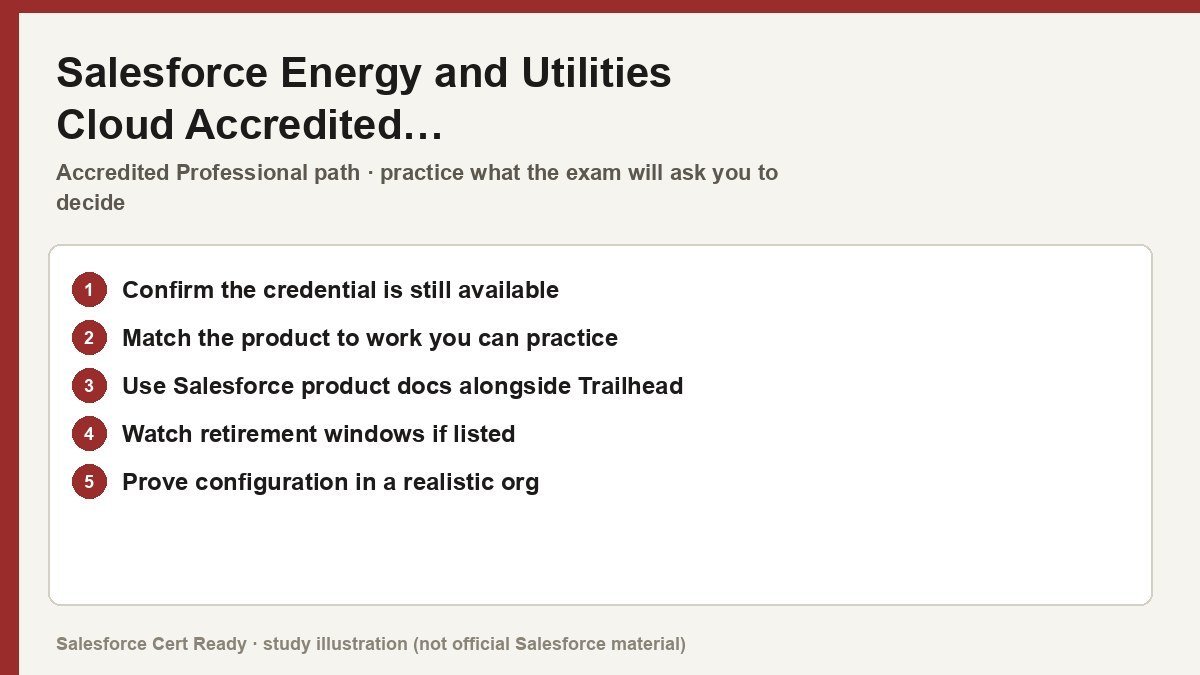
Study map for Salesforce Energy and Utilities Cloud Accredited…. Confirm objectives on current Salesforce sources.
Salesforce Energy and Utilities Cloud Accredited Professional
Catalog status checked July 19, 2026: Available; scheduled for retirement.
Salesforce says registration closes July 24, 2026, the last exam date is August 31, 2026, and the credential retires February 1, 2027.
Current credential snapshot
| Item | Current listing |
|---|---|
| Credential | Salesforce Energy and Utilities Cloud Accredited Professional |
| Track | Accredited Professional |
| Level in source inventory | Specialty |
| Exam code in source inventory | AP-207 |
| Price in source inventory | $150 USD |
| Availability | Available; scheduled for retirement |
Exam format, objectives, pricing, and prerequisites can change. Confirm those details in Salesforce’s current exam guide before purchasing or scheduling an exam.
Study overview
⚡ Master the industry transition from legacy billing to AI-powered utility operations.Energy and Utilities Cloud Accredited Professional
Validate your expertise in designing and implementing Salesforce solutions for the global energy, gas, water, and renewable sectors.
At a Glance
| Category | Details |
|---|---|
| Exam Code | AP-207 |
| Duration | 75 minutes |
| Questions | 50 multiple-choice/multiple-select |
| Passing Score | 60% |
| Cost | $150 USD |
| Delivery | Online Proctored or In-person |
| Prerequisites | None explicitly required; Salesforce Partner status typically required for AP access |
| Recommended Experience | 2-3 years of Salesforce consulting; experience with OmniStudio and industry data models |
Who Should Take This
- Industry Consultants: Professionals who advise energy providers on digital transformation, grid modernization, and customer experience improvements.
- Solution Architects: Lead designers responsible for mapping complex utility business requirements to the
Energy and Utilities Cloudtechnical roadmap. - Implementation Partners: Technical leads tasked with configuring
Service Points,Premises, andMeterintegrations within the Salesforce ecosystem. - Technical Professionals: Developers and admins working specifically within the utility sector who need to validate their knowledge of the
VlocityandOmniStudiolayers.
What You’ll Prove
This credential confirms you can navigate the intersection of Salesforce core capabilities and specialized industry functionality. You aren’t just an admin; you are a specialist who understands how power and water move from the grid to the customer’s bill. * You can design end-to-end solutions that handle the unique “Account-Premise-Service Point” hierarchy.
- You can implement pre-built industry components like the
Contact Center ConsoleandContractor Portal. - You can configure complex
OmniStudioflows for “Move-In/Move-Out” and “Start/Stop Service” journeys. - You can integrate Salesforce with external
Customer Information Systems(CIS) andMeter Data Management(MDM) platforms. - You can execute data migrations that respect the specific relationships between
Assets,Meters, andWork Orders.
Exam Outline
| Domain | Weight | What’s Covered |
|---|---|---|
| Implementation | 38% | Org setup, license assignment, Order Capture, post-sales processes, and third-party integrations. |
| Test and Deploy | 36% | UAT milestones, deployment planning for Vlocity components, and executing test scenarios. |
| Discovery | 13% | Requirement gathering, identifying process gaps, and documenting current state vs. standard capabilities. |
| Solution Design | 13% | Future state architecture, data model fitment, and organizational security considerations. |
💡 In Notion, convert each domain row into a toggle to nest your study notes underneath.
Suggested Study Path
- Master the Data Model. Deep dive into the relationship between
Account,Premise,Service Point, andAsset. You must know exactly where a meter lives vs. where the bill goes. - Explore OmniStudio Components. Review the pre-configured
OmniScriptsandFlexCardsprovided in theContact Center Console. Pay attention to how they surfaceUsage Tabdata andBilling Insights. - Review Industry Use Cases. Study the “Move-In/Move-Out” and “High Bill Inquiry” workflows. These aren’t just standard Service Cloud cases; they rely on specific industry-standard logic.
- Learn Deployment Specifics. Understand the nuances of moving
Vlocity Datapacksand metadata between environments. This is a common pitfall for those only used to standard Change Sets. - Analyze Integration Patterns. Review how to connect to external billing systems via
Integration Proceduresand how to handleMuleSoftconnectors for grid data.
Watch Out For
- The Object Hierarchy Trap: Don’t confuse a
Service Account(billing) with aService Point(technical connection). The exam loves to test if you know which one holds the meter data. - Vlocity Dependency: This isn’t a pure “Core” exam. If you aren’t familiar with how
OmniStudiopowers the UI in Industry Clouds, you will struggle with the implementation questions. - Deployment Order: Remember that
Energy and Utilities Cloudrequires specific post-installation steps and metadata deployments before theContact Center Consoleactually functions. - Scenario Complexity: Questions often present a customer with multiple
Premises. Ensure you can identify how to aggregate billing vs. how to dispatch a technician to a specific physical location.
Resources
- Official Exam Guide
- Energy and Utilities Cloud Documentation
- Trailmix: Prepare for the Energy & Utilities Cloud AP Exam
- OmniStudio Documentation for Industry Clouds
Get your head around the data model, and the rest is just plumbing. Pass this, and you’re officially the smartest person in the room when the power goes out.
Official status sources
Catalog status last verified: 2026-07-19.