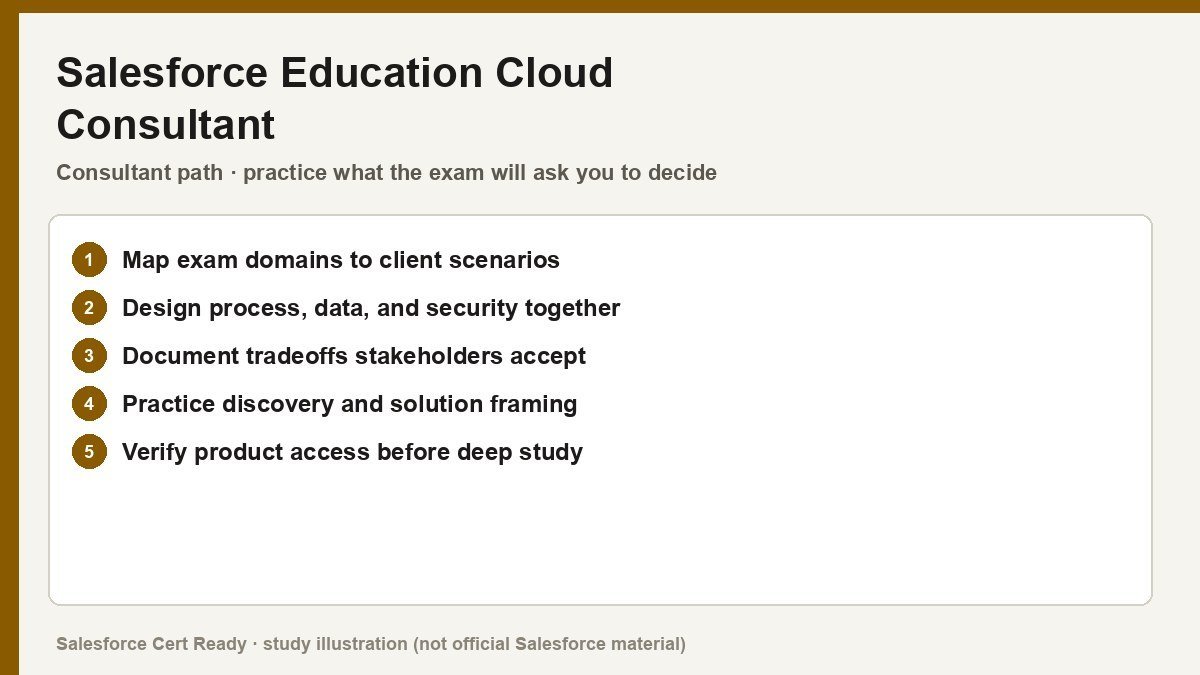
Study map for Salesforce Education Cloud Consultant. Confirm objectives on current Salesforce sources.
Salesforce Education Cloud Consultant
Catalog status checked July 19, 2026: Available; scheduled for retirement.
Salesforce says registration closes July 24, 2026, the last exam date is August 31, 2026, and the credential retires February 1, 2027.
Current credential snapshot
| Item | Current listing |
|---|---|
| Credential | Salesforce Education Cloud Consultant |
| Track | Consultant |
| Level in source inventory | Mid |
| Exam code in source inventory | ED-Con-101 |
| Price in source inventory | $200 USD |
| Availability | Available; scheduled for retirement |
Exam format, objectives, pricing, and prerequisites can change. Confirm those details in Salesforce’s current exam guide before purchasing or scheduling an exam.
Study overview
🎓 Stop guessing and start architecting for the student lifecycle.Salesforce Certified Education Cloud Consultant
The benchmark for professionals implementing industry-specific solutions across the K-20 spectrum.
At a Glance
| Feature | Details |
|---|---|
| Exam Code | ED-Con-101 |
| Duration | 105 Minutes |
| Questions | 60 Multiple-Choice (plus 5 unscored) |
| Passing Score | 67% |
| Cost | $200 USD ($100 Retake) |
| Delivery | Onsite or Online Proctored (Kryterion) |
| Prerequisites | Salesforce Certified Administrator |
| Recommended Experience | 2+ years of Salesforce consulting and 6+ months of Education Cloud exposure |
🎯 Who Should Take This – Implementation Consultants: Professionals who lead client-facing engagements to replace legacy Student Information Systems (SIS) with modern CRM workflows.
- Business Analysts: Individuals skilled at mapping complex academic operations—like recruitment, admissions, and advancement—to
Education Cloudcapabilities. - Higher Ed Architects: Technical leads responsible for designing scalable data models that handle large volumes of student records while maintaining performance.
- Experienced Administrators: Power users in the education sector looking to validate their expertise in industry-specific tools like
Student Success Hub.
What You’ll Prove
This certification validates your ability to design and deploy maintainable solutions on the Salesforce platform that meet the unique needs of educational institutions. It proves you understand the “Education way” of doing things rather than just standard CRM logic. – You can architect solutions using the Education Cloud data model to track the full learner journey from prospect to alumni.
- You can configure industry-specific features including
Business Rules Engine,OmniStudio, andSalesforce Scheduler. - You can integrate external systems like
SISor Learning Management Systems (LMS) while managing large data volumes and potential data skew. - You can recommend the appropriate mix of core products like
Sales Cloud,Service Cloud, andMarketing Cloudto satisfy institutional departmental requirements. - You can navigate the complexities of academic structures, including terms, sessions, academic programs, and student affiliations.
Exam Outline
| Domain | Weight | What’s Covered |
|---|---|---|
| Education Cloud Configuration | 22% | Installation, setup, Common Features, compatibility with core products, and configuring OmniStudio. |
| Solution Design | 19% | Account model considerations, scalability, K-12 Architecture Kit, and choosing between standard vs. custom objects. |
| Domain Expertise | 18% | Recruitment, admissions, student experience, and advancement solutions for K-12 and Higher Ed. |
| Implementation Strategies | 18% | Project planning, requirements gathering, governance, change management, and ALM models. |
| Integration & Data Management | 16% | API strategies, data migration, LDV considerations, and SIS integration patterns. |
| Analytics | 7% | Reporting solutions, Tableau CRM (CRM Analytics) use cases, and choosing the right dashboard tool. |
💡 In Notion, convert each domain row into a toggle to nest your study notes underneath.
Suggested Study Path
- Master the Prerequisites by ensuring your
Administratorknowledge is rock solid, specifically around security models and standard automation. - Review the Data Model documentation to understand how
Education Clouddiffers fromEDA(Education Data Architecture), specifically looking at person accounts and industry objects. - Complete the Official Trailmix on Trailhead, focusing heavily on the
OmniStudioandBusiness Rules Enginemodules which are now core to the industry clouds. - Hands-on Practice in a trial org to walk through the installation process and configure a
Student Success Hubalert or a recruitment journey. - Analyze Integration Patterns by studying the
RESTandSOAPAPI use cases for syncing student data from a third-partySIS. - Take a Practice Exam to get used to the scenario-based question format, as most questions require you to pick the best solution for a specific university challenge.
⚠️ Watch Out For – EDA vs. Education Cloud: Do not confuse the older EDA (Education Data Architecture) triggers (TDTM) with the newer, metadata-driven Education Cloud. The exam has shifted focus toward the latter.
- Scenario Trickery: Many questions provide three potential answers that could work. You must select the one that aligns with Salesforce best practices for scalability and maintenance.
- The Prerequisite Trap: While the guide mentions the
Platform Administratorcredential, common industry documentation still lists the standardAdministratoras the primary gatekeeper. Verify your eligibility in Webassessor early. - Large Data Volume (LDV): In a university context, data skew (too many records tied to a single parent account) is a frequent pitfall. Know how to mitigate this.
🔗 Resources – Official Exam Guide
- Official Trailmix: Prepare for Your Credential
- Education Cloud Documentation
- Trailblazer Community: Salesforce.org Education Cloud
Go get that cert. Just remember: if the solution involves a change set, you’re probably living in 2015—think modern ALM.
Official status sources
Catalog status last verified: 2026-07-19.