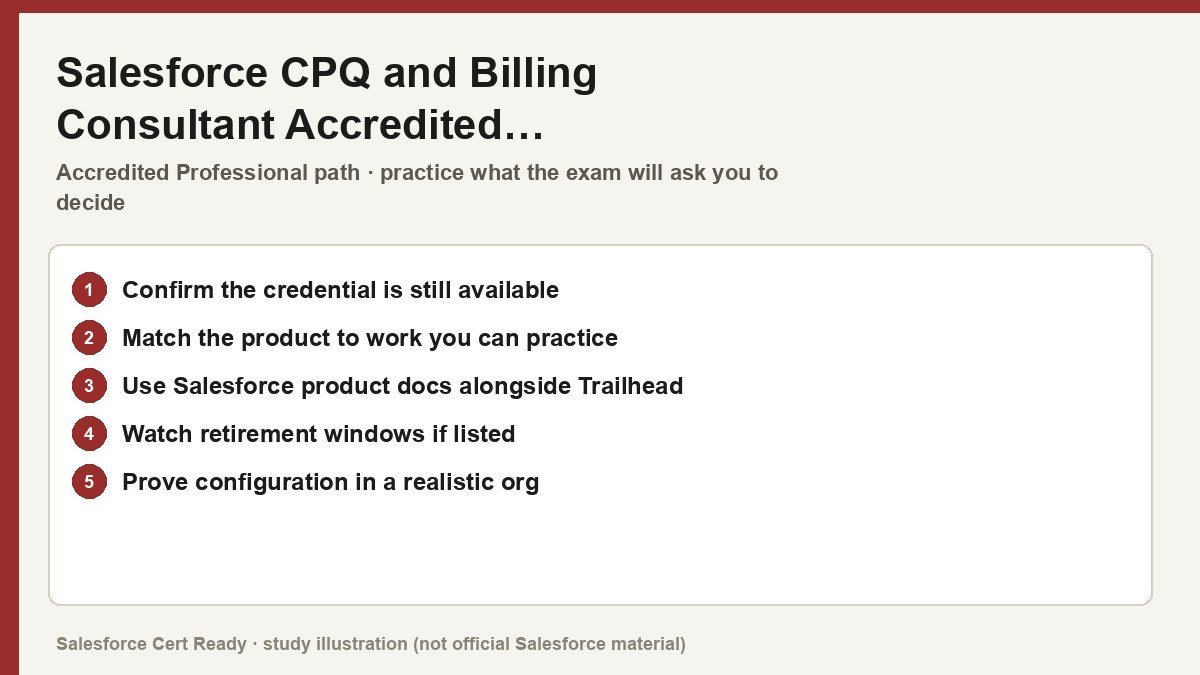
Study map for Salesforce CPQ and Billing Consultant Accredited…. Confirm objectives on current Salesforce sources.
Salesforce CPQ and Billing Consultant Accredited Professional
Catalog status checked July 19, 2026: Available; scheduled for retirement.
Salesforce says registration closes July 24, 2026, the last exam date is August 31, 2026, and the credential retires February 1, 2027.
Current credential snapshot
| Item | Current listing |
|---|---|
| Credential | Salesforce CPQ and Billing Consultant Accredited Professional |
| Track | Accredited Professional |
| Level in source inventory | Specialty |
| Exam code in source inventory | AP-223 |
| Price in source inventory | $150 USD |
| Availability | Available; scheduled for retirement |
Exam format, objectives, pricing, and prerequisites can change. Confirm those details in Salesforce’s current exam guide before purchasing or scheduling an exam.
Study overview
💸 Stop leaving money on the table. Master the flow from Quote to Cash.CPQ and Billing Consultant Accredited Professional
Validate your expertise in designing, building, and deploying revenue lifecycle solutions on the Salesforce platform.
At a Glance
| Feature | Details |
|---|---|
| Exam Code | AP-223 |
| Duration | 60 minutes |
| Questions | 35-40 (Multiple Choice / Multi-select) |
| Passing Score | 74% |
| Cost | $150 USD |
| Delivery | Online Proctored (Kryterion / Pearson VUE) |
| Prerequisites | None |
| Recommended Experience | 6-12 months implementing Salesforce CPQ and Salesforce Billing |
Who Should Take This
- The Implementation Consultant: You lead discovery sessions, map business processes to technical requirements, and own the build in the sandbox.
- The Revenue Operations Architect: You focus on the big picture—how
Product,Price,Quote, andInvoiceobjects interact to create a single source of truth for finance. - The Solution Developer: You know when standard
Price Rulesaren’t enough and when to investigate aQuote Calculator Plugin (QCP)orApex Triggers. - The Salesforce Partner: You are an employee of a partner firm looking to maintain your company’s Navigator status and prove your individual competence to clients.
What You’ll Prove
This exam confirms you have the specialized knowledge to move beyond basic CRM administration and into the high-stakes world of automated revenue management. It tests your ability to handle complex pricing scenarios, recurring revenue models, and the hand-off between sales and finance. * You can recommend design solutions that stay within the proper capabilities of the managed packages while minimizing technical debt.
- You can lead scoping sessions that focus on business transformation rather than just recreating legacy spreadsheets in a new UI.
- You can configure advanced product logic including
Selection Rules,Validation Rules, andFilter Rulesfor nested bundles. - You can manage the transition from an
Orderto anInvoice, ensuring thatTaxation,Payments, andRevenue Recognitionare handled accurately. - You can troubleshoot performance issues like governor limits in large bundle configurations by adjusting package settings.
Exam Outline
| Domain | Weight | What’s Covered |
|---|---|---|
| Revenue Cloud Technical Design | 68% | CPQ and Billing design solutions, legacy data implications, customization vs. standard, and project risk assessment. |
| Revenue Cloud Implementation Management | 29% | Scoping sessions, solution design documentation, and managing build, test, and deployment phases. |
| New Release Capabilities | 3% | Impact of new release updates on existing implementations and where to find the latest documentation. |
💡 In Notion, convert each domain row into a toggle to nest your study notes underneath.
Suggested Study Path
- Master the Lead-to-Cash trail on Trailhead. Complete the “Go from Lead to Cash with Salesforce CPQ and Billing” trail to understand the logical flow from
OpportunitytoPayment. - Review the Partner Learning Camp curriculum. If you have access, the
Accredited Professionalexam course is the definitive source for the specific scenarios tested. - Deep dive into CPQ objects. Ensure you understand the field mapping between
Quote Line,Order Product,Subscription, andInvoice Line. - Practice bundle configuration. Build complex, nested bundles in a developer org. Experiment with
Product Rulesthat hide or enable options based onConfiguration Attributes. - Study the Billing process. Learn how
Invoice Runswork, how to handleCancel and Rebillscenarios, and howCredit Notesare generated from negative invoice lines. - Simulate the exam environment. Use practice questions to get used to the 60-minute time limit; with only 35-40 questions, each one carries significant weight.
Watch Out For
- The Customization Trap: Salesforce heavily emphasizes a “standard first” approach. If a question offers a choice between a custom
Apexsolution and a standardPrice Rule, standard usually wins unless the scenario explicitly mentions a gap in package capability. - Proration Logic: Pay close attention to how
Subscriptiondates andProration Day of Monthsettings affect the finalTotal Price. This is a frequent pain point in real-world implementations. - Legacy Data Migration: Migrating
ContractsandSubscriptionsfrom a legacy system is a high-weight topic. You need to know the required fields for theContractandSubscriptionobjects to support future renewals and amendments. - Large Configuration Performance: Understand the “Enable Large Configurations” setting and its impact on user experience in the
Quote Line Editor.
Resources
- Official Exam Summary & Objectives
- Trailhead: Learn Salesforce CPQ Admin Fundamentals
- Trailhead: Master Salesforce Billing Admin Fundamentals
- Salesforce CPQ & Billing Help Documentation
- Partner Community: Accredited Professional Page
If you can’t explain why a Percent of Total subscription didn’t calculate correctly, you aren’t ready. Go break a sandbox and come back when you’ve fixed it.
Official status sources
Catalog status last verified: 2026-07-19.