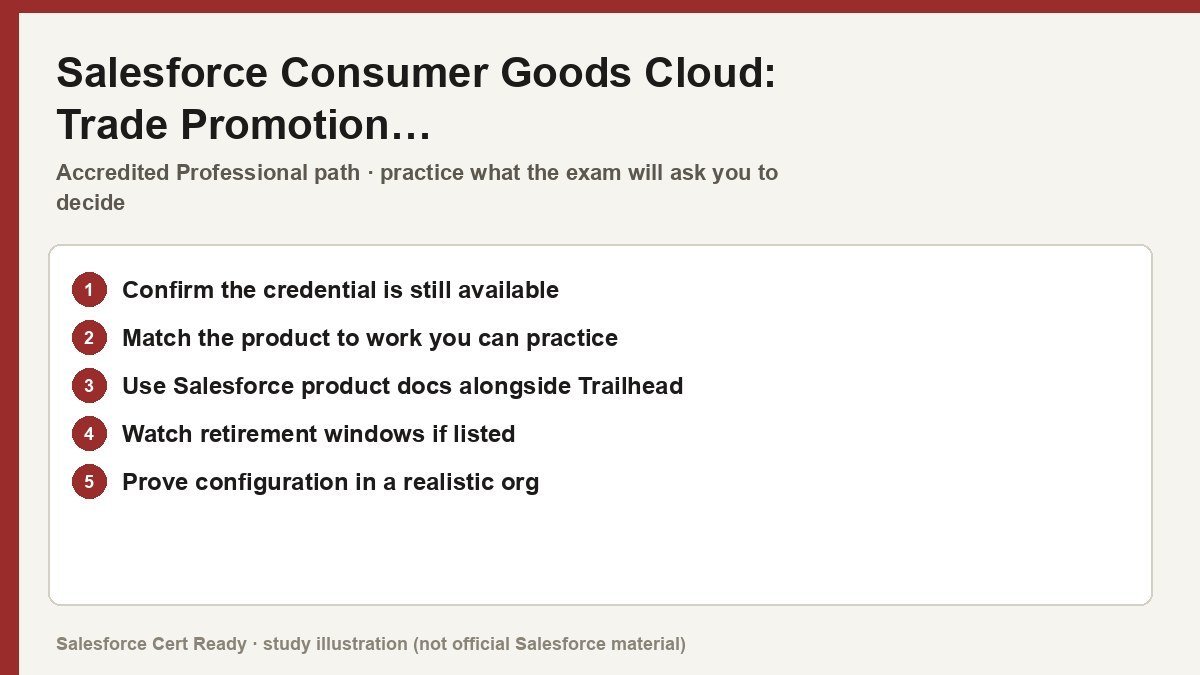
Study map for Salesforce Consumer Goods Cloud: Trade Promotion…. Confirm objectives on current Salesforce sources.
Salesforce Consumer Goods Cloud: Trade Promotion Management Accredited Professional
Catalog status checked July 19, 2026: Available; scheduled for retirement.
Salesforce says registration closes July 24, 2026, the last exam date is August 31, 2026, and the credential retires February 1, 2027.
Current credential snapshot
| Item | Current listing |
|---|---|
| Credential | Salesforce Consumer Goods Cloud: Trade Promotion Management Accredited Professional |
| Track | Accredited Professional |
| Level in source inventory | Specialty |
| Exam code in source inventory | AP-205 |
| Price in source inventory | $150 USD |
| Availability | Available; scheduled for retirement |
Exam format, objectives, pricing, and prerequisites can change. Confirm those details in Salesforce’s current exam guide before purchasing or scheduling an exam.
Study overview
⚡ Master the mechanics of trade spend and promotion ROI.Consumer Goods Cloud Trade Promotion Management Accredited Professional
Advanced validation for consultants and architects specializing in the complex lifecycle of consumer goods trade promotions.
At a Glance
| Feature | Details |
|---|---|
| Exam Code | AP-205 |
| Duration | 75 minutes |
| Questions | 62 multiple-choice/multiple-select |
| Passing Score | 66% |
| Cost | $150 USD (Retake: $150 USD) |
| Delivery | Proctored (Onsite or Online) |
| Prerequisites | Verify on official guide |
| Recommended Experience | 2-3 years consulting; experience with Service Cloud and Consumer Goods Cloud |
Who Should Take This
- Implementation Consultants: Professionals responsible for translating high-level business requirements into technical
TPMsolutions that fit a customer’s existing landscape. - Solution Architects: Designers who need to structure complex data models, promotional workflows, and integrations between Salesforce and third-party ERP systems.
- Business Analysts: Domain experts who lead discovery sessions, conduct gap analyses, and document the end-to-end customer journey within the trade promotion space.
What You’ll Prove
This credential confirms your ability to handle the full lifecycle of a trade promotion project, from initial discovery to deployment. You are expected to demonstrate proficiency in both the “why” of business processes and the “how” of technical configuration. * You can architect master data designs and KPI structures that align with a customer’s specific Go-To-Market approach and planning processes.
- You can configure complex promotional elements, including
Funds,Tactics,Transactions, andRate-Based Fundingrecords. - You can implement specialized
Consumer Goods Cloudfeatures likeTrade Calendars,Claims Management, andCustomer Business Plans. - You can manage the deployment lifecycle, including environment strategy, sequential migration steps, and licensing requirements for the
CGGpackage. - You can analyze promotional impact in real-time using P&L capabilities to optimize future spend and ROI.
Exam Outline
| Domain | Weight | What’s Covered |
|---|---|---|
| Discovery | 32% | Business process documentation; mapping components to TPM or third-party systems; conducting stakeholder interviews. |
| Design | 36% | Master data architecture; standard KPI capabilities; designing planning structures and account P&L views. |
| Implement | 32% | Licensing and package installation; deployment strategies; configuring Claims, Funds, and Promotions. |
💡 In Notion, convert each domain row into a toggle to nest your study notes underneath.
Suggested Study Path
- Review the Exam Blueprint. Start by understanding the weightings. Since the domains are nearly equal, you cannot afford to skip any section.
- Complete the TPM Learning Journey. Work through the
Consumer Goods Cloud TPMmodules on Trailhead, focusing specifically onPromotions Setup,Funds Administration, andClaims Management. - Study Master Data Dependencies. Focus on how
Account PlansandRetail Store Groupsdrive promotional visibility. Understand the “Inventory-Driven MACD” design logic. - Practice Scenario-Based Logic. Review how to create
Rate-Based Fundingand the difference between aPromotionand aTacticwithin theTPMhierarchy. - Verify Deployment Steps. Memorize the pre- and post-installation steps for the
CGGpackage and how to establish a migration strategy across environments. - Take a Timed Practice Test. Use simulation tools to get used to the 75-minute limit and the 66% passing threshold.
Watch Out For
- KPI Confusion: Ensure you know the difference between standard
KPIcapabilities and custom requirements. The exam specifically tests your ability to rationalize standard functionality first. - Licensing Gaps: Don’t overlook the “Implement” domain’s focus on licensing needs. You need to know which licenses are required to install and run the
CGGpackage. - Data Quality Cascades: Be prepared for questions about how poor master data setup causes failures in downstream activities like visit planning or analytics.
- Tactic vs. Promotion: Understand the technical relationship between these objects. You’ll need to know which object holds specific attributes like
Tactic Funds.
Resources
- Official Exam Guide
- Trailhead: Set Up Trade Promotion Management
- Consumer Goods Help Documentation
- Deep Dive into Promotions Course
Stop moving numbers around in spreadsheets and start configuring them in the cloud. If you can explain a Tactic Fund to a confused stakeholder, you’re halfway to the cert.
Official status sources
Catalog status last verified: 2026-07-19.