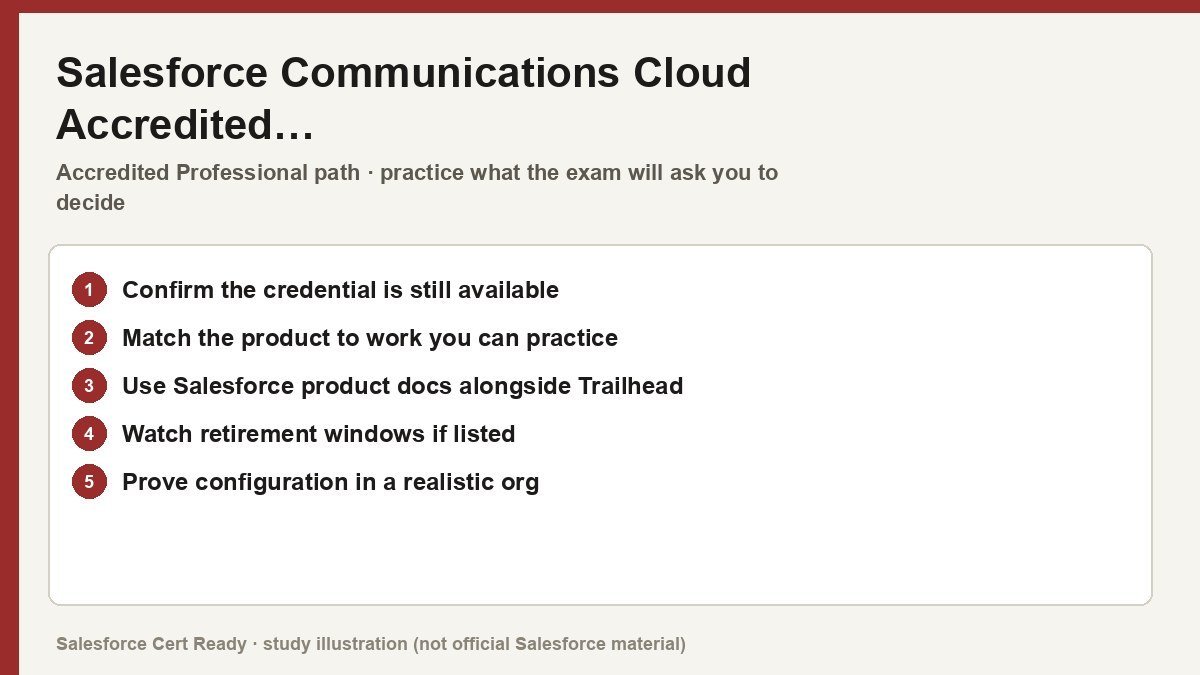
Study map for Salesforce Communications Cloud Accredited…. Confirm objectives on current Salesforce sources.
Salesforce Communications Cloud Accredited Professional
Catalog status checked July 19, 2026: Available.
Current credential snapshot
| Item | Current listing |
|---|---|
| Credential | Salesforce Communications Cloud Accredited Professional |
| Track | Accredited Professional |
| Level in source inventory | Specialty |
| Exam code in source inventory | AP-203 |
| Price in source inventory | $150 USD |
| Availability | Available |
Exam format, objectives, pricing, and prerequisites can change. Confirm those details in Salesforce’s current exam guide before purchasing or scheduling an exam.
Study overview
📡 Bridge the gap between telecom business requirements and technical fulfillment with industry-leading standards.Communications Cloud Accredited Professional
Validate your expertise in designing and delivering scalable B2C and B2B solutions on the Salesforce Communications platform.
At a Glance
| Category | Details |
|---|---|
| Exam Code | AP-203 |
| Duration | 90 minutes |
| Questions | 55 multiple-choice/multiple-select |
| Passing Score | 65% |
| Cost | $150 USD |
| Delivery | Proctored (Onsite or Online) |
| Prerequisites | None (Partner Learning Camp access required) |
| Recommended Experience | Knowledge of OmniStudio, Industries CPQ, and Order Management |
Who Should Take This
- Solution Architects responsible for mapping complex multi-site B2B telecom requirements to the
Enterprise Sales Managementframework. - Functional Consultants who lead discovery sessions to identify the role of legacy billing and fulfillment systems within a customer’s data landscape.
- Salesforce Partners aiming to demonstrate mastery over industry-specific patterns like
TMForumstandards and catalog-driven architectures.
What You’ll Prove
This credential confirms your ability to navigate the full lifecycle of a Communications Cloud implementation, from initial discovery to the technical handoff for fulfillment. It isn’t just about knowing the features; it’s about knowing how to architect a solution that remains performant under high-volume order scenarios. * You can design catalog-driven solutions that utilize Commercial and Technical product modeling to separate sales offers from technical provisioning.
- You can map business processes to specific tools like
Industries Order Managementto broker data between the front office and back-office fulfillment. - You can implement advanced quoting scenarios, including multi-site proposals and negotiated pricing for large-scale enterprise customers.
- You can configure complex product rules using
OmniStudioandIndustries CPQto ensure order accuracy and reduce manual intervention.
Exam Outline
| Domain | Weight | What’s Covered |
|---|---|---|
| Discovery | 24% | Requirement gathering, stakeholder interviews, and identifying third-party system dependencies. |
| Planning and Design | 60% | Catalog-driven architecture, Product Modeling, CPQ workflows, and Orchestration design. |
| Delivery | 16% | Implementation best practices, OOTB vs. custom evaluation, and data migration strategies. |
💡 In Notion, convert each domain row into a toggle to nest your study notes underneath.
Suggested Study Path
- Master the Product Catalog. Spend significant time understanding the difference between
CommercialandTechnicalproducts. Review modeling patterns likeOffer MeiosisandAttribute-Basedconfiguration. - Review OmniStudio Foundations. Since Communications Cloud is built on
OmniStudio, ensure you understand howIntegration ProceduresandDataRaptorshandle data movement forCPQ. - Deep dive into Order Management. Focus on
Orchestration Plans,Decomposition Relationships, and how the system handlesMACD(Move, Add, Change, Delete) orders. - Study TMForum Standards. Understand how the
SIDmodel influences the Salesforce Communications Cloud architecture, particularly regarding product life cycle and service catalogs. - Practice B2B Scenarios. Focus on
Enterprise Sales Management(ESM) features, specifically how to handle bulk uploads for multi-site quotes and site-based discounting. - Complete the Partner Learning Camp. Follow the official 8-hour curriculum on the PLC to see real-world application of
CLMandDocument Generationwithin the telecom context.
Watch Out For
- Over-Customization Pitfall: The exam heavily favors a “catalog-driven” approach. If you find yourself thinking about custom Apex code for pricing logic, you’ve probably missed a declarative
CPQrule. - Commercial vs. Technical Confusion: Understand that
Technical Productsare for provisioning and are typically invisible in the cart. Misidentifying where an attribute belongs (e.g., “Installation Type”) is a common mistake. - Cardinality Nuances: Pay close attention to
Min,Max, andDefaultsettings in bundles. A common scenario involves products that are optional but limited to a quantity of one. - Orchestration vs. Decomposition: Know exactly when
Decompositionstops (mapping the offer to technical services) and whenOrchestrationbegins (the step-by-step fulfillment of those services).
Resources
- Official Exam Guide
- Communications Cloud Product Documentation
- TMForum Industry Standards
- Trailhead: Communications Cloud Basics
Stop building custom monsters when the catalog can do the heavy lifting. Get certified, go get coffee, and let the orchestration engine handle the drama.
Official status sources
Catalog status last verified: 2026-07-19.