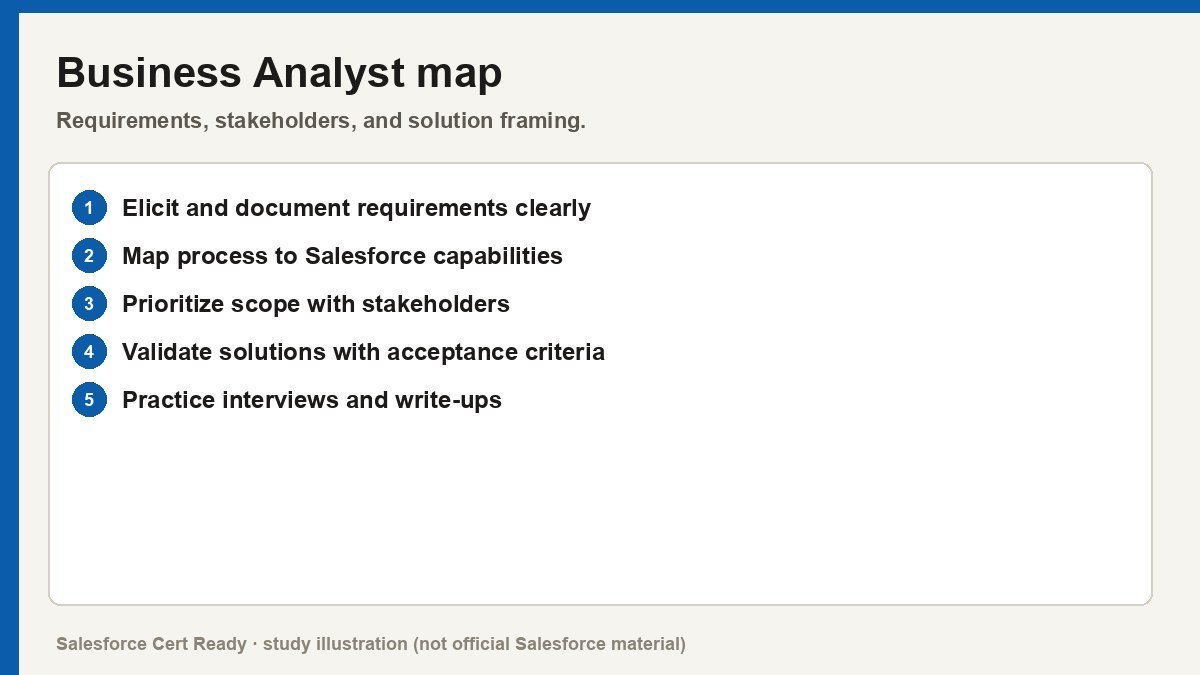
Show how you turn messy needs into testable requirements.
Salesforce Business Analyst
Catalog status checked July 19, 2026: Available.
Current credential snapshot
| Item | Current listing |
|---|---|
| Credential | Salesforce Business Analyst |
| Track | Consultant |
| Level in source inventory | Mid |
| Exam code in source inventory | BA-201 |
| Price in source inventory | $200 USD |
| Availability | Available |
Exam format, objectives, pricing, and prerequisites can change. Confirm those details in Salesforce’s current exam guide before purchasing or scheduling an exam.
Study overview
💡 Bridging the gap between abstract business needs and high-impact technical solutions.Salesforce Certified Business Analyst
The essential credential for the strategic liaison between stakeholders and the development team.
At a Glance
| Category | Details |
|---|---|
| Exam Code | BA-201 |
| Duration | 105 Minutes |
| Questions | 60 scored (up to 5 unscored) |
| Passing Score | 72% |
| Cost | $200 USD |
| Delivery | Online or In-person proctored |
| Prerequisites | None (Administrator is no longer required as of May 2023) |
| Recommended Experience | 2 Years Business Analyst experience; 2 Years Salesforce Platform experience |
Who Should Take This
- The Seasoned Analyst: Professionals with at least two years of experience who want to validate their expertise in mapping complex processes, eliciting requirements, and driving business improvements within the Salesforce ecosystem.
- The Strategic Administrator: Certified Admins who have transitioned from simple configuration to leading discovery sessions, managing stakeholder expectations, and translating business “wants” into functional “needs.”
- The Implementation Consultant: Consultants who act as the primary link between the client’s business leadership and the technical build team, ensuring that the final solution aligns with the documented scope.
What You’ll Prove
This certification is less about knowing which button to click in Setup and more about the “Why” and “How” of project delivery. You are demonstrating that you can navigate the entire implementation lifecycle, from the first discovery call to the final sign-off of user acceptance testing. It proves you have the soft skills to manage conflict and the hard skills to document technical scope. * You can plan discovery activities by identifying key stakeholders, analyzing the customer environment, and selecting the appropriate facilitation techniques for virtual or in-person workshops.
- You can map complex business processes by breaking them down into manageable, logical steps and defining the “future state” using industry-standard documentation practices.
- You can elicit and prioritize requirements, effectively distinguishing between a high-level business goal and a specific, testable functional requirement that a developer can act upon.
- You can write effective user stories complete with clear, concise acceptance criteria that ensure the development team understands the definition of “done” without ambiguity.
- You can lead the user acceptance testing (
UAT) process by defining the test plan, preparing the environment, and confirming that the delivered solution actually meets the business requirements. - You can act as a trusted advisor, using various communication styles to influence stakeholders at all levels of the organization and move projects toward successful delivery.
Exam Outline
| Domain | Weight | What’s Covered |
|---|---|---|
| Collaboration with Stakeholders | 24% | Planning discovery, stakeholder analysis, influencing styles, and building trust as a project liaison. |
| User Stories | 18% | Components of a story, writing valid acceptance criteria, and managing scope via version control. |
| Requirements | 17% | Distinguishing requirements vs. user stories, validation, prioritization, and preventing scope creep. |
| Customer Discovery | 17% | Analyzing the customer environment, identifying opportunities/constraints, and aligning capabilities to needs. |
| Business Process Mapping | 16% | Defining scope, breaking down processes, and applying process mapping best practices/languages. |
| User Acceptance | 8% | Defining and preparing the UAT plan and confirming the solution meets the documented business requirements. |
💡 In Notion, convert each domain row into a toggle to nest your study notes underneath.
Suggested Study Path
- Analyze the Official Guide. Download the
Business AnalystExam Guide and perform a self-assessment. Be honest about your gaps in “soft skills” like stakeholder conflict negotiation versus “hard skills” like process mapping. - Complete the Core Trailmix. Move through the “Prepare for Your Salesforce Business Analyst Credential” Trailmix. Pay close attention to the modules on
Agilebasics andUser Experiencefundamentals, as these often trip up technical experts. - Master the Mapping Language. Practice documenting “As-Is” and “To-Be” states for your current projects. Ensure you can explain the difference between a process map, a capability map, and a value stream map.
- Refine Your Writing. Practice writing user stories for a common Salesforce feature (like
Lead Conversion). Ensure your acceptance criteria areINVESTcompliant: Independent, Negotiable, Valuable, Estimable, Small, and Testable. - Simulate the Scenario. Use the “Cert Prep: Salesforce Business Analyst” module to practice scenario-based questions. Focus on the “highest-weighted” categories first to maximize your study efficiency.
Watch Out For
- Requirement vs. User Story. The exam is pedantic about this. A requirement is what the business needs; a user story is a tool to facilitate the conversation about how that need is met. Know when to use which.
- The “Admin” Trap. Since the
Platform Administratorprerequisite was removed, don’t assume you don’t need admin knowledge. You still need to know what the platform can do (likeFlow,Validation Rules, andRecord Types) to recommend viable solutions. - Stakeholder Conflict Scenarios. Many questions aren’t about the “right” technical answer, but the “best” professional answer. Look for options that involve collaboration, empathy, and clear communication rather than just “following the rules.”
- UAT is Not QA. Understand that User Acceptance Testing is about business validation, not just finding bugs. The exam will test your ability to manage the transition from “built” to “accepted.”
Resources
- Official Salesforce Exam Guide
- Prepare for Your Salesforce Business Analyst Credential Trailmix
- Salesforce Business Analyst Certification Prep
- Trailblazer Community – Business Analyst Group
Stop being just an order-taker and start being the architect of the solution’s purpose. Now go book that exam before you talk yourself out of it.
Official status sources
Catalog status last verified: 2026-07-19.