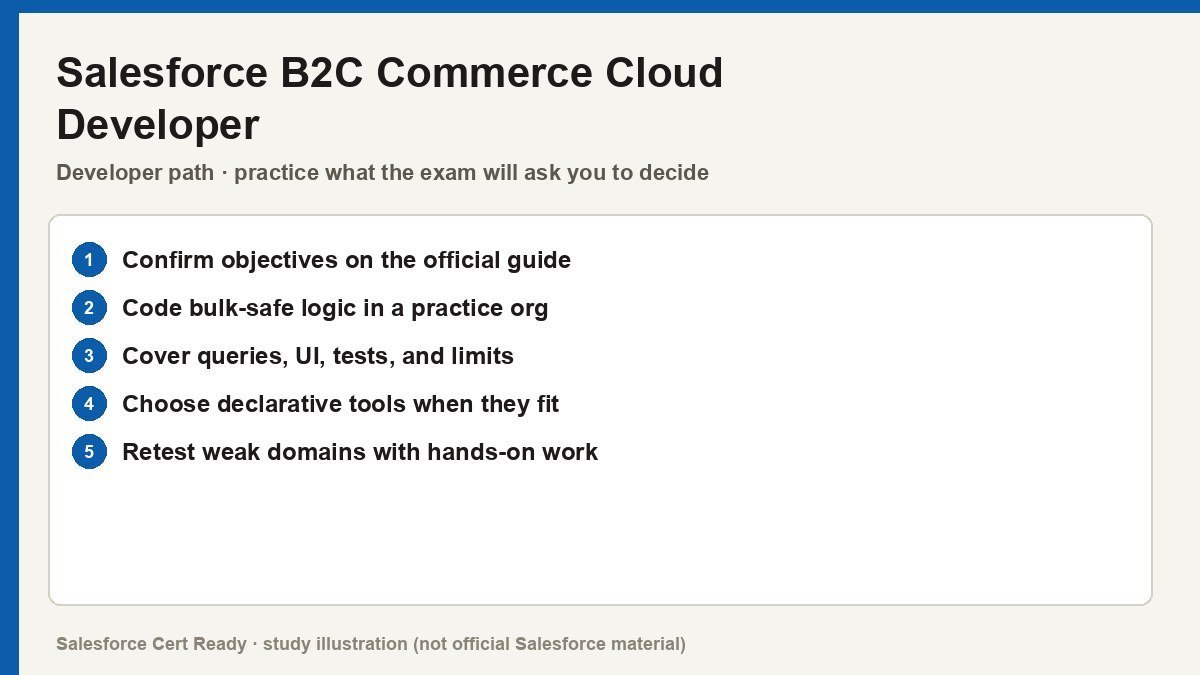
Study map for Salesforce B2C Commerce Cloud Developer. Confirm objectives on current Salesforce sources.
Salesforce B2C Commerce Cloud Developer
Catalog status checked July 19, 2026: Available.
Current credential snapshot
| Item | Current listing |
|---|---|
| Credential | Salesforce B2C Commerce Cloud Developer |
| Track | Developer |
| Level in source inventory | Mid |
| Exam code in source inventory | Comm-Dev-101 |
| Price in source inventory | $200 USD |
| Availability | Available |
Exam format, objectives, pricing, and prerequisites can change. Confirm those details in Salesforce’s current exam guide before purchasing or scheduling an exam.
Study overview
🛒 Build and scale high-performance storefronts on the most robust e-commerce engine in the market.Salesforce Certified B2C Commerce Developer
The definitive credential for full-stack engineers specializing in Salesforce B2C Commerce Digital solutions.
At a Glance
| Feature | Details |
|---|---|
| Exam Code | Comm-Dev-101 |
| Duration | 105 minutes |
| Questions | 60 scored, up to 5 unscored |
| Passing Score | 65% |
| Cost | $200 USD |
| Delivery | Onsite or Online Proctored |
| Prerequisites | None |
| Recommended Experience | 1 year developer experience + 3-6 months in a B2C Commerce role |
Who Should Take This
- Full-Stack Developers responsible for implementing both the front-end user experience and the back-end business logic of a digital storefront.
- Backend Engineers focused on server-side
JavaScript, API integrations, and complex data modeling within the Commerce Cloud ecosystem. - Technical Consultants who need to demonstrate mastery of
SFRA(Storefront Reference Architecture) and Business Manager configuration. - Support Engineers tasked with troubleshooting complex issues across
ISMLtemplates, controllers, and site performance.
What You’ll Prove
This certification validates your ability to design, build, and troubleshoot comprehensive e-commerce solutions. It moves beyond simple configuration into deep programmatic mastery of the platform. * You can develop robust business logic using JavaScript controllers, models, and decorators while adhering to API best practices.
- You can create dynamic, localized front-end experiences using
ISMLtemplates,form definitions, andresource bundles. - You can manage complex data architectures including catalogs, products, price books, and inventory via Business Manager and
XMLimports. - You can implement advanced search functionality, including refinements, sorting rules, and
Einsteinpredictive intelligence. - You can integrate external systems using
OCAPI(Open Commerce API) and Web Services to extend storefront capabilities.
Exam Outline
| Domain | Weight | What’s Covered |
|---|---|---|
| Application Development | 53% | ISML, Controllers, Scripts API, Forms, Services, Hooks, and OCAPI. |
| Data Management | 24% | Search preferences, Refinements, Sorting, Custom Objects, and Logging. |
| Work With a B2C Site | 12% | Product models, Categorization, Content Assets, and Order processing. |
| B2C Commerce Setup | 11% | Cartridge paths, Sandbox configuration, WebDAV, and Site imports. |
💡 In Notion, convert each domain row into a toggle to nest your study notes underneath.
Suggested Study Path
- Complete the Official Trail entitled “Develop for Salesforce B2C Commerce.” This is your baseline for understanding
SFRAand the core development lifecycle. - Configure a Sandbox environment to get hands-on experience with
WebDAV, uploading cartridges, and managing the cartridge path in Business Manager. - Master Business Manager by performing manual data imports, setting up search refinements, and configuring localization settings (currencies and locales).
- Deep-Dive into SFRA code samples. Specifically, study how controllers leverage decorators and how
ISMLtemplates utilize local and remote includes. - Review Troubleshooting Tools like the Storefront Toolkit, Request Logs, and custom logging levels to prepare for performance-based questions.
- Take Practice Exams to get used to the wording of scenario-based questions, particularly those involving
OCAPIpermissions and job scheduling.
Watch Out For
- The SFRA Learning Curve: If you are coming from “Core” Salesforce (Apex/LWC), the B2C stack is entirely different. Don’t assume your Flow or Apex knowledge will carry you here; focus heavily on server-side
JavaScriptandNode.jspatterns. - Cartridge Path Logic: Expect questions that test your understanding of how the platform resolves code. If a file exists in multiple cartridges, you must know which one “wins” based on the order of the path.
- Logging and Debugging: Pay close attention to how to enable custom logging. Many candidates trip up on the specific settings required in both Global Preferences and Site Preferences to make logs visible in the Storefront Toolkit.
- ISML vs. HTML: Understanding the nuances of
ISMLtags like<isprint>,<iscomponent>, and<isdecorate>is essential for the front-end portion of the exam.
Resources
- Official Exam Guide
- Trail: Develop for Salesforce B2C Commerce
- B2C Commerce Developer Documentation
- SFCC Learning Community
Stop overthinking the cartridge path and just start coding. If you can build a custom checkout flow without breaking the sandbox, you’re halfway there.
Official status sources
Catalog status last verified: 2026-07-19.