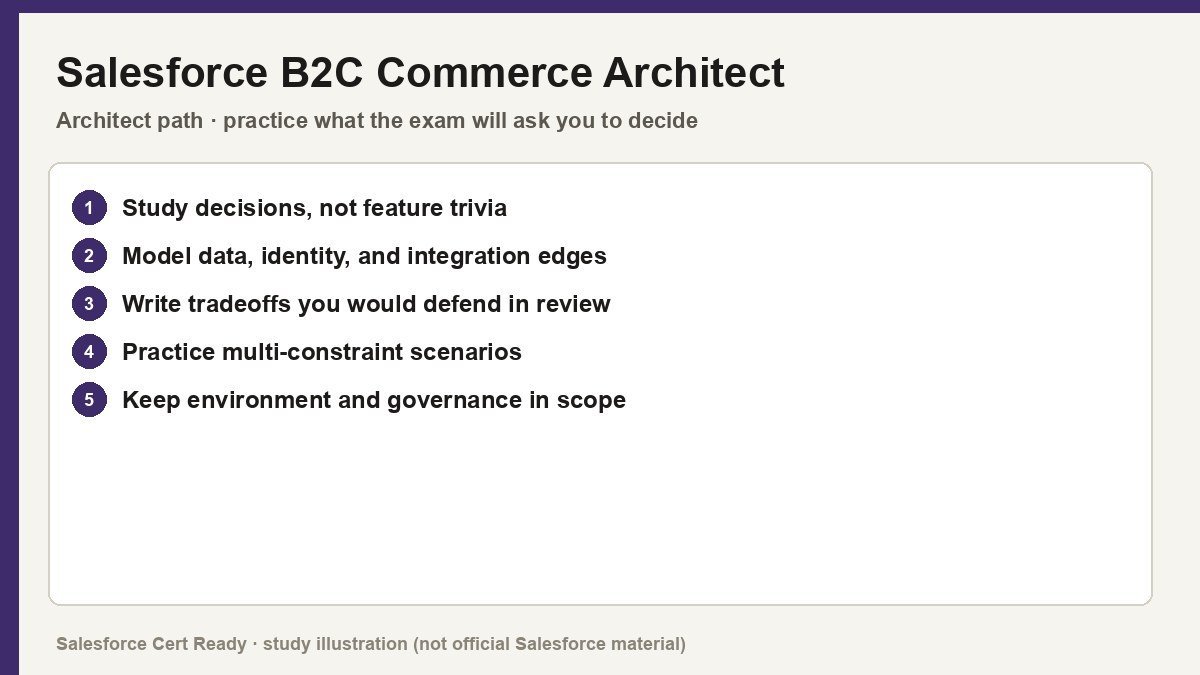
Study map for Salesforce B2C Commerce Architect. Confirm objectives on current Salesforce sources.
Salesforce B2C Commerce Architect
Catalog status checked July 19, 2026: Available; scheduled for retirement.
Salesforce says registration closes July 24, 2026, the last exam date is August 31, 2026, and the credential retires February 1, 2027.
Current credential snapshot
| Item | Current listing |
|---|---|
| Credential | Salesforce B2C Commerce Architect |
| Track | Architect |
| Level in source inventory | Senior |
| Exam code in source inventory | Arch-303 |
| Price in source inventory | $400 USD |
| Availability | Available; scheduled for retirement |
Exam format, objectives, pricing, and prerequisites can change. Confirm those details in Salesforce’s current exam guide before purchasing or scheduling an exam.
Study overview
💡 The peak of B2C technical leadership.Salesforce Certified B2C Commerce Architect
Designing global, multi-site storefronts that actually scale.
At a Glance
| Category | Details |
|---|---|
| Exam Code | Arch-303 |
| Duration | 105 Minutes |
| Questions | 60 multiple-choice/multiple-select |
| Passing Score | 65% |
| Cost | $400 USD |
| Delivery | Onsite at testing center or Online proctored |
| Prerequisites | Salesforce Certified B2C Commerce Developer |
| Recommended Experience | 5+ years of ecommerce experience; 3-4 years of SFCC specific experience |
Who Should Take This
- Technical Leads who act as the primary owner of technical design and quality for complex, multi-site implementations.
- Solution Architects responsible for gathering business requirements and translating them into robust technical specifications and diagrams.
- Senior Developers with deep full-stack experience in
SFRAwho are ready to move into a strategic advisory role. - Technical Directors who oversee high-level estimates, integration jobs, and global replication schedules.
What You’ll Prove
This certification validates that you aren’t just a coder; you are a strategist capable of managing the entire lifecycle of a B2C Commerce realm. You understand how to maintain global brand consistency while managing regional technical constraints. * You can design modular and reusable global architectures that support multiple brands and localized channels.
- You can evaluate third-party
LINKcartridges for compatibility, performance, and security before they hit production. - You can optimize system performance by identifying root causes in
Log Centerand addressing quota violations or cache issues. - You can orchestrate complex integrations using
SOAP,REST, and theJob Frameworkto sync data with external systems like OMS or ERP. - You can manage high-stakes site launches, including
eCDNconfiguration, SEO aliases, and data replication schedules.
Exam Outline
| Domain | Weight | What’s Covered |
|---|---|---|
| Design/Discovery | 29% | Business requirement analysis, technical artifacts, system architecture diagrams, and scalability. |
| Integrations & Customizations | 22% | OCAPI, SCAPI, Job/Service frameworks, third-party integrations, and secure API communication. |
| Build | 19% | Implementation best practices, load testing, code organization, and modular extension development. |
| Launch | 16% | Data replication, SEO/URL aliases, cutover planning, and rollback strategies. |
| Monitoring & Troubleshooting | 14% | Performance optimization, log analysis, quota monitoring, and root cause identification. |
💡 In Notion, convert each domain row into a toggle to nest your study notes underneath.
Suggested Study Path
- Master the Prerequisites by ensuring your
B2C Commerce Developerknowledge is fresh, particularly regardingSFRAandBusiness Manager. - Review the Official Guide to map out the specific weightings and ensure you aren’t over-studying low-impact topics.
- Deep Dive into Architecture by exploring documentation on
PIGandSIGconfigurations, realm management, and data sharing between sites. - Practice Scenario Analysis using real-world case studies where you must choose between global vs. site-specific catalogs and replication strategies.
- Get Hands-on with Monitoring by spending time in a Sandbox environment to analyze
Log Centerand practice identifying cache hit ratios. - Take Timed Practice Tests to simulate the pressure of answering 60 questions in 105 minutes, as time management is a common fail point.
Watch Out For
- Replication Nuances: Don’t confuse what can be replicated from Staging to Production versus what must be imported directly into the instance.
- Quota Blindness: The exam often tests your ability to spot
OCAPIor system quota violations that cause silent performance degradation. - The “Tricky” Aliases: Questions regarding SEO and URL aliases often have very similar-looking answers; read the syntax carefully.
- Multi-Cloud Overlap: Ensure you understand where B2C Commerce ends and where
Order Management (OMS)orService Cloudbegins in a standard integration.
Resources
- Official Salesforce Exam Guide
- B2C Commerce Architect Prep Trailmix
- Salesforce B2C Commerce Documentation
- Trailblazer Community – Commerce Cloud
Stop building for today and start architecting for Black Friday. If your code can’t handle a 10x traffic spike, it’s just a very expensive hobby.
Official status sources
Catalog status last verified: 2026-07-19.