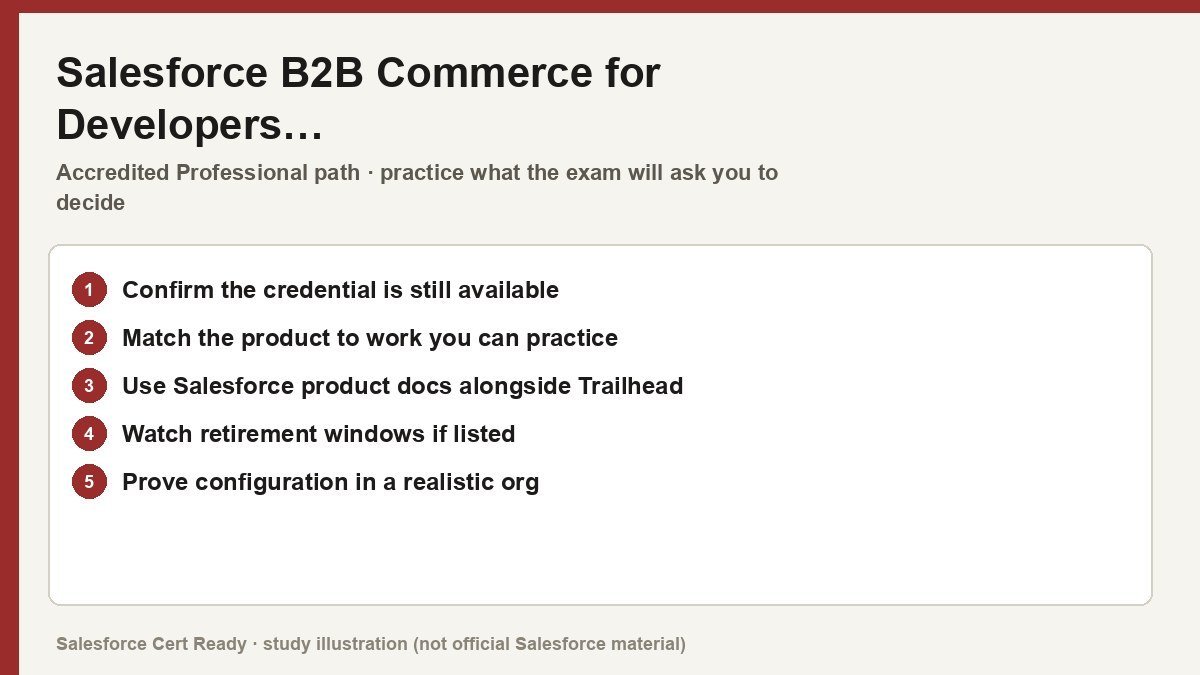
Study map for Salesforce B2B Commerce for Developers…. Confirm objectives on current Salesforce sources.
Salesforce B2B Commerce for Developers Accredited Professional
Catalog status checked July 19, 2026: Available.
Current credential snapshot
| Item | Current listing |
|---|---|
| Credential | Salesforce B2B Commerce for Developers Accredited Professional |
| Track | Accredited Professional |
| Level in source inventory | Specialty |
| Exam code in source inventory | AP-202 |
| Price in source inventory | $150 USD |
| Availability | Available |
Exam format, objectives, pricing, and prerequisites can change. Confirm those details in Salesforce’s current exam guide before purchasing or scheduling an exam.
Study overview
🛠️ Build and customize complex B2B storefronts with programmatic precision.B2B Commerce for Developers Accredited Professional
The definitive credential for developers extending Salesforce B2B Commerce through advanced code and integration.
At a Glance
| Feature | Details |
|---|---|
| Exam Code | AP-202 |
| Duration | 75 Minutes |
| Questions | 60 multiple-choice/multiple-select |
| Passing Score | 68% |
| Cost | $150 USD |
| Delivery | Online proctored or onsite testing center |
| Prerequisites | None (Registration limited to Salesforce Partners) |
| Recommended Experience | Hands-on experience with Apex, Lightning Web Components, and Experience Cloud |
Who Should Take This
- The Salesforce Partner Developer: You work for an implementation partner and need to validate your ability to deliver high-complexity commerce solutions for B2B clients.
- The Full-Stack Architect: You are responsible for the technical design of storefronts, requiring a deep understanding of how
ApexandLWCinteract with the commerce engine. - The Integration Specialist: You spend your time connecting commerce storefronts to ERPs, payment gateways, and third-party tax providers via the
Buyer Experience SDK.
What You’ll Prove
This exam moves beyond basic configuration. It validates your ability to write efficient, scalable code within the specific constraints and patterns of the Salesforce B2B Commerce platform. You aren’t just clicking buttons; you are architecting the “buy” experience. * You can implement complex business logic using Apex service handlers and data models unique to B2B commerce.
- You can customize the user interface by modifying and creating new
Lightning Web Components(LWC) tailored for storefront use cases. - You can manage high-volume data operations including price books, product catalogs, and complex account relationships.
- You can develop custom checkout flows, including the integration of external payment and tax services.
- You can troubleshoot and diagnose issues within debug logs by identifying discrete code units in commerce transactions.
Exam Outline
| Domain | Weight | What’s Covered |
|---|---|---|
| Advanced LWC Development | 30% | Creating/extending components, event handling, Lightning Data Service. |
| Basic LWC Development | 20% | Component structure, rendering properties, Aura-to-LWC wrapping. |
| Reference Implementations | 15% | Standard code patterns for checkout, payment, and storefront logic. |
| Data Management | 15% | Objects, Apex classes, SOQL/DML for commerce, and data modeling. |
| Checkout Flow Development | 10% | Customizing flows, Buyer Experience SDK, and integration hooks. |
| Error Handling & Diagnostics | 10% | Debug logs, ccLog vs System.debug, and troubleshooting transactions. |
💡 In Notion, convert each domain row into a toggle to nest your study notes underneath.
Suggested Study Path
- Review the Partner Learning Camp: Start with the official B2B Commerce for Developers curriculum. This is the source of truth for the exam’s architectural philosophy.
- Master the Buyer Experience SDK: Spend significant time understanding how to implement interfaces for tax, shipping, and payment. These are the most common programmatic extension points.
- Build Custom LWCs for Storefronts: Practice creating components that interact with the cart and product detail pages. Understand how to handle events fired within the template.
- Analyze Debug Log Patterns: Familiarize yourself with how commerce transactions appear in logs. Know the difference between
ccLogadvantages and standard debugging. - Simulate a Full Checkout Customization: Create a scenario where you must modify the standard checkout flow to include a custom checkbox-based logic for payment options.
Watch Out For
- B2B vs. B2C Nuances: Don’t let your B2C knowledge trip you up. B2B has specific data models for account relationships and price book handling that behave differently.
- Over-reliance on
System.debug: The exam specifically tests knowledge ofccLogand browser-based debugging for commerce. Know when and why to use the commerce-specific logging tools. - Manual vs. Engine-based Taxing: Pay close attention to how tax implementations handle previous entries and the difference between out-of-the-box calculators and third-party engines.
- Old vs. New Component Frameworks: Ensure you are clear on the syntax for rendering properties in
LWCversus older frameworks, as these are easy points to lose on “gotcha” syntax questions.
Resources
- Official B2B Commerce Developer Exam Guide
- Salesforce Partner Learning Camp
- B2B Commerce Developer Documentation
- Trailblazer Community – B2B Commerce Group
Stop over-engineering your study plan and start building in a sandbox. If you can’t debug a failed tax call in the console, you aren’t ready for the badge.
Official status sources
Catalog status last verified: 2026-07-19.