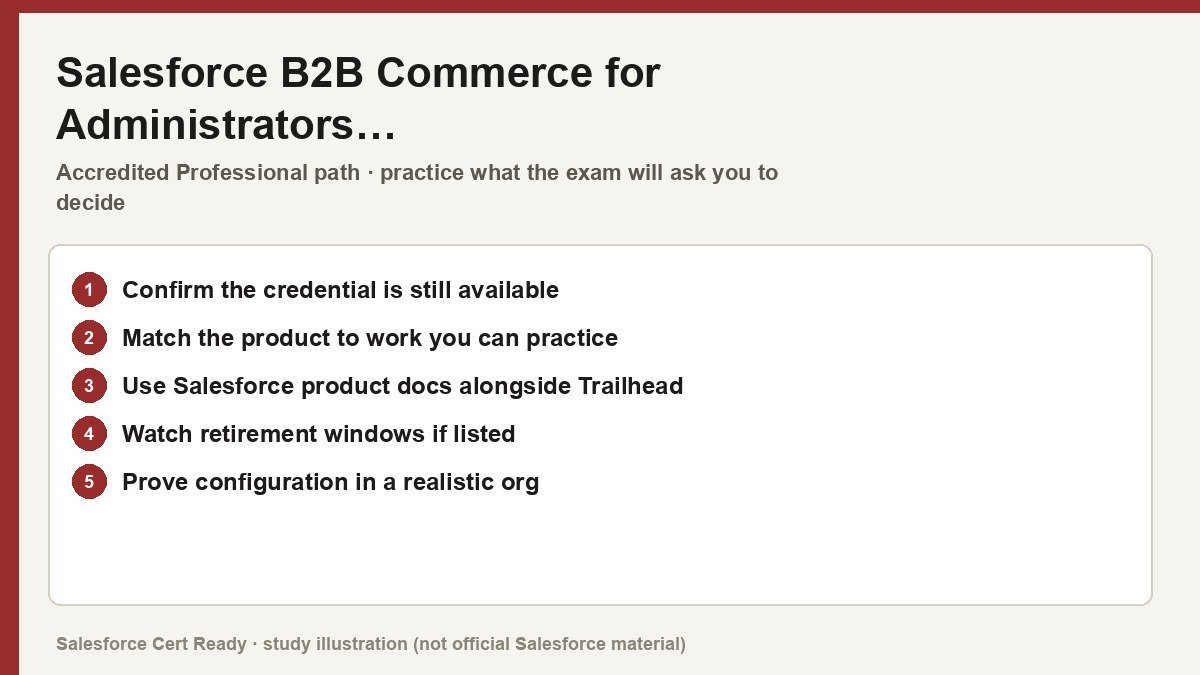
Study map for Salesforce B2B Commerce for Administrators…. Confirm objectives on current Salesforce sources.
Salesforce B2B Commerce for Administrators Accredited Professional
Catalog status checked July 19, 2026: Available.
Current credential snapshot
| Item | Current listing |
|---|---|
| Credential | Salesforce B2B Commerce for Administrators Accredited Professional |
| Track | Accredited Professional |
| Level in source inventory | Specialty |
| Exam code in source inventory | AP-201 |
| Price in source inventory | $150 USD |
| Availability | Available |
Exam format, objectives, pricing, and prerequisites can change. Confirm those details in Salesforce’s current exam guide before purchasing or scheduling an exam.
Study overview
🛒 Stop talking about carts and start configuring them.B2B Commerce for Administrators Accredited Professional
Master the mechanics of high-volume, business-to-business storefronts on the Salesforce platform.
At a Glance
| Feature | Details |
|---|---|
| Exam Code | AP-201 |
| Duration | 90 minutes |
| Questions | 60 multiple-choice/multiple-select |
| Passing Score | 75% |
| Cost | $150 USD |
| Delivery | Online or Onsite proctored |
| Prerequisites | None (Partner Learning Camp access required) |
| Recommended Experience | 2-3 years of Salesforce platform experience; 6 months B2B Commerce focus |
🎯 Who Should Take This – Commerce Administrators who handle the day-to-day operations of B2B stores, from managing product readiness to configuring complex buyer group entitlements.
- Implementation Consultants tasked with translating business requirements into functional storefronts using “clicks-not-code” configuration.
- Salesforce Partners seeking to validate their expertise within the Partner Learning Camp ecosystem for industry-specific cloud deployments.
- Solution Architects who need a deep understanding of the
Buyer Account,Catalog, andPrice Bookrelationship to design scalable commerce solutions.
What You’ll Prove
This credential validates your ability to deploy and manage a B2B storefront that handles complex purchasing behaviors. You are expected to move beyond basic admin tasks and demonstrate a grasp of the full commerce lifecycle. – You can configure sophisticated data models including Buyer Groups, Entitlement Policies, and multi-level Product Categories.
- You can deploy a functional storefront from scratch, ensuring all supporting objects and domain mappings are correctly aligned.
- You can manage product hierarchies, including variations, attributes, and bulk imports via CSV to maintain large-scale portfolios.
- You can optimize the buyer experience by customizing
Experience Buildercomponents, search facets, and checkout flows. - You can troubleshoot storefront configuration issues that hinder launch, such as indexing errors or pricing visibility gaps.
Exam Outline
| Domain | Weight | What’s Covered |
|---|---|---|
| Salesforce B2B Commerce Basics | 15% | Architecture, licensing (Member vs. Login), and B2B vs. B2C distinctions. |
| Salesforce B2B Commerce App | 20% | Navigation, Admin Console tools, and monitoring storefront health. |
| Storefront Deployment | 20% | Domain mapping, SSL, sandbox-to-production lifecycle, and store activation. |
| Product Org & Administration | 15% | Catalogs, Categories, Product Variations, and data import strategies. |
| Content Integration | 7% | Leveraging Salesforce CMS for product media and rich storefront content. |
| Storefront Management | 17% | Search facets, cart behavior, checkout workflows, and Experience Cloud layouts. |
| Advanced Topics | 6% | Multi-currency, contract management, and performance best practices. |
💡 In Notion, convert each domain row into a toggle to nest your study notes underneath.
Suggested Study Path
- Secure Partner Access. Ensure you have an active login for the Partner Learning Camp (PLC), as this is where the primary “Get to Know B2B Commerce” curriculum lives.
- Master the Data Model. Spend significant time in a scratch org or sandbox mapping the relationship between
Buyer Accounts,Buyer Groups,Entitlement Policies, andPrice Books. If a product isn’t showing up, it’s usually one of these four. - Execute a Store Build. Follow the “Configure Your Salesforce Commerce Store” trail on Trailhead. Do not just read—actually stand up a store, import a CSV catalog, and run a test checkout.
- Deep Dive into CMS. Learn how
Salesforce CMSinteracts with the commerce app. Practice assigning images to products and ensuring they render correctly in theLWR(Lightning Web Runtime) template. - Review Release Notes. The exam currently aligns with the Summer ’24 release. Check for any recent changes to
Flow Builderintegration orEinsteincommerce features.
⚠️ Watch Out For – Entitlement Visibility. A common pitfall is forgetting that Entitlement Policies are the bridge between products and buyer groups. Without them, your store is just a collection of invisible items.
- LWR vs. Aura. Understand the limitations and advantages of the
LWRtemplate used in modern B2B stores compared to olderAuraversions, especially regarding component availability. - Buyer Manager Permissions. Distinguish between a standard
Buyerand aBuyer Manager. Managers requireCustomer Community Pluslicenses to access role-based sharing and reports. - Price Book Priorities. Ensure you understand how the system selects a price when a buyer belongs to multiple groups with conflicting
Price Books.
🔗 Resources – Official B2B Commerce Admin Exam Guide
- Trailmix: Prepare for B2B Commerce Administrator
- Partner Learning Camp: B2B Foundations Curricula
- Salesforce Help: B2B Commerce Setup Checklist
This isn’t just about checkboxes; it’s about making sure the “Add to Cart” button actually works when $100k is on the line. Study hard, don’t break the production org, and get that badge.
Official status sources
Catalog status last verified: 2026-07-19.