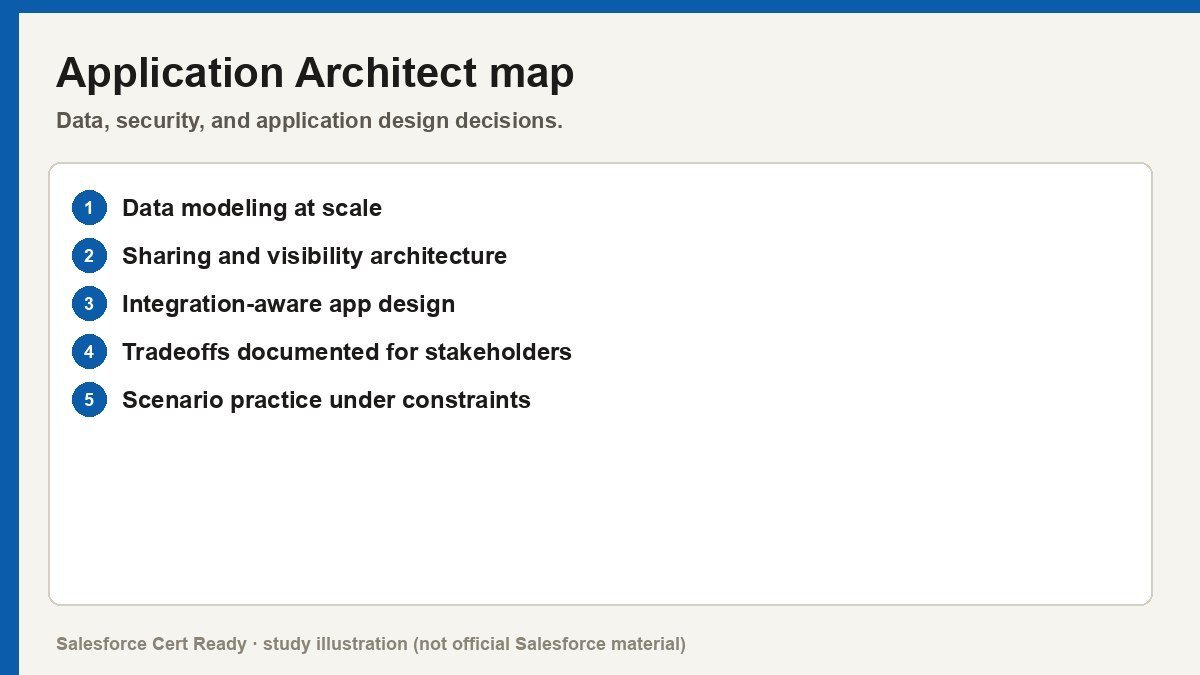
Architect credentials test decisions, not feature trivia.
Salesforce Application Architect
Catalog status checked July 19, 2026: Available.
Current credential snapshot
| Item | Current listing |
|---|---|
| Credential | Salesforce Application Architect |
| Track | Architect |
| Level in source inventory | Senior |
| Exam code in source inventory | App-Arch |
| Price in source inventory | $0 USD |
| Availability | Available |
Exam format, objectives, pricing, and prerequisites can change. Confirm those details in Salesforce’s current exam guide before purchasing or scheduling an exam.
Study overview
🏛️ Master the internal architecture of the Salesforce platform.Salesforce Certified Application Architect
The standard for experts in native features, data modeling, and sharing logic.
At a Glance
| Item | Details |
|---|---|
| Exam Code | N/A (Credential granted upon prerequisites) |
| Duration | N/A |
| Questions | N/A |
| Passing Score | N/A |
| Cost | Free (Accumulated cost of prerequisites: $1,000 USD) |
| Delivery | Automatic issuance upon meeting criteria |
| Prerequisites | Platform App Builder, Platform Developer I, Data Architect, Sharing and Visibility Architect |
| Recommended Experience | 5+ years implementation, 2+ years lead architect role |
Who Should Take This
- Aspiring Technical Architects looking to complete the first half of the “Pyramid” on their journey toward the
Certified Technical Architect (CTA)Review Board. - Senior Developers who have moved beyond writing
Apextriggers and now focus on the strategic design of data models and scalable security structures. - Solution Architects who need to validate their expertise in balancing declarative features with custom code while maintaining platform governed limits.
- Data Strategists responsible for managing
Large Data Volumes (LDV)and complex sharing requirements in enterprise-scale Salesforce orgs.
What You’ll Prove
This credential confirms you have moved past “building apps” and into “architecting systems.” You demonstrate a deep mastery of how Salesforce handles data at scale and how to protect that data without crippling performance. * You can architect scalable data models using the appropriate mix of Master-Detail, Lookup, and External Objects.
- You can design complex security and sharing models that satisfy strict compliance requirements using
OWD,Criteria-Based Sharing, andApex Managed Sharing. - You can evaluate the trade-offs between declarative tools like
Flowand programmatic solutions likeApexorLWCfor business logic. - You can manage the
Application Lifecycle Management (ALM)process to ensure stable deployments and effective governance across multiple sandboxes. - You can mitigate risks associated with
Large Data Volumes (LDV), including record locking, non-selective queries, and sharing recalculations.
📚 Exam Outline
Since this is a milestone certification, your “exam” is actually the mastery of four distinct domains.| Domain | Weight | What’s Covered |
| :
—- | :
| :
— |
| Data Architecture | 25% | LDV strategies, Skinny Tables, indexing, and ETL best practices. |
| Security Architecture | 25% | Implicit Sharing, Role Hierarchy design, and Territory Management. |
| Business Logic | 25% | Build vs. Buy decisions, Governor Limits, and Asynchronous Processing. |
| Deployment Lifecycle | 25% | Governance, Source Control, Continuous Integration, and sandbox strategy. |
💡 In Notion, convert each domain row into a toggle to nest your study notes underneath.
Suggested Study Path
- Secure the Foundations by earning your
Platform App BuilderandPlatform Developer I. These are the “bricks” you will use to build your architectural house. - Master the Data Layer by tackling the
Data Architectexam. Focus heavily on how Salesforce handles millions of records and the specific mechanics ofSalesforce Connect. - Solve the Sharing Puzzle by earning the
Sharing and Visibility Architect. This is often cited as the most “real-world” useful exam in the entire track. - Adopt an Architect Mindset by reviewing the
Architect Evaluationmaterials. Even though there is no final exam for CAA, the Evaluation guide covers how these four pillars interact. - Audit your Experience against the CTA 601 course materials to ensure you aren’t just memorizing facts, but can actually justify design trade-offs to stakeholders.
Watch Out For
- The “Paper Architect” Trap. It is possible to pass the exams in a year, but without 3–5 years of hands-on experience, you will struggle to explain why a design works during a Review Board.
- Prerequisite Order. While Salesforce allows any order, taking
Data ArchitectandSharing and Visibility Architectback-to-back is highly recommended as the topics overlap significantly. - Ignoring Governor Limits. At this level, “it works” isn’t enough. You must prove it works within
Heap Size,CPU Time, andView Stateconstraints. - Over-Engineering. Junior architects often reach for code first. A true Application Architect knows when
Custom Metadata TypesandFloware superior toApex.
Resources
- Official Salesforce Application Architect Guide
- Architect Journey: Data Architecture Trailmix
- Architect Journey: Sharing and Visibility Trailmix
- Ladies Be Architects Study Groups
- Salesforce Ben: Application Architect Guide
Keep your OWDs private and your data models normalized. You’re halfway to CTA—don’t let a non-selective query break your spirit now.
Official status sources
Catalog status last verified: 2026-07-19.