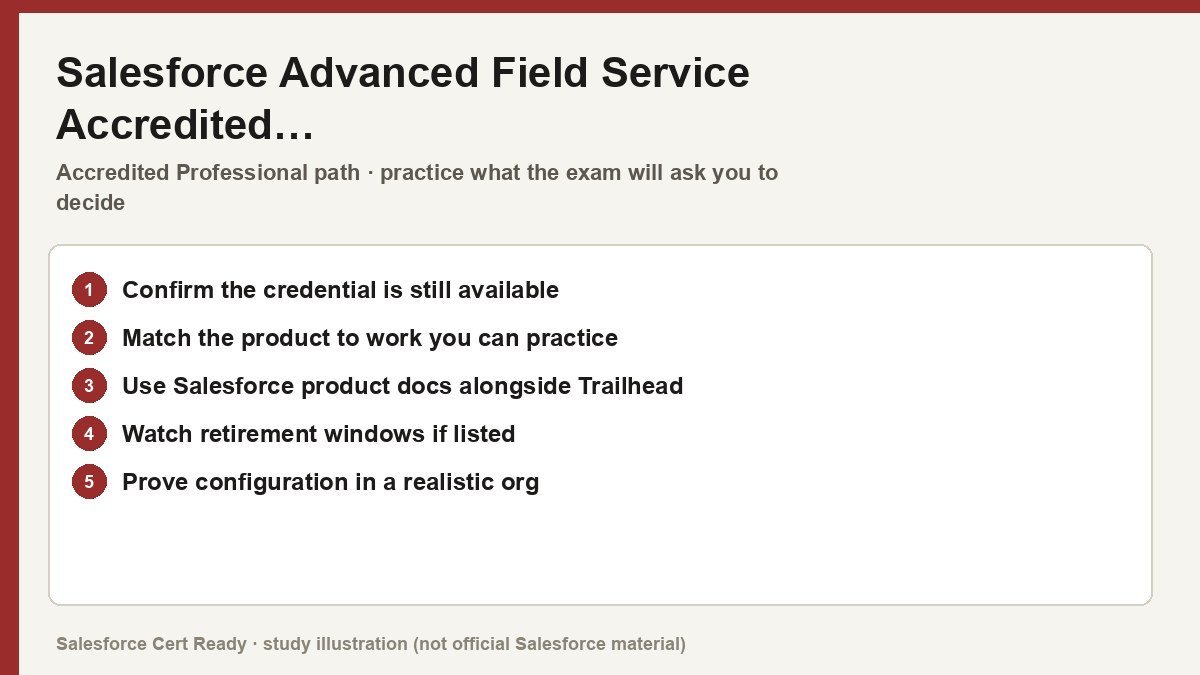
Study map for Salesforce Advanced Field Service Accredited…. Confirm objectives on current Salesforce sources.
Salesforce Advanced Field Service Accredited Professional
Catalog status checked July 19, 2026: Available; scheduled for retirement.
Salesforce says registration closes July 24, 2026, the last exam date is August 31, 2026, and the credential retires February 1, 2027.
Current credential snapshot
| Item | Current listing |
|---|---|
| Credential | Salesforce Advanced Field Service Accredited Professional |
| Track | Accredited Professional |
| Level in source inventory | Specialty |
| Exam code in source inventory | AP-209 |
| Price in source inventory | $150 USD |
| Availability | Available; scheduled for retirement |
Exam format, objectives, pricing, and prerequisites can change. Confirm those details in Salesforce’s current exam guide before purchasing or scheduling an exam.
Study overview
Optimization, resource logic, and complex scheduling at scale.
Advanced Field Service Accredited Professional
Validation of implementation expertise for high-complexity mobile workforce requirements.
At a Glance
| Feature | Detail |
|---|---|
| Exam Code | AP-209 |
| Duration | 75 minutes |
| Questions | 46 multiple-choice/multiple-select |
| Passing Score | 73% |
| Cost | $150 USD |
| Delivery | Proctored (Onsite or Online) |
| Prerequisites | None (though Field Service Consultant is highly recommended) |
| Recommended Experience | 2+ years implementing Field Service capabilities |
Who Should Take This
- Senior Field Service Consultants who manage end-to-end implementations and need to solve for complex resource constraints.
- Solution Architects designing high-volume scheduling engines that require deep tuning of the global optimization engine.
- Salesforce Partners looking to earn Navigator status points and prove domain expertise in the Field Service industry cloud.
What You’ll Prove
This credential moves beyond basic setup and focuses on the strategic application of advanced features. It’s less about creating a work order and more about how you handle thousands of them across global territories without breaking your dispatcher’s sanity. * You can architect complex Asset hierarchies and Maintenance Plans to automate long-term preventive service cycles.
- You can configure sophisticated
Scheduling PoliciesandService Objectivesto balance business KPIs like travel time vs. priority. - You can troubleshoot optimization results using the
Optimization Requestlogs and theGanttchart’s diagnostic tools. - You can extend the
SFS Mobileapp using customizations that ensure field technicians remain productive even while working offline. - You can facilitate successful consulting engagements by translating business requirements into scalable deployment and licensing strategies.
Exam Outline
| Domain | Weight | What’s Covered |
|---|---|---|
| Resource Management | 31% | Availability, Territory Management, Resource Types, and optimal scheduling logic. |
| Optimization | 22% | Service Objectives, Global Optimization, troubleshooting, and improving result quality. |
| Foundation | 16% | Complex work modeling, Maintenance Plans, and Dispatcher Console customization. |
| Mobile | 13% | Offline capabilities, app extensions, and dispatcher-to-tech communication. |
| Assets | 11% | Asset architecture, lifecycle management, and analyzing asset-based service scenarios. |
| Implementation Strategies | 7% | Consulting methodologies, deployment strategies, and licensing needs. |
💡 In Notion, convert each domain row into a toggle to nest your study notes underneath.
Suggested Study Path
- Audit the official guide to identify your weakest domains, paying particular attention to Resource Management and Optimization weights.
- Spin up a Developer Org with Field Service enabled and build out a multi-level
Assethierarchy linked to aMaintenance Plan. - Stress-test the Optimizer by creating conflicting
Service Appointmentsand adjustingScheduling Policiesto see how the Gantt reacts. - Review Mobile Extension docs to understand the limits of LWC on mobile and how to handle data synchronization conflicts.
- Utilize Partner Learning Camp resources if you have access, as this exam is specifically tailored for the Salesforce Partner ecosystem.
- Take a practice exam to get used to the “choose two” or “choose three” question format and the 75-minute time pressure.
Watch Out For
- Global Optimization vs. In-Day: Don’t confuse the use cases for Global Optimization (large-scale re-shuffling) with In-Day Optimization (fixing immediate schedule gaps).
- Asset Architecture Pitfalls: Ensure you understand when to use
Work Order Line Itemsvs. separateWork Ordersfor complex asset maintenance. - Mobile Offline Limits: Be ready for questions on what data is available offline and how
Briefcase Builderimpacts the technician’s mobile experience. - Licensing Nuances: Know which features require specific add-on licenses beyond the standard Field Service technician or dispatcher seats.
Resources
- Official Exam Guide
- Trailhead: Manage Field Service Center
- Field Service Implementation Guide
- Salesforce Field Service Trailblazer Community
Stop overthinking the Gantt and start trusting your logic. You’ve built this in the field; now just prove it to the computer.
Official status sources
Catalog status last verified: 2026-07-19.